John Frankenheimer was riding high with a string of critically acclaimed films and popular successes when he decided to try something different: a light comedy. Though he'd shown darkly satire edges in The Manchurian Candidate (1962) and Seconds (1966), he was known as a director of serious dramas with social concerns. Coming off of Grand Prix (1966), a sprawling drama of race car drivers shot on locations across Europe with a glamorous international cast, Frankenheimer wanted to change gears, so to speak. He chose a World War II comedy about an eccentric British Captain whose barely seaworthy wreck of a ship is beached on a small island in the Philippines. When four misfit American sailors, who were lost at sea, wash up on the island, they help the Captain repair his ship with the aid of a female trading post owner.
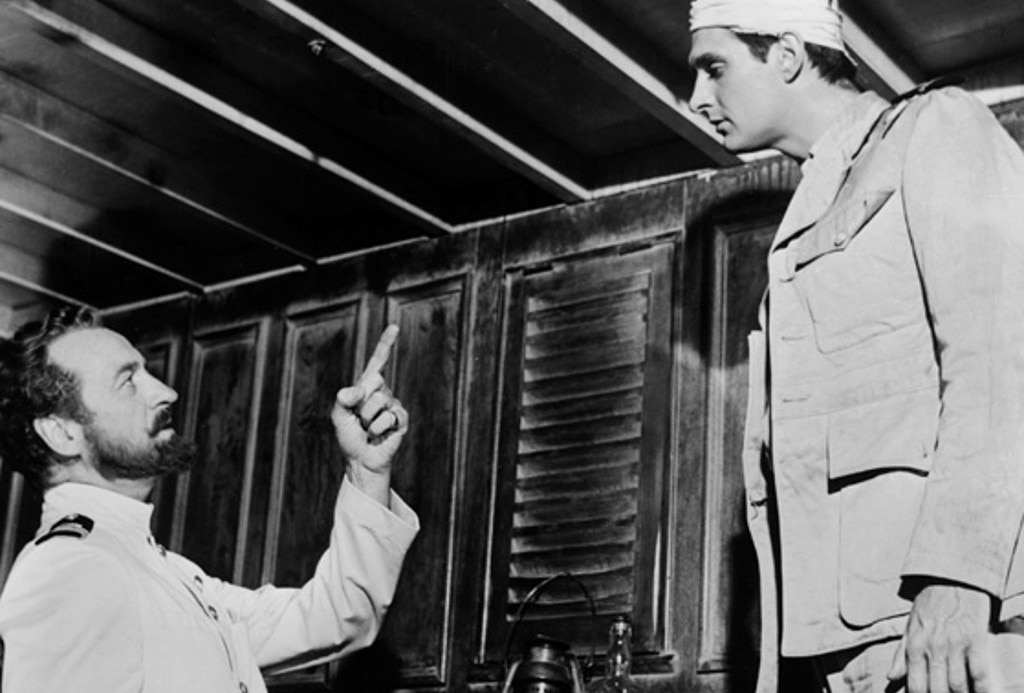
Set in the final days of the war, The Extraordinary Seaman (1969) is more farce than satire. David Niven receives top billing as Commander John Finchhaven, a sardonic old salt with a crisply British sense of decorum and a bottomless cargo of Scotch, and he plays the role with a bemused sense of dignity and unflinching perseverance in the face of disaster, incompetence and bad judgment. The romantic lead was a young stage actor by the name of Alan Alda; this was his first major screen appearance as an ill-equipped junior officer saddled with command of three more experienced (but far less motivated) sailors: a paranoid cook (Mickey Rooney), a gunner's mate (Jack Carter) and a suspicious seaman (Manu Tupou), a native American who is silent but for reciting his name, rank and serial number to friend and foe alike. And it was the fourth feature for rising star Faye Dunaway, who was fresh off Bonnie and Clyde (1967) when she was cast as the beautiful gun-toting grease-monkey of a trading post operator given passage in exchange for supplies. Frankenheimer underplays the romance angle, letting the slapstick complications throw them together time and again while the chemistry of two attractive young people in a crew of old eccentrics did the rest. It's a wartime comedy of a misfit unit and a Captain of questionable pedigree, a military farce, a slapstick romance and a crazy ghost story all in one strange package.
The production faced one obstacle after another. After failing to find locations in the Philippines, Frankenheimer settled on a remote Mexican location on the Gulf Coast, a literal backwater far from civilization, where equipment and supplies had to be trucked in through the jungle. Faye Dunaway recalls "nearly daily tropical downpours" that "could drive anyone to the brink of madness." The rain sent the film over schedule while, according to Frankenheimer, misunderstandings with the script supervisor (hired from the local Mexican industry, where they did things a little differently) left them with significantly less material in the can than they assumed. Faced with a film well under feature length, Frankenheimer interspersed clips of newsreels and classic wartime movies through the film, played as ironic counterpoint to the incompetence of the characters on screen, to pad out the running time.
"My memories of The Extraordinary Seaman are memories of David Niven," Frankenheimer recalled decades later to Charles Champlin, a sentiment echoed in Dunaway's memoirs. Her best memories of the production were elegant dinners thrown by Frankenheimer and his wife where Niven was the center of attention. "He was a wonderful raconteur and would tell us tales of old Hollywood, all the behind-the-scenes intrigues that make it such a rich, if often distasteful, culture."
"We decided we could really use this premise to make an anti-war statement," Frankenheimer told Gerald Pratley in 1968, after the film was completed but before it was released. "I think we did, and it terrified MGM." More likely, MGM was scared off after a string of dismal screenings for exhibitors and critics, where the response was tepid at best. "Light comedy, parodying as satire, does not seem to be [Frankenheimer's] particular art," read the Hollywood's Reporter review, one of the less hostile reviews. MGM held up the film for two years, and then gave it a nominal release before it disappeared except for infrequent television showings.
Decades later, after riding through a career dotted with the highs and lows of ambitious dramas and works for hire, some hits and a few flops, a more reflective Frankenheimer remembered things a little differently in Charles Champlin's interview book John Frankenheimer: Conversation. "We had a wonderful cast: David Niven, Faye Dunaway, Mickey Rooney and Alan Alda, and a funny script, and we just screwed it up." Seen with contemporary eyes, The Extraordinary Seaman looks more like a wacky artifact of sixties Hollywood in transition, a misguided satire that mixes modernity and slapstick, satire and absurdity. It's a knockabout curiosity and easily the strangest film in Frankenheimer's rich and varied career.
Producer: Edward Lewis
Director: John Frankenheimer
Screenplay: Hal Dresner; Phillip Rock (screenplay and story)
Cinematography: Lionel Lindon
Art Direction: Edward Carfagno, George W. Davis
Music: Maurice Jarre
Film Editing: Fredric Steinkamp
Cast: David Niven (Cmdr. John Finchhaven, RN), Faye Dunaway (Jennifer Winslow), Alan Alda (Lt. 'j.g.' Morton Krim), Mickey Rooney (Cook 3/C W. J. Oglethorpe), Jack Carter (Chief Gunners Mate Orville Toole), Juano Hernandez (Ali Shar), Manu Tupou (Seaman 1/C Lightfoot Star), Barry Kelley (Adm. Barnwell), Leonard O. Smith (Dyak), Richard Guizon (Dyak), John Cochran (Dyak), Jerry Fujikawa (Adm. Shimagoshi).
BW&C-80m. Letterboxed. Closed Captioning.
by Sean Axmaker
The Extraordinary Seaman
by Sean Axmaker | October 06, 2010
SIGN UP FOR OUR NEWSLETTERS

CONNECT WITH TCM