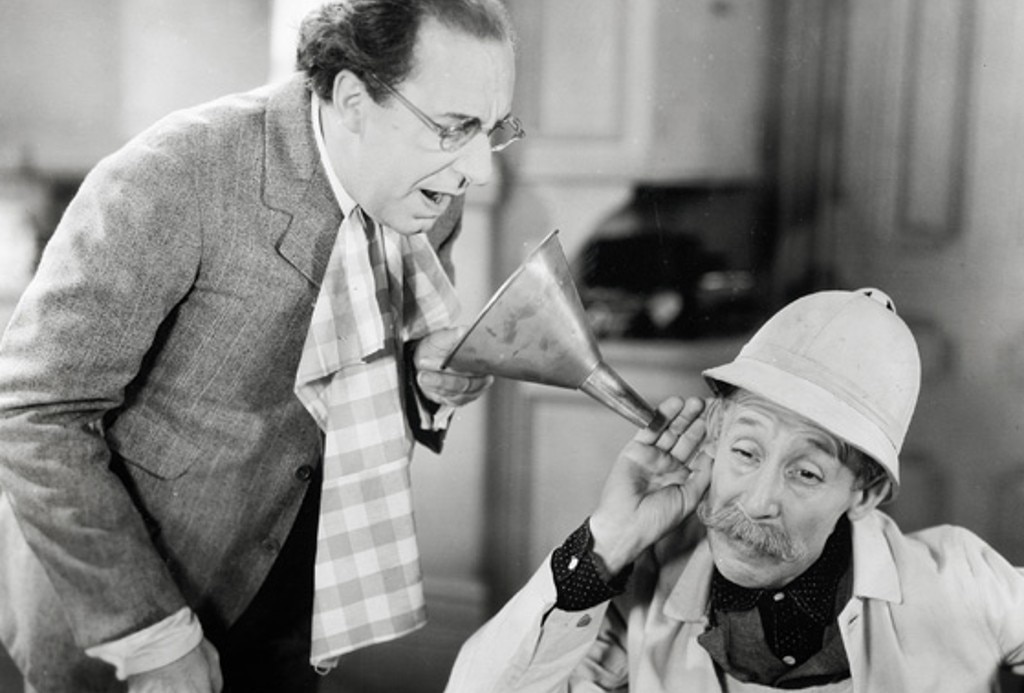
Daffy stage and radio comedian Ed Wynn brought to the screen his trademark persona of "The Perfect Fool" in Charles Reisner's The Chief (1933). In its review of the film, The New York Times encapsulated Wynn's appeal: "Mr. Wynn is more than a funny man; he is lovable. It is impossible not to feel affection for him even in the moment that one is laughing most heartlessly at the bewildered saucer eyes behind the horn-rimmed spectacles, the foolish agitation of the hands, the apologetic hiccough, the strained falsetto and the collapsible forehead."
The quavering-voiced, google-eyed Wynn plays Henry Summers, the bumbling son of a heroic fire chief, who is made honorary chief in his father's honor. Dragged against his will to an actual fire, Summers's clumsiness is mistaken for bravery and he becomes a popular figure in New York's Bowery district (in the Gay Nineties). Summers is fired from his day job (for incompetence), until his boss, Al Morgan (Purnell Pratt) realizes he could profit from Summers's political pull. With a little feminine persuasion from a worldly but good-hearted dame (Dorothy Mackaill), Summers agrees to run for alderman against the well-connected Paul Clayton (C. Henry Gordon). To keep Summers from being a shoe-in, Clayton kidnaps Summers's mother (Effie Ellsler) and blackmails the son to throw the election. Unable to withdraw from the election so late in the race, Summers decides to fake insanity and parade like a madman through the streets of New York -- not realizing that his mother has won the hearts of her captors with home-made biscuits and material affection.
An hour into the film, just as it reaches its climax, there is an abrupt shift of format and setting, and The Chief becomes a radio show, with Wynn performing behind the mike, along with straight-man Graham McNamee. This was clearly a sop to Wynn's listenership, a five-minute bonus feature for those hoping for a glimpse of the radio star in his natural habitat (the Times called it "a somewhat desperate attempt to corral the comedian's radio public"). Wynn performed his radio show in much the same way as it appears in The Chief, opening with a hand-cranked siren, with a live studio audience, and back-up orchestra. The degree to which MGM was cashing in on Wynn's popularity is obvious in the film's title itself, as the comedian's radio show was called The Fire Chief (sponsored by Texaco).
The Times's greatest complaint about The Chief was that, instead of letting Wynn perform his shtick in his usual way, the filmmakers forced him into slapstick situations that didn't jibe with his direct-address comedy stylings. "In a perfect world there would be unmentionable penalties for gag-men who weighted him down with the bewhiskered slapstick that has found its way into The Chief."
Born in Philadelphia as Isaiah Edwin Leopold, the comedian began earning a reputation in vaudeville in the early 1910s, formulating a stage name from his middle name (Edwin = Ed Wynn). By the mid-1910s, he had graduated to the high-profile Broadway extravaganzas of Florenz Ziegfeld. Wynn's only silent movie credit was the Paramount feature Rubber Heels, opposite Chester Conklin and Thelma Todd, in 1927. The stage and radio suited him better, since his flustered, warbling voice was such a crucial component of his persona.
The Chief's director, Charles Reisner, had helmed Buster Keaton's last independent feature, Steamboat Bill, Jr. (1928) and it's apparent that the studio was attempting to make Wynn's radio/stage comedy more cinematic. It seems the experiment was not considered a success, and Wynn didn't truly return to the big screen until providing the voice of the Mad Hatter in Disney's Alice in Wonderland (1951). By that time, he had fully trademarked his shtick and conquered television with The Ed Wynn Show (1949-50).
Comfortable in his success, Wynn later took on straight dramatic roles, in the original production of Requiem for a Heavyweight on TV's Playhouse 90 (1956).
Wynn's son, Keenan (1916-1986), followed his father into show business, and is probably best remembered as Colonel "Bat" Guano in Stanley Kubrick's Dr. Strangelove (1964).
The Chief is notable for having an early (albeit brief) appearance by rising star Mickey Rooney. He has no lines, and appears in two shots in the opening sequence, as a mischievous boy who tosses firecrackers at the feet of the near-hysterical Summers. Though the role is miniscule, Rooney was billed prominently, perhaps a sign that MGM had big plans for the thirteen-year-old lad. The Chief was made while Rooney was appearing in a long run of "Mickey McGuire" comedies, independent short films based on a character in Fontaine Fox's "Toonerville Folks" comic strip. Rooney's experience on the set of The Chief must not have been consequential, as he failed to mention the production in his 1991 memoir Life Is Too Short.
Director: Charles Reisner
Producer: Harry Rapf
Screenplay: Arthur Caesar and Robert E. Hopkins
Cinematography: Edward Paul
Production Design: Stan Rogers
Cast: Ed Wynn (Henry Summers), Dorothy Mackaill (Dixie Dean), Effie Ellsler (Ma Summers), C. Henry Gordon (Paul Clayton), Purnell Pratt (Al Morgan), Nat Pendleton (Big Mike), Charles "Chic" Sale (Uncle Joe), William "Stage" Boyd (Danny O'Rourke), George Givot (Clothier), Mickey Rooney (Willie), Graham McNamee (himself).
BW-66m.
by Bret Wood
The Chief
by Bret Wood | October 05, 2010
SIGN UP FOR OUR NEWSLETTERS

CONNECT WITH TCM