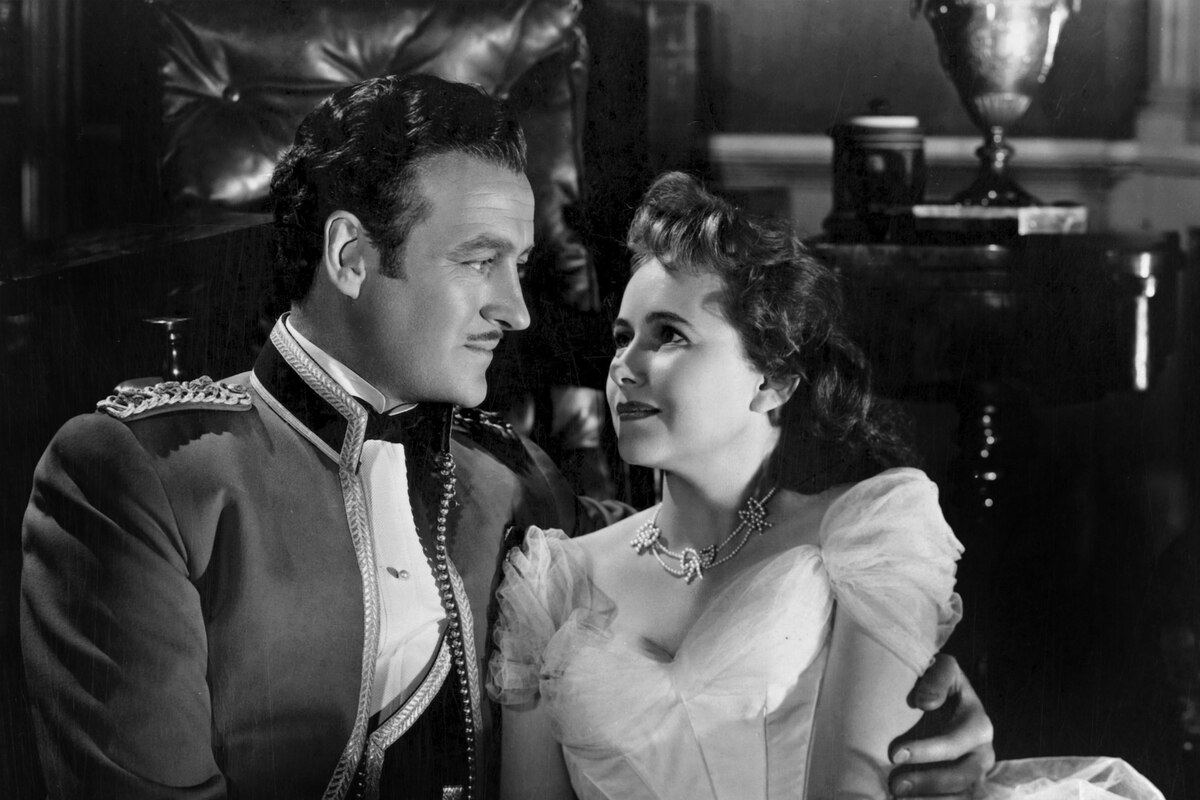
Based on the 1945 novel Take Three Tenses by Rumer Godden, Enchantment (1948) is a bewitching love story from producer Sam Goldwyn that spans two generations. Evelyn Keyes plays Grizel, a young ambulance driver during World War II who goes to stay with her elderly great uncle Rollo (David Niven) in London. While there, Grizel soon discovers that Rollo is haunted by the memory of his long lost love Lark (Teresa Wright), an orphaned girl who was sent to live with his family when he was a boy. Rollo tells Grizel about their love story just as romance begins to blossom between her and Pax Masterson (Farley Granger), a fighter pilot who just happens to be Lark's nephew. Fusing past and present with flashbacks and evocative cinematography by Gregg Toland, Enchantment is a high class tearjerker about not letting love get away.
Actress Teresa Wright was at the height of her fame when she made Enchantment. Still under a long-term contract to Sam Goldwyn, Wright had quickly risen to stardom following a string of hits and an Academy Award® win for Best Supporting Actress for her work in Mrs. Miniver (1942). Her talent and fresh-faced ingénue good looks made her perfect for the role of the angelic Lark.
Wright's co-star, David Niven, was also one of Sam Goldwyn's discoveries who had been under contract to him since the mid-1930s. After a decade of smaller supporting parts, Niven returned from his service in World War II primed to take on starring roles in films such as A Matter of Life and Death (1946) and The Bishop's Wife (1947). The part of Rollo in Enchantment presented a unique acting challenge for the elegant Englishman in that he would play the same character as both a young and old man.
While two Goldwyn veterans, Niven and Wright, starred as the lovers of the past in Enchantment, two of Goldwyn's newest rising stars, Farley Granger and Evelyn Keyes, made their mark playing the modern day World War II lovers. Goldwyn had brought Granger into his studio fold a few years earlier with the intention of grooming the handsome young talent into a major star, while Evelyn Keyes was borrowed from Columbia Studios. According to Keyes in her 1977 autobiography Scarlett O'Hara's Younger Sister, Goldwyn always claimed to be a fan of hers. Every time he saw her he would bellow out for all to hear, "Ahhh! My favorite actress!"
Keyes, according to co-star Farley Granger, was not Goldwyn's first choice to play Grizel -- it was actress Cathy O'Donnell (The Best Years of Our Lives [1946]). According to Granger's 2007 autobiography Include Me Out, O'Donnell had already been cast in the part when she was suddenly fired by Goldwyn right before rehearsals were set to begin on Enchantment. It had to do, said Granger, with a long standing feud between Goldwyn and Oscar®-winning director William Wyler. Wyler, who had directed many outstanding films for Goldwyn including Best Picture winner The Best Years of Our Lives, had recently left Goldwyn Studios to form his own production company. Goldwyn was reportedly furious at Wyler's departure and never forgave him. O'Donnell was caught in the crossfire because she had quietly married Wyler's brother Robert the week before Enchantment was to begin shooting. When Goldwyn found out, according to Granger, he went "ballistic" and gave O'Donnell an ultimatum: she would either have the marriage annulled or be fired. When O'Donnell argued with him, Goldwyn terminated her on the spot. "The next thing I knew," said Granger, "Evelyn Keyes, who had played Scarlett O'Hara's younger sister, was playing Cathy's part."
Even though David Niven had a starring role in Enchantment, there was tension between him and longtime boss Goldwyn. The two had a complicated relationship, with Niven often fighting with Goldwyn over everything from money to his disdain at being loaned out to other studios. Then in his late thirties, Niven found himself starring with the younger Goldwyn discovery Farley Granger in a part where he was required to spend half of his screen time in makeup that aged him into an old man. Still, the role of Rollo was a showy one that Niven sunk his teeth into, determined to make the best of it. "I'd never played a really old man before," Niven told columnist Hedda Hopper, "and after watching a few I decided that they did everything just a bit slower than I did. So I had about 32 pounds of lead distributed about my person: my sleeves were so weighted down that I could hardly get a glass up to my lips. Then Sam Goldwyn said I had to bleach my hair to make it look silver on the screen: when I got home that night the dog bit me and the children burst into tears, but what was really embarrassing was that, when it finally washed out, it left my hair looking bright mauve. Then I went for a holiday and the sun turned it magenta, and for about two years I had hair all the colors of the rainbow, mainly in stripes. Then the film finally came out and one critic wrote, 'Niven's performance was ruined by a totally appalling wig.' I think that was when I really began to lose patience with Goldwyn."
Niven's performance in Enchantment impressed his co-star Teresa Wright. "I believe Enchantment was where David first became a character actor," said Wright according to Sheridan Morley's 1985 biography of Niven The Other Side of the Moon. "It was the first time he hadn't been able to trade on that youthful charm of his, and in that sense I think it led on to Separate Tables [1958] ten years later. A lot of people were surprised by the performance he gave in Enchantment, including maybe himself."
Niven's ability to get lost in his character -- especially as the elderly Rollo -- may have worked too well. According to Evelyn Keyes, Niven was so convincing as an old man that people started to treat him as one on the set without realizing it. "One day as [Farley Granger and I] stood giggling about something between takes," she recounted in her autobiography, "David, who was standing nearby, spoke up rather querulously, 'You two are ignoring me as if I really were old and can't understand your youthful chatter.' It was true. I couldn't remember the other David at all."
While some of the actors dismissed Enchantment as a sentimental trifle, Sam Goldwyn loved it and decided to promote the film as "Just About the Most Wonderful Love Story Ever Filmed." Goldwyn told the New York Times that he envisioned Enchantment as "something which might counteract the trend of tough, hard, gangster pictures and others of a similar type...springing up again after the war...I wanted to say in Enchantment that there was more to life than bitterness and disillusionment or escape through slam-bang crime stories."
Unfortunately, Goldwyn's marketing plan for Enchantment didn't work. While the film received generally favorable reviews, it failed to catch on with audiences and was considered a box office failure. Evelyn Keyes felt Goldwyn's disappointment firsthand. "Sam stopped calling me his favorite actress," she said. "He had to blame somebody, and he owned all the other players."
Shortly after the release of Enchantment Sam Goldwyn and Teresa Wright parted ways professionally. According to some accounts, Goldwyn canceled her contract over a dispute regarding Wright's refusal to help promote the film. Although Wright continued to act for the rest of her life, her later film career never regained the prestige of the projects she had worked on under Goldwyn's guidance.
Enchantment also marked the last film that David Niven made at Goldwyn Studios. After two more loan outs to other studios, Niven asked Goldwyn to release him from his contract. Niven struggled to regain his footing as a leading man, but bounced back nicely in the 1950s with several hit films and an Academy Award® win as Best Actor in the 1958 film Separate Tables.
Enchantment is also notable for being the final film that cinematographer Gregg Toland worked on before his sudden death just a few weeks after the film's release from a coronary thrombosis at the age of 44. Toland, whose credits included Citizen Kane (1941), Wuthering Heights (1939) and The Best Years of Our Lives, had been one of Goldwyn's prime assets. Toland, who was known for having perfected the deep focus technique, had photographed almost all of Goldwyn's talking pictures, providing an invaluable contribution to the style that became known as the "Goldwyn Touch."
Producers: Samuel Goldwyn
Director: Irving Reis
Screenplay: John Patrick (writer); Rumer Godden (novel "Take Three Tenses")
Cinematography: Gregg Toland
Art Direction: George Jenkins
Music: Hugo Friedhofer
Film Editing: Daniel Mandell
Cast: David Niven (General Sir Roland 'Rollo' Dane), Teresa Wright (Lark Ingoldsby), Evelyn Keyes (Grizel Dane), Farley Granger (Pilot Officer Pax Masterson), Jayne Meadows (Selina Dane), Leo G. Carroll (Proutie), Philip Friend (Pelham Dane), Shepperd Strudwick (Marchese Guido De Laudi), Henry Stephenson (General Fitzgerald), Colin Keith-Johnston (The Eye).
BW-101m.
by Andrea Passafiume
Enchantment
by Andrea Passafiume | August 12, 2010
SIGN UP FOR OUR NEWSLETTERS

CONNECT WITH TCM