The Law (1959) is many films in one: a metaphorical, occasionally
disturbing social drama, a lurid comedy with musical interludes, a Euro sex romp,
and an atmospheric slice of sun-drenched, southern Italian life. It's also a
star-studded international affair, with the Italian stars Gina Lollobrigida and
Marcello Mastroianni, the French Yves Montand and Pierre Brasseur, and the Greek
Melina Mercouri -- with directing by the American Jules Dassin from an
award-winning French novel by Roger Vailland. The film was shot on location in
Italy, with dialogue in French.
The mixed tones of the story and the many nationalities of the artists involved
mesh together more or less successfully, resulting in something unique and
memorable, if a bit over the top at times. While it may not rank as one of
director Jules Dassin's very best films, The Law is still criminally
underrated, and its debut in Region 1 DVD is most welcome.
At the heart of The Law is "the law" -- ostensibly a drinking game in
which the winner imposes his rule over the losers. He can ask them embarrassing
questions they must answer, even if it affects their honor; he can insinuate
things that normally would provoke a violent response; he can make them perform
humiliating actions, and he can insult them all he wishes. The losers must
endure the taunts and obey silently. They are not allowed to question or
challenge the law. (The game exists in real life in certain parts of Italy and
was banned in Rome because it often led to violence. In northern Italy it is
known as the "passatella.")
When we see the game played on screen, it starts out as funny, grows disturbing,
and finally becomes sadistic and cruel. But the film takes "the law" and turns it
into much more than a drinking game. It becomes a metaphor for the greater theme
of characters exerting their wills over one another. We see this done in family
relationships, in love, in issues of law and order, in sexual situations -- all
unfolding in a coastal Italian village.
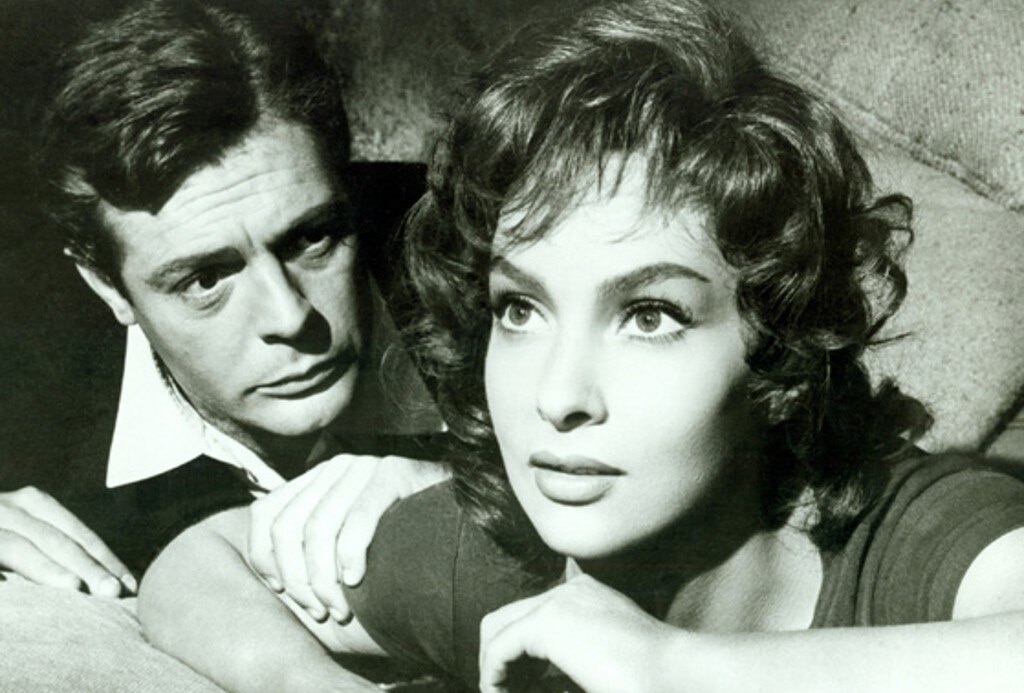
At the center of it all is Gina Lollobrigida as Mariette, the unbearably sexy and
gorgeous housekeeper to the local godfather Don Cesare (legendary French actor
Pierre Brasseur). Every single man in town lusts after her; every single woman
in town resents her. Mariette herself is strong-willed, impulsive, and full of
heightened emotions, which seem to infect the other characters and the film as a
whole. An agricultural engineer named Enrico (Marcello Mastroianni) comes to town
to drain the local swamps to reduce the risk of malaria, and Mariette falls for
him and tells him she wants to marry him. He says he's too poor, so Mariette
attempts to steal a huge wad of cash. Meanwhile, a local gangster named Brigante
(Yves Montand, superb) sets his sights on shutting Enrico out so he can take
Mariette for himself -- which is not to say that she wants him. Brigante's son,
Francesco (Raf Mattioli), starts a clandestine affair with the much older
Donna Lucrezia (Melina Mercouri), the wife of the local judge, incurring the
anger of Brigante, who publicly humiliates him.
There's a lot going on here plotwise, which has the effect too often of making
the movie feel unfocused, but there are some mesmerizing individual scenes. The
astonishing opening sequence -- in which Dassin's camera starts on a man talking
to a pigeon before gliding and craning around a town square and along a row of
windows, while Gina Lollobrigida's voice sings a haunting melody from across the
way -- elegantly introduces many of the characters and a comic tone while
establishing a palpable, sensual atmosphere. One can feel the lazy summer heat.
When Lollobrigida is finally revealed, she doesn't disappoint. She is out on a
balcony, shining her employer's boots and singing so sexily that it's only a
minute or so until she is literally swatting away a man.
Other memorable scenes: the main sequence of "the law" drinking game, so intense
that one feels violence could erupt at any moment; an electric moment where
Brigante confronts his son on a crowded bus; a fishing sequence that feels like a
piece of neo-realism; a scene where Lollobrigida oversees the dismantling and
theft of a bicycle by a gang of local kids.
Lollobrigida's earthy sensuality is marvelous. Dassin emphasizes it right off the
bat, with her singing, and continues to stress it in scene after scene, giving
her bits of solo business like rolling in a pile of cash and making a crown out
of the bills. In a directing joke that runs through the film, Dassin costumes and
frames her in almost every scene so that her cleavage is on full, prominent
display -- so much so that it should have received its own credit. Dassin takes
things to the limit with a jaw-dropping, outrageous (and wonderful) scene in
which Lollobrigida is strapped to a table, her head resting in a bowl of
jalapenos, and whipped by her mother and two sisters for being a "slut."
Ironically, Lollobrigida wasn't even supposed to be in this film. When the
financing arrangements shifted at the last minute and new producers insisted on
casting the bombshell, Dassin was forced to rewrite what he considered one of his
best scripts in order to suit her.
The director of fine films noirs like Brute Force (1947), Thieves'
Highway (1949) and Night and the City (1950), Dassin had been
blacklisted in 1952 and resettled in France and then Greece, where he remained
for the rest of his life and career. He went on to make some very successful
European films like Rififi (1955), Never on Sunday (1960) and
Topkapi (1964). Melina Mercouri, one of the stars of The Law,
worked with Dassin several times, and the two married in 1966.
The Law was first released in America in 1960 as Where the Hot Wind
Blows!, dubbed in English and edited for the censors. Three years later it
was re-released uncut with subtitles and its original title (and condemned by the
Catholic Legion of Decency), but this was a limited and brief reissue designed to
capitalize on the success of Never on Sunday, and The Law
thereafter disappeared with nary a trace. In the summer of 2010 it was
resuscitated and restored by New York indie distributor Oscilliscope
Laboratories, a new company launched by Beastie Boys founder Adam Yauch.
Oscilliscope has already established itself as having great taste, with an
eclectic slate of new films and the occasional DVD release of an unheralded
classic like The Law.
The Law and some other recent DVDs, in fact, have made it clear that
Oscilliscope is a cream-of-the-crop DVD distributor. Everything about this
release of The Law is on a par with Criterion: the exceptional dual-layer
transfer, the expert commentary, the plentiful and genuinely engaging extras, and
the packaging, which is beautifully illustrated with images from the film and
includes two essays about it (one from a 1958 film magazine, the other a new
piece by Harvard Film Archive director Haden Guest).
The featurette extras include a fascinating 1958 French TV show which traveled to
the set of The Law and interviewed Montand, Dassin, Mercouri and
Lollobrigida. We also get a 1957 French TV interview with Roger Vailland, the
author of The Law novel. The movie was not yet going at the time of this
interview; Vailland simply discusses the themes of his story and how and why he
explored them. Finally, there is a new 40-minute documentary about the game of
"the law" as it's played in southern Italy today.
Time Out film critic David Fear's audio commentary is quite good (despite
some early moments of over-enthusiasm that get the better of him). He is
extremely knowledgeable about the film, Dassin's personal history, and the major
players involved.
For more information about The Law, visit Oscilloscope Laboratories. To
order The Law, go to
TCM Shopping.
by Jeremy Arnold
The Law - Gina Lollobrigida, Marcello Mastroianni, Melina Mercouri & Yves Montand in THE LAW aka Where the Hot Wind Blows
by Jeremy Arnold | August 03, 2010
SIGN UP FOR OUR NEWSLETTERS

CONNECT WITH TCM