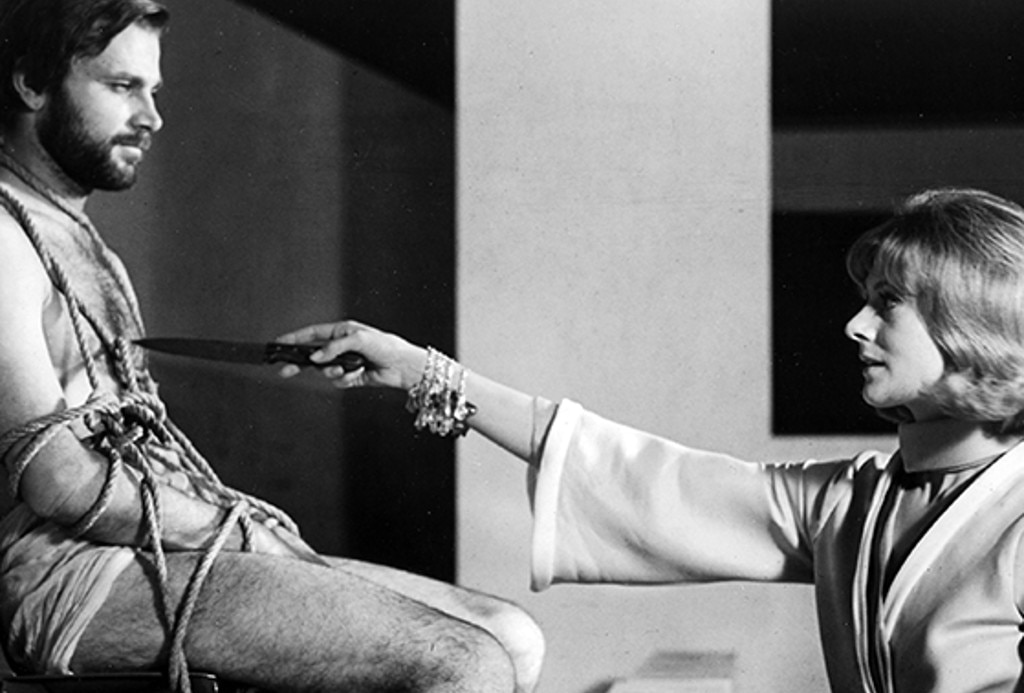
Leonardo needs to get away from the hectic pace of urban Milan. A popular painter of boldly colored, wall-sized canvases, he suddenly develops an almost paralyzing anxiety over his work. Disturbing sadomasochistic nightmares and violent fantasies don't help his condition and, with the help of his mistress/art dealer Flavia, he rents a sprawling, deserted villa in the country for a quieter work environment. At first, Leonardo feels inspired to paint again but soon becomes aware of another presence in his villa and it's not an earthbound one. Is Leonardo losing his mind or is the villa actually haunted by the spirit of its former owner, a possessive nymphomaniac who wants the artist all to herself?
A tale of mental disintegration seen from the victim's viewpoint, A Quiet Place in the Country (1969, Italian title: Un tranquillo posto di campagna) is an often brilliant fusion of experimental filmmaking pyrotechnics and gothic horror conventions. Made in the wake of the blockbuster musical, Camelot (1967), where Vanessa Redgrave and Franco Nero first met and became lovers, this further collaboration between them, directed by Elio Petri, is decidedly less conventional and almost forgotten today. The only reason it probably received distribution in an English-dubbed version in the U.S. in 1970 was due to the tabloid notoriety of Redgrave and Nero, who were living together openly and had a child together. (They eventually separated but reunited and were legally married in 2006).
Unlike some of the art house bombs Elizabeth Taylor and Richard Burton, another famous celebrity couple of the sixties, made at the height of their fame (Doctor Faustus [1967], Boom! [1968], Under Milk Wood [1972]), Redgrave and Nero's Italian film phase consisted of outre genre films. A Quiet Place in the Country is a giallo on acid, Drop-Out (1970) is a picaresque road movie, and La Vacanza (1971) is an avant-garde historical drama; the latter two were directed by Tinto Brass, who later specialized in softcore erotica.
On a visual level, A Quiet Place in the Country is an astonishing tour-de-force that begins with the credits, rendered like an underground film with scratched emulsion and countdown leader interspersed with quick cuts of classic and contemporary paintings. As the film progresses, Luigi Kuveiller's cinematography reflects the erratic mood of its tormented protagonist, going from wild mood swings (a slo-mo trashing of Leonardo's studio with buckets of paint spilled everywhere by a poltergeist) to pastoral bliss (Leonardo lying in a golden-hued farm field drinking wine and intently studying a nudie magazine). The unsettling tone of the movie is further enhanced by Ennio Morricone's cacophonous and nerve-jangling score that mixes industrial sounds with free-form jazz and the "natural music" of the countryside - flies, birds, crickets, the sound of the wind, creaking wooden doors.
While both Nero and Redgrave are fine in their respective roles as the disturbed artist and his jeopardized lover, the real star of A Quiet Place in the Country is the superb villa where the bulk of the disturbing narrative takes place. According to Redgrave in her autobiography, "We filmed in a huge deserted villa about twenty miles from Vicenza and Padua. Franco and I rented a wing of the Casa Veronese, a villa surrounded by a farm, from two elderly spinsters, the Misses Veronese, and we spent about two months there, in May and June 1967." The filming of A Quiet Place in the Country was a joyful experience for them both and they were sad to leave the villa when it was finished.
While A Quiet Place in the Country was not a commercial success in Europe or the U.S. due to its refusal to follow genre expectations or resolve the film's mysteries, it did receive several rave reviews from a handful of high profile critics such as Howard Thompson of The New York Times who wrote, "This Italian-made color film, if you stay with it on its own terms, will absolutely nail you to the seat...the picture visually hurtles and roars to a climax of complete logic and conviction, blending real and unreal images that will curl your hair. The total effect is devastating."
Elio Petri, director of A Quiet Place in the Country, is probably best known for his 1970 psychological drama, Investigation of a Citizen Above Suspicion, which received an Oscar® nomination for Best Story and Screenplay. Unfortunately, his other work is less well known in the U.S. though it should be because it is some of the most inventive and engaging Italian cinema of the sixties and includes the sci-fi satire The 10th Victim (1965), We Still Kill the Old Way (1967), a black comedy about the Mafia, and Todo Modo (1976), a nightmarish political allegory.
Producer: Alberto Grimaldi
Director: Elio Petri
Screenplay: Elio Petri, Luciano Vincenzoni (story and screenplay); Tonino Guerra (story)
Cinematography: Luigi Kuveiller
Music: Ennio Morricone
Film Editing: Ruggero Mastroianni
Cast: Franco Nero (Leonardo Ferri), Vanessa Redgrave (Flavia), Georges Geret (Attilio), Gabriella Grimaldi (Wanda), Madeleine Damien (Wanda's Mother), Rita Calderoni (Egle), John Francis Lane (Asylum Attendant), Renato Menegotto (Egle's Friend), David Maunsell (Medium).
C-106m.
by Jeff Stafford
SOURCES:
Vanessa Redgrave: An Autobiography
The New York Times
www.afi.com
IMDB
A Quiet Place in the Country
by Jeff Stafford | July 07, 2010
SIGN UP FOR OUR NEWSLETTERS

CONNECT WITH TCM