Two MGM musical stars achieved career milestones in Two Weeks With Love, a pleasant 1950
musical about a turn-of-the-century family on vacation in the Catskills.
As the eldest daughter, Jane Powell graduated from juvenile to adult roles,
even winning the handsome Latin leading man Ricardo Montalban. Replacing her in
the juvenile ranks was Debbie Reynolds, whose spirited turn as Powell's
younger sister generated enough fan mail for the studio to put her on the
fast track to stardom.
Powell was only 15 when MGM signed her to a long-term contract in 1944.
With her surprisingly mature soprano voice, the studio hoped to turn her
into another Deanna Durbin, a child singing star they had released from contract in the
'30s only to see her save Universal Pictures from bankruptcy. For years,
Powell was the pleasant juvenile star of such minor-league musicals as A
Date With Judy (1948) and Nancy Goes to Rio (1950), in which she sang
pleasantly but lost the more mature leading men to older actresses. By the
time she made the latter film, however, Powell was clearly moving into
adulthood, a transition producer Jack Cummings hoped to ease with her role
in Two Weeks With Love.
Powell starts the film as a young innocent,
only to grow up fast when she develops her first adult romance, with
traveling actor Montalban. Initially she poses as a sophisticated woman
of the world, only to find he's more attracted to the youthful innocence he
rarely finds in theatre actresses. Along the way she sings the romantic ballad
"There Are Such Things," the light opera favorite "My Hero" and an original
ragtime number, "The Oceana Roll," choreographed by Busby Berkeley. The
switch worked with film audiences, and Powell would continue to shine in more mature roles opposite Fred Astaire in Royal Wedding (1951) and Howard
Keel in Seven Brides for Seven Brothers (1954).
For Reynolds, Two Weeks With Love provided the kind of showy
supporting role every show business hopeful dreams of. She had gotten into
the movies after winning the title of Miss Burbank in 1948. After the
pageant, rival talent scouts from Warner Bros. and MGM wanted to sign her.
They flipped a coin, and Warners won, but all the studio gave her were two
small roles and a new first name. Jack Warner turned Mary Frances Reynolds
into Debbie Reynolds. But after a year, they dropped her contract.
Still, Reynolds' original talent scouts still had faith in her. The Warners scout
called his friend at MGM to announce that she was available and even took
her there for an interview. MGM signed her and put her to work with
acting, dancing and singing lessons, where she impressed everybody with her
hard work and ambition. Producer Jack Cummings thought she had just the
right energy for a small part in Three Little Words (1950), the musical
biography of songwriters Bert Kalmer and Harry Ruby. He cast Reynolds as
"boop-boop-a-doop" singer Helen Kane, who dubbed all of her lines. But
even without her voice, Reynolds was enchanting, vamping Carleton Carpenter
innocently through Kane's trademark song, "I Wanna Be Loved by You." For
the first time, she started to get fan mail.
Quick to capitalize on his new screen team, Cummings cast Reynolds as
Powell's sister in Two Weeks With Love, with Carpenter as her love
interest. The two dueted spiritedly on the vintage hits "Row, Row, Row"
and "Abba Dabba Honeymoon" (the latter was excerpted 24 years later in the
original That's Entertainment, 1974). MGM also sent them out on a
publicity tour for the film. As her popularity grew, Reynolds was promoted
to full star status as Gene Kelly's leading lady in Singin' in the
Rain (1952).
Of course, Two Weeks With Love wouldn't have helped anybody's career
without the kind of cast and crew that was a matter of course for an MGM
production. Providing a solid backdrop to the leading performances were
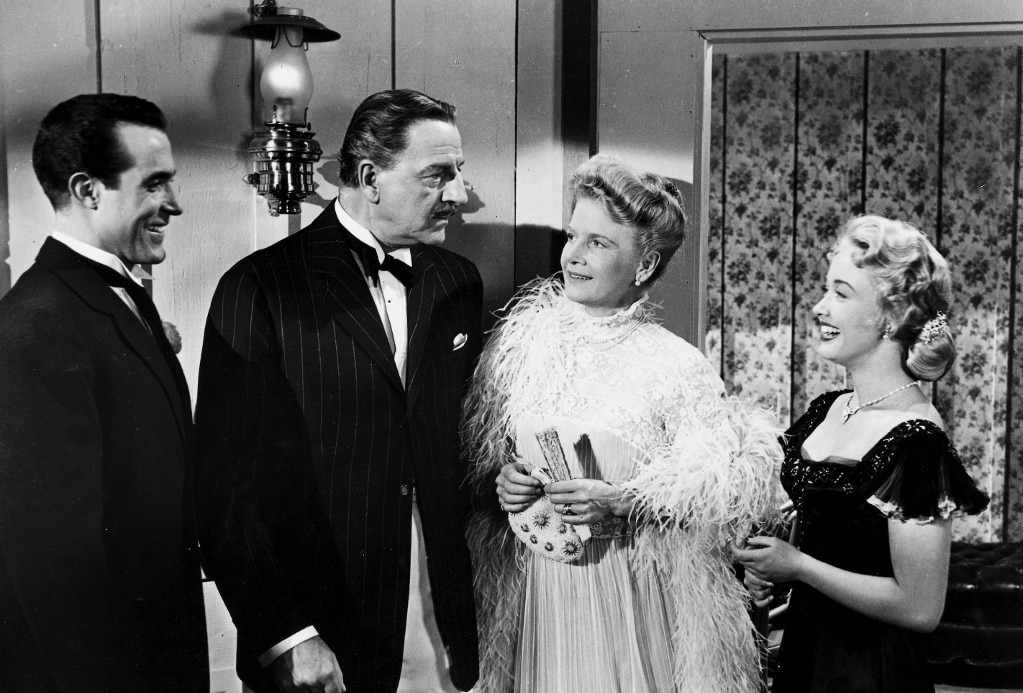
veteran actors Louis Calhern and Ann Harding, who teamed as Powell and
Reynolds' parents before starring in the unconventional biopic, The
Magnificent Yankee (1950). Harding, the queen of the RKO Studios lot in the
early '30s, had come out of retirement at old friend Calhern's urging to play the part. Writer Dorothy Kingsley had made a name for
herself coming up with one-liners for Bob Hope and Edgar Bergen on radio.
Choreographer Busby Berkeley was busy staging some of swimming star Esther
Williams' most impressive water ballets when he took time out to produce the
vaudeville-style numbers for this film. And Roy Rowland, who had started
his career directing comic shorts for Pete Kelly's MGM production unit,
would give the film the same off-beat charm he would bring to his most
famous picture, the 1953 Dr. Seuss musical The 5,000 Fingers of Dr.
T. That film starred Powell and Reynolds' younger brother from Two
Weeks With Love, Tommy Rettig, just before he found stardom in the
family television series Lassie.
Producer: Jack Cummings
Director: Roy Rowland
Screenplay: Dorothy Kingsley, John Larkin
Based on a story by Larkin
Cinematography: Alfred Gilks
Art Direction: Cedric Gibbons, Preston Ames
Music: Georgie Stoll
Principal Cast: Jane Powell (Patti Robinson), Ricardo Montalban (Demi
Armendez), Louis Calhern (Horatio Robinson), Ann Harding (Katherine
Robinson), Phyllis Kirk (Valerie Stressemann), Carleton Carpenter (Billy
Finlay), Debbie Reynolds (Melba Robinson), Tommy Rettig (Ricky Robinson).
C-93m. Closed Captioning.
by Frank Miller
Two Weeks With Love
by Frank Miller | August 23, 2003
SIGN UP FOR OUR NEWSLETTERS

CONNECT WITH TCM