Jane Russell delivered a cinematic answer to her 1953 hit Gentlemen
Prefer Blondes when she inaugurated her production company with the
1955 musical, Gentlemen Marry Brunettes. With location shooting in Paris and on the Riviera, vintage
songs from the '20s and '30s and a surprisingly sexy performance by
girl-next-door Jeanne Crain, the film offered fans a pleasant
surprise.
Russell's contract with eccentric tycoon Howard Hughes and RKO Studios was
due to end in 1954, and she wasn't sure if they'd be asking her to stay
around. RKO wasn't doing that well, and speculation was that Hughes was
about to get out of the picture business. So she got together with her
husband, former football star Robert Waterfield, her agents at MCA and
attorney Sam Zagon to form her own production company, Russ-Field. She
wasn't blazing any trails. Several other stars were doing the same thing
in the '50s. But she did succeed in creating a hedge for herself against
RKO's fading fortunes. As it turned out, Hughes offered her a contract she
couldn't afford to turn down -- $1 million for five films, with payments
made over the next 20 years. And the terms were so loose that she could
still work for other production companies, including her own.
Zagon sold Russ-Field's services to United Artists, which agreed to six
pictures if the first was Gentlemen Marry Brunettes. Although based
on a story by Anita Loos, who'd written the original Gentlemen Prefer
Blondes, the only thing it retained was the title and the Loos name, in
the person of Anita's niece Mary, who had written the script for Russell's
latest film, The French Line (1954). That should have been a warning to
Russell -- The French Line would be the worst film she ever made if
she hadn't followed it with Underwater! (1955). Russell didn't care for the
story of a sister act who flee the U.S. for Paris to escape their ardent
suitors. Even the chance to play a double role during flashbacks depicting
how her mother and aunt had taken Europe by storm didn't sell her. She
finally gave in to the studio's assurances that it was a sure thing. The
large budget concerned her, too, as did plans to shoot entirely in
Europe.
Many of her concerns turned out to be well-founded. Although she traveled
with a friend, she was desperately homesick. She had left her children at
home to spare them the prying eyes of the British tabloid press, but the
move backfired when her son developed a stutter in her absence (it vanished
when she finally came home). Her husband visited for a few months, but
then went home to spend Christmas with the children. He also embarked on
an affair that would lead to a decade of marital problems. On top of that,
Russell was horrified at the mounting expenses. When she saw how quickly
her expense allowance was depleted, she told the chef hired to cook for her
during studio shooting in London that she was on a diet. As a result, her
weight fluctuates throughout the film.
On the plus side, shooting was going well. Russell's leading man, Scott
Brady, had been a friend since they co-starred in Montana Belle in
1952. Twenties heartthrob Rudy Vallee was on hand to play himself as
Russell's modern-day protector and one of her mother's suitors. The
costumes were top of the line, designed by couturier Christian Dior and
Hollywood veteran Travilla. And Jack Cole, who had choreographed and
directed the musical numbers in Gentlemen Prefer Blondes, returned to create some unique routines, highlighted by a lavish interpretation of "Ain't
Misbehavin'."
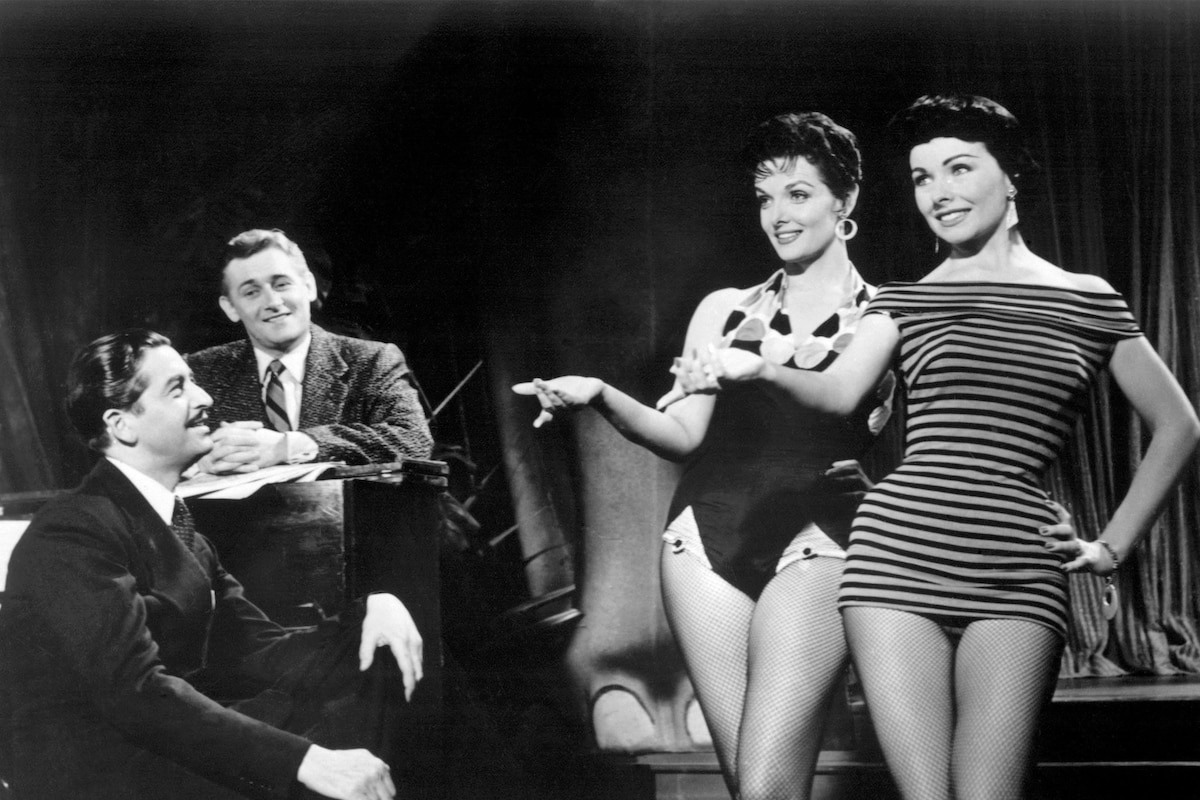
Best of all, however, was Jeanne Crain's surprising performance as
Russell's sister. Having just finished her contract with 20th Century-Fox,
Crain had fought for the role, hoping it would help her shake the squeaky
clean image fostered by the studio. Shake it she did, as she dropped
wisecracks and shimmied her way through the provocative dance numbers. Her
singing was dubbed by Anita Ellis, best known for supplying the steamy
vocals for Rita Hayworth's rendition of "Put the Blame on Mame" in
Gilda (1946). Crain reveled in the chance to break free and also enjoyed
the fans' attention during location shooting. "There's nothing bigger than
a Hollywood star in Europe," she said. "One day of being followed through
the city by screaming fans is enough to cure any star of an inferiority
complex."
Crain got the film's best reviews, with the New York Herald
Tribune's critic commenting, "[She] has been hiding her light under a
pinafore far too long. She turns out to be a fine song and dance girl from
head to toe." Unfortunately, Russell's fears about the film's extravagant
budget proved correct. It was too expensive to turn a profit.
Producer: Richard Sale, Robert Waterfield
Director: Richard Sale
Screenplay: Richard Sale, Mary Loos
Based on the Story "But Gentlemen Marry Brunettes" by Anita Loos
Cinematography: Desmond Dickinson
Music: Robert Farnon
Principal Cast: Jane Russell (Bonnie/Mimi Jones), Jeanne Crain
(Connie/Mitzi Jones), Alan Young (Charlie Biddle/Mrs. Biddle/Mr. Biddle,
Sr.), Scott Brady (David Acton), Rudy Vallee (Himself), Guy Middleton (Earl
of Wickenware).
C-99m. Letterboxed.
by Frank Miller
Gentlemen Marry Brunettes
by Frank Miller | August 23, 2003
SIGN UP FOR OUR NEWSLETTERS

CONNECT WITH TCM