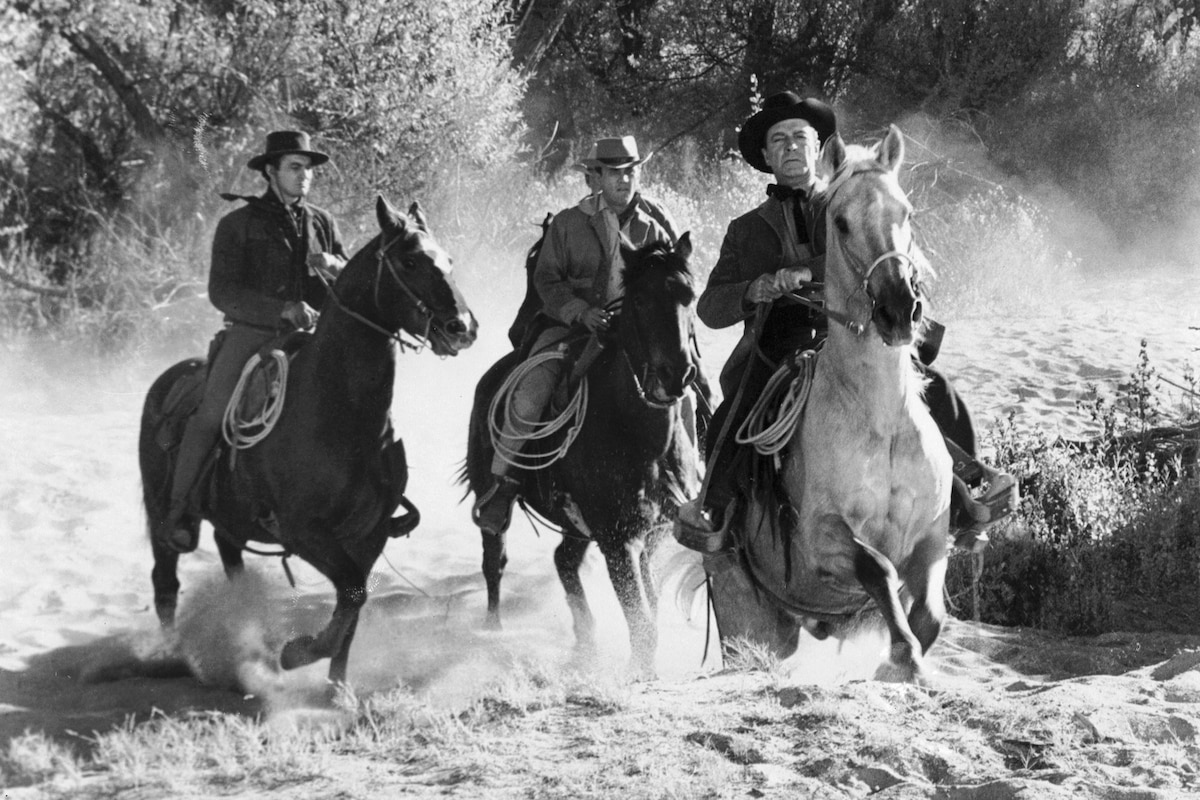
Robert Taylor made his last stand at MGM in 1963 when he starred in Cattle King, a
low-budget Western about an honest cattleman fighting to protect his land
from the free grazing movement. Taylor had already gone off the studio's
contract rolls in 1959, after more than 25 years there. He'd been there so
long, in fact, that he was one of the few MGM actors ever to qualify for a
studio pension (Clark Gable and Lewis Stone were two others). By the '60s,
he was better known as the star of television's The Detectives, but
his name could still draw film audiences in smaller theatres, where
Cattle King turned a tidy profit.
Helping tremendously was the presence of a team of Western veterans behind
the cameras. Producer Nat Holt had gotten his start in the genre in 1946
with RKO's Badman's Territory, then had moved into
television with such series as Tales of Wells Fargo and Overland
Trail. Writer and associate producer Thomas Thompson had worked
primarily on television Westerns, scripting episodes for such acclaimed
series as Rawhide, Bonanza and The Virginian. He
would go on to pen best selling novels (Celebrity) and true-crime
books (Serpentine). Director Tay Garnett had helped Taylor give one
of his best performances, in the World War II epic Bataan (1943).
Although he had done few big screen Westerns -- he was best known for the
classic film noir The Postman Always Rings Twice (1946) -- television's
inroads on movie production had sent him to the small screen. There he was
a fixture on some of the series Thompson had penned.
Joining Taylor on screen were a strong cast of veterans and some talented
newcomers. His leading lady, Joan Caulfield, had been one of the top box
office stars of the '40s in films like Blue Skies (1946) before turning to
low-budget Westerns like this in a futile effort to build a new career as a
character actress. She's probably best known, however, for the fact that
the marquee for her film Dear Ruth (1947), in which she co-starred with
William Holden, gave J.D. Salinger the name for the protagonist of
Catcher in the Rye, Holden Caulfield. Corpulent villain Robert
Middleton had cornered the market on evil as the demented killer in The
Desperate Hours (1955) and a murderous knight in The Court Jester (1956).
Larry Gates, who pretty much stole the film as President Chester A. Arthur,
was a stage veteran who would go on to win a Daytime Emmy as oil magnate
H.B. Lewis on Guiding Light.
Contemporary audiences may focus more
on three cast members destined for bigger things. Middleton's violent
henchman, Robert Loggia, would go on to become one of Hollywood's top
character actors after winning an Oscar® nomination for Jagged
Edge in 1985. William Windom, cast as Caulfield's drunken brother, was
destined for television stardom on such series as The Farmer's
Daughter and My World and Welcome to It. Most recognizable,
however, is rancher's wife Virginia Christine, soon to achieve stardom as
the Swedish-accented Mrs. Olson in a series of coffee commercials.
Using the same economy they had developed for their television work, Holt
and Garnett shot Cattle King in just three weeks. Much of the
filming was done on the Walker Ranch and Western Street in Kernville,
Calif. The popular film location had figured in films since the silent
days, most notably in John Ford's classic Stagecoach (1939). Most
recently, it was used in the 2001 Kevin Spacey drama K-PAX.
Producer: Nat Holt
Director: Tay Garnett
Screenplay: Thomas Thompson
Cinematography: William E. Snyder
Art Direction: Walter Holscher
Music: Paul Sawtell, Bert Shefter
Principal Cast: Robert Taylor (Sam Brassfield), Joan Caulfield (Sharleen),
Robert Loggia (Johnny Quarto), Robert Middleton (Clay Mathews), Larry Gates
(President Chester A. Arthur), William Windom (Harry Travers), Virginia
Christine (Ruth Winters).
C-91m.
by Frank Miller
Cattle King
by Frank Miller | August 25, 2003
SIGN UP FOR OUR NEWSLETTERS

CONNECT WITH TCM