In the early 1930s, Maurice Chevalier had become a big star in Hollywood, thanks to a number of sexy, intelligent comedy musicals at Paramount directed by the great Ernst Lubitsch and co-starring Jeannette MacDonald (before she met Nelson Eddy and moved to MGM). Chevalier had returned to France in 1936 and had made his last film there in 1939. During the war, he had remained in France and performed at Alten Grabow, the same prisoner of war camp where he had been a POW during World War I. This led to accusations of collaborating with the Germans. Chevalier explained that the only way he could entertain French prisoners of war was to perform in front of their captors. In fact, Chevalier was able to secure the release of several prisoners in exchange for performing. Now, eight years later, at the age of 58, and with his name not entirely cleared in the court of public opinion, Chevalier was cast in Man About Town (1947, French title Le Silence est D'Or ) when the intended star, Raimu, died in September 1946.
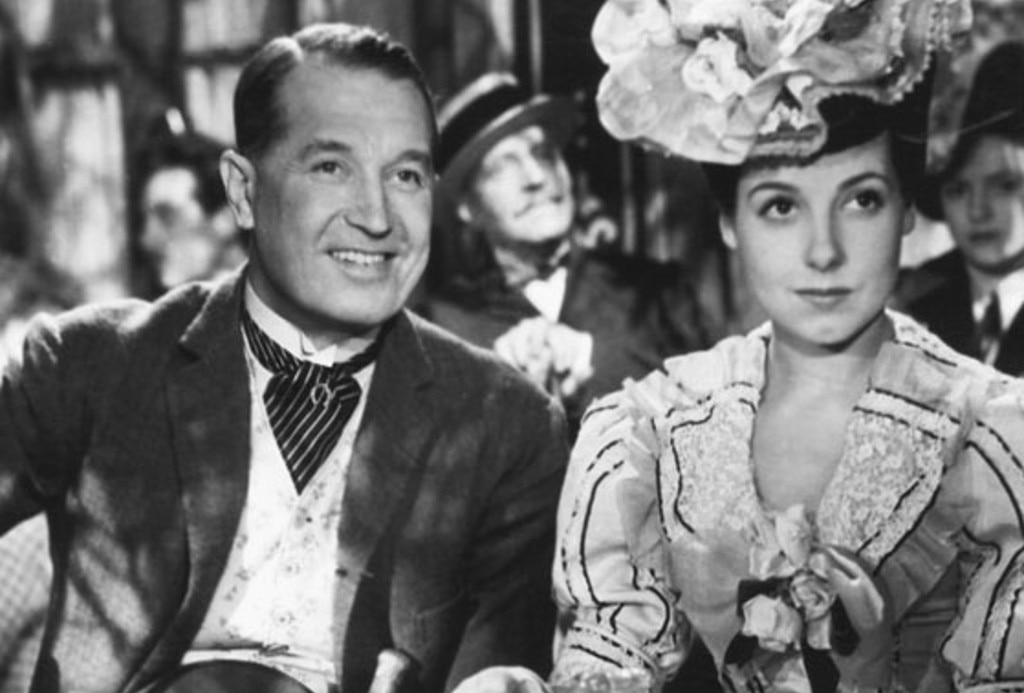
Written, produced and directed by Rene Clair, Man About Town is set in the earliest days of movie making in France. Chevalier plays a producer who falls in love with a much younger actress, who is in love with someone else. It was a departure for Chevalier, who was used to getting the girl. For Rene Clair, the film was a look back, influenced by "youthful memories that gave birth to this comedy. The action is set in the pioneer era of the French cinema. These souvenirs of artisans who, between 1900 and 1910, gave birth to the first film industry in France, is a tribute to their memory by their pupil."
RKO financed both versions of the film an all-French language version and another with Chevalier explaining the story in English. Clair called the latter less artistic than the French version and was made for "those who don't like to read subtitles."
Life gushed over the film and Chevalier, stating "Maurice Chevalier has not made a film for 12 [sic] years, but after seeing Man About Town he still seems to be the most charming man in the world. [...] Man About Town is made like a Mack Sennett farce: the two lovers play it straight and everybody else is a comedian. Some scenes are just inventive slapstick but as a whole Man About Town is performed so deftly and with such gaiety that it makes most U.S. comedies seem cruder than Mortimer Snerd." Bosley Crowther in The New York Times wrote that it was "a quaint and beguiling little fable of the sidewalks of Paris of long ago of a Paris that never existed, perhaps, save in romantic dreams." Crowther disagreed with Clair about the necessity of having Chevalier narrate the film in English, "an ingenious trick of having Mr. Chevalier give a running commentary from off screen and in English-licks the awkward necessity of subtitles to translate the French dialogue. And it also permits the fluid Frenchman to take a slightly kidding attitude toward it all-an attitude, incidentally, which may be its saving grace."
Man About Town certainly helped Chevalier's career; he returned to the United States soon after the film was released, performing in an extremely successful one man show in New York.
Producer: René Clair
Director: René Clair
Screenplay: René Clair (scenario & dialogue)
Cinematography: Alain Douarinou, Armand Thirard
Music: Georges Van Parys
Film Editing: Louisette Hautecoeur, Henri Taverna
Cast: Maurice Chevalier (Emile Clément), François Périer (Jacques), Marcelle Derrien (Madeleine), Dany Robin (Lucette), Raymond Cordy (Le Frisé), Bernard La Jarrige (Paulo), Paul Ollivier (Le comptable), Christiane Sertilange (Marinette), Roland Armontel (Celestin), Paul Demange (Le sultan de Socotora).
BW-89m.
by Lorraine LoBianco
SOURCES:
Crowther, Bosley "Maurice Chevalier Stars in 'Man About Town,' Nostalgic Fable of Paris, Produced by Rene Clair, Presented at the Bijou" New York Times 22 Oct 47
"Man About Town: Maurice Chevalier as an Aging Wolf" Life 10 Nov 47
Parish, James Robert and Pitts, Michael R. Hollywood Songsters: Allyson to Funicello
Sadoul, Georges and Morris, Peter Dictionary of Films
Wilinsky, Barbara Sure Seaters: The Emergence of Art House Cinema
Man About Town
by Lorraine LoBianco | August 25, 2010
SIGN UP FOR OUR NEWSLETTERS

CONNECT WITH TCM