In 1865, the Matterhorn was the last great peak in the Alps that remained unconquered. The Challenge (1938) was not the first film to dramatize the race to the top of this treacherous mountain but this British drama, directed by Milton Rosmer in collaboration with Italian mountaineer turned filmmaker Luis Trenker, is the most famous.
Robert Douglas stars as British artist and adventurer Edward Whymper, who makes an attempt to scale the Matterhorn from the Italian side, and Trenker plays Jean Antoine Carrel, the Italian guide who cautions Whymper against a dangerous route and then saves his life when Whymper, having ignored the sage advice, meets with an accident. The incident bonds the two men in friendship and Whymper promises to return and conquer the peak with Carrel, "This time as friends." But rival expeditions, political pressures and national pride split the men into competing parties, each man convinced the other has betrayed his trust.
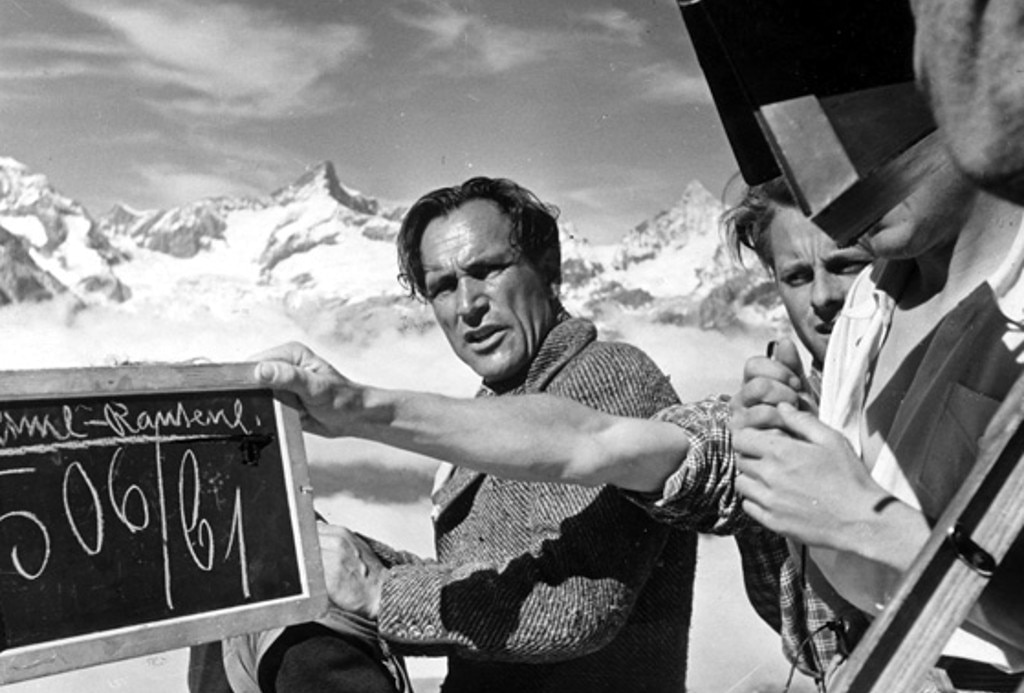
The story takes a decidedly melodramatic turn in the face of a fatal accident that becomes an accusation of murder fueled by jealousy and suspicion. But it's not the story that makes the film memorable. It's the dramatic alpine footage, directed by co-star Trenker, that gives the film its majesty. A real life ski champion and mountaineer turned actor and filmmaker, Trenker is responsible for the stunning footage of the Alps and the climbers on the sheer cliffs and dramatic peaks. He apprenticed with the best, having appeared in numerous German "mountain film" adventures directed by Arnold Fanck, the father of what was a thriving genre in twenties and thirties Germany. He also played opposite Leni Riefenstahl in The Holy Mountain (1926), one of the greatest films of the genre. He had even portrayed the legendary mountain guide Carrel in the 1928 German film Fight for the Matterhorn. As a filmmaker, Trenker directed, wrote and produced dozens of productions, both documentary and fiction but invariably focused on mountain sports and pursuits.
The Challenge proved to be the last directorial effort for British filmmaker Milton Rosmer, but his acting career continued through the 1950s, including performances in Carol Reed's The Stars Look Down (1940) and Michael Powell's The Small Back Room (1949). British star Robert Douglas went on to a lively Hollywood career after the war, specializing in playing aristocrats in costume pieces, before he changed careers and became a busy television director through the 1960s and 1970s.
Apart from the magnificent mountain footage, The Challenge is notable as the first British credit by Emeric Pressburger, a German-born screenwriter who had fled Nazi Germany and landed in England with other European Jews struggling to find work. While the film did little to further his reputation, it led to The Spy in Black (1939), his first collaboration with director Michael Powell. It was the beginning of one of the most successful and creative filmmaking partnerships in film history, resulting in such classics as The Life and Death of Colonel Blimp (1943), A Matter of Life and Death (1946) and The Red Shoes (1948). That makes The Challenge an auspicious English language debut for a future film legend.
Producer: Günther Stapenhorst
Director: Milton Rosmer; Luis Trenker (co-director: alpine sequences); Vincent Korda (uncredited)
Screenplay: Emeric Pressburger (screenplay); Patrick Kirwan, Milton Rosmer (scenario)
Cinematography: Albert Benitz, Georges Périnal
Art Direction: Vincent Korda, Frederic L. Pusey
Music: Allan Gray
Film Editing: E.B. Jarvis
Cast: Robert Douglas (Edward Whymper), Frank Birch (Rev. Charles Hudson), Geoffrey Wardwell (Lord Francis Douglas), Moran Caplat (Mr. Hadow), Lyonel Watts (F.K. Morris - Publisher), Luis Trenker (Jean Antoine Carrel), Mary Clare (Carrel's Mother), Fred Groves (Bruno Favre - Innkeeper), Joan Gardner (Felicitas Favre - His Daughter), Lawrence Bascomb (The Podesta - Mayor).
BW-75m.
by Sean Axmaker
For more information, read the blog entry on TCM Movie Morlocks.
The Challenge (1938)
by Sean Axmaker | June 28, 2010
SIGN UP FOR OUR NEWSLETTERS

CONNECT WITH TCM