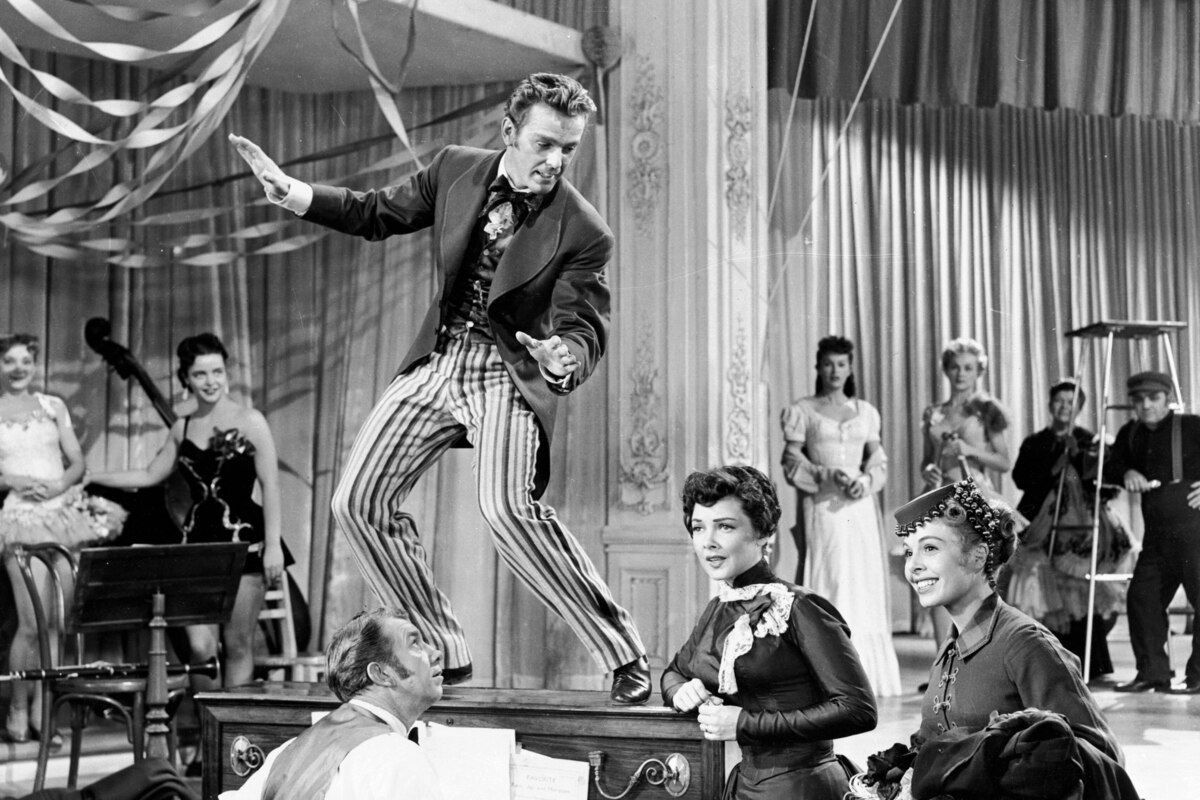
With its 1951 remake of Show Boat, MGM added color and the genius of
Arthur Freed's production unit to one of the greatest musicals of all time,
a pioneering work in the integration of song and story. The production set
new standards for on-screen opulence, including the use of the largest and
most expensive prop in film history, the 170-foot-long, 57-foot-high
Cotton Blossom paddle wheeler.
MGM bought the rights to Show Boat in 1938, two years after the
Universal version with Irene Dunne, Allan Jones, Helen Morgan and Paul
Robeson premiered. Originally, they had hoped to star their own singing
screen team, Jeanette MacDonald and Nelson Eddy, but as the box-office
returns on the pair's films waned, those plans were dropped. Producer
Arthur Freed maintained his interest in a new film version nonetheless. In
1946, MGM financed a Broadway revival of the show. Then Freed included a
lengthy medley of songs from it in his 1947 musical biography of composer
Jerome Kern, Till the Clouds Roll By. Still, it would take another
five years to get the show back on the screen.
One of the problems was the book. Freed felt that it suffered from a lack
of narrative interest. Turning to writer John Lee Mahin for help, he
finally decided that the story covered too much time. The show's lovers,
Gaylord and Magnolia, were kept apart for decades and only reunited as
senior citizens (in Edna Ferber's original novel, they never got back
together at all). Mahin restructured the story so that they were reunited
while still young enough to enjoy a long life together. He also made
Gaylord, the gambler turned actor turned gambler again, a more active,
heroic character in the mold of the roles he had written for Clark Gable in
such films as Red Dust (1932) and Test Pilot (1938).
For the leads, Freed cast Kathryn Grayson and Howard Keel, two classically
trained singers who had already established a name for themselves in MGM's
slate of musicals. To play Joe, the ship's hand who sings "Ol' Man River,"
Freed's musical assistant, Roger Edens, discovered the young classical
singer William Warfield, who had never sung a popular song before.
Originally, Freed wanted to beef up the role of Julie, the mulatto torch
singer, as a vehicle for Judy Garland. When she was fired from MGM in
1950, however, they had to look elsewhere. Studio head Dore Schary
promised the role to Dinah Shore, but Freed convinced her that the public
would never accept her as a woman who turns to prostitution. Lena Horne
was perfect for the role, but at the time her musical numbers were still
being cut from films in some southern states. Instead, director George
Sidney suggested Ava Gardner and shot a test of her performing to a
recording of Horne singing "Can't Help Lovin' Dat Man of Mine." Gardner
wasn't really interested in the role until she decided that she could sing
the songs herself. Edens coached her endlessly on the numbers, which she
recorded, imitating Horne's earlier renditions. Just for insurance, they
also recorded the numbers with Annette Warren, who had dubbed for Gardner
in the past. Julie's numbers were among the first shot for the film, and
for months executives couldn't decide whether to use Gardner's voice or the
professional singer's. Finally, after a less-than-successful preview, they
settled on Warren's vocals, which then had to be re-recorded to match
Gardner's on-screen performance. For the soundtrack album, they recorded
the tracks with Lena Horne, who was forced to imitate Gardner's
performance. Then the legal department informed the studio that they
couldn't use Gardner's name and image on the album cover without including
her on the recording. So Gardner did a new version of the songs, imitating
Horne imitating Gardner imitating Horne. With careful tweaking in the
recording studio, her vocals actually came out quite well, and she
collected a royalty on the soundtrack for the rest of her life.
Originally, the scenes involving the Cotton Blossom were to have
been shot on location on the Mississippi. When production was scheduled
for the early winter, however, designer Jack Martin Smith figured out a way to use the studio's Tarzan Jungle Lake as the river, with the Natchez port
built along its shore. He then designed the massive ship, complete with 19
1/2-foot paddle wheels and two curving staircases leading to a staging area
on the front deck, for a cost of $125,000. The ship included engines to
operate the paddles and produce enough steam to flow from the smokestacks
and power a calliope. When the smoke engines almost burned the ship down
during filming, it had to be re-constructed for an additional $67,000. As
impressive as the Cotton Blossom was, it was also the film's major
historical inaccuracy. The original show boats, which began carrying
entertainment to U.S. river towns in 1817, were actually barges without any
engines of their own. They required tugboats to pull them from town to
town. To operate paddlewheels like those on the film's Cotton
Blossom would have required massive engines that would have left no
room for the ship's indoor theatre.
Fortunately for MGM, historians represent only a fraction of the movie
audience. Show Boat brought in almost $9 million at the box office
on an investment of $2.3 million. For years, the studio maintained the
Cotton Blossom as an attraction for visitors. When owner Kirk
Kerkorian auctioned off MGM's properties and costumes in the early '70s,
the ship was sold to the Worlds of Fun amusement park in Kansas City, where
it stood in a large pond until a few years ago, when the pond was drained
and the Cotton Blossom torn apart by bulldozers. But at least the
ship lives on in screenings of Show Boat as William Warfield sings
an eternal paean to "Ol' Man River."
Producer: Arthur Freed
Director: George Sidney
Screenplay: John Lee Mahin
Based on the Musical by Jerome Kern and Oscar Hammerstein II Based on the
Novel by Edna Ferber
Cinematography: Charles Rosher
Art Direction: Cedric Gibbons, Jack Martin Smith, Edwin B. Willis
Music: Adolph Deutsch, Conrad Salinger
Principal Cast: Kathryn Grayson (Magnolia Hawks), Ava Gardner (Julie LaVerne), Howard Keel (Gaylord Ravenal), Joe E. Brown (Capt. Andy Hawks), Marge Champion (Ellie May Shipley), Gower Champion (Frank Schulz), Robert Sterling (Stephen Baker), Agnes Moorehead (Parthy Hawks), William Warfield (Joe).
C-108m. Closed captioning. Descriptive Video.
by Frank Miller
Show Boat (1951) - Show Boat (1951)
by Frank Miller | August 26, 2003
SIGN UP FOR OUR NEWSLETTERS

CONNECT WITH TCM