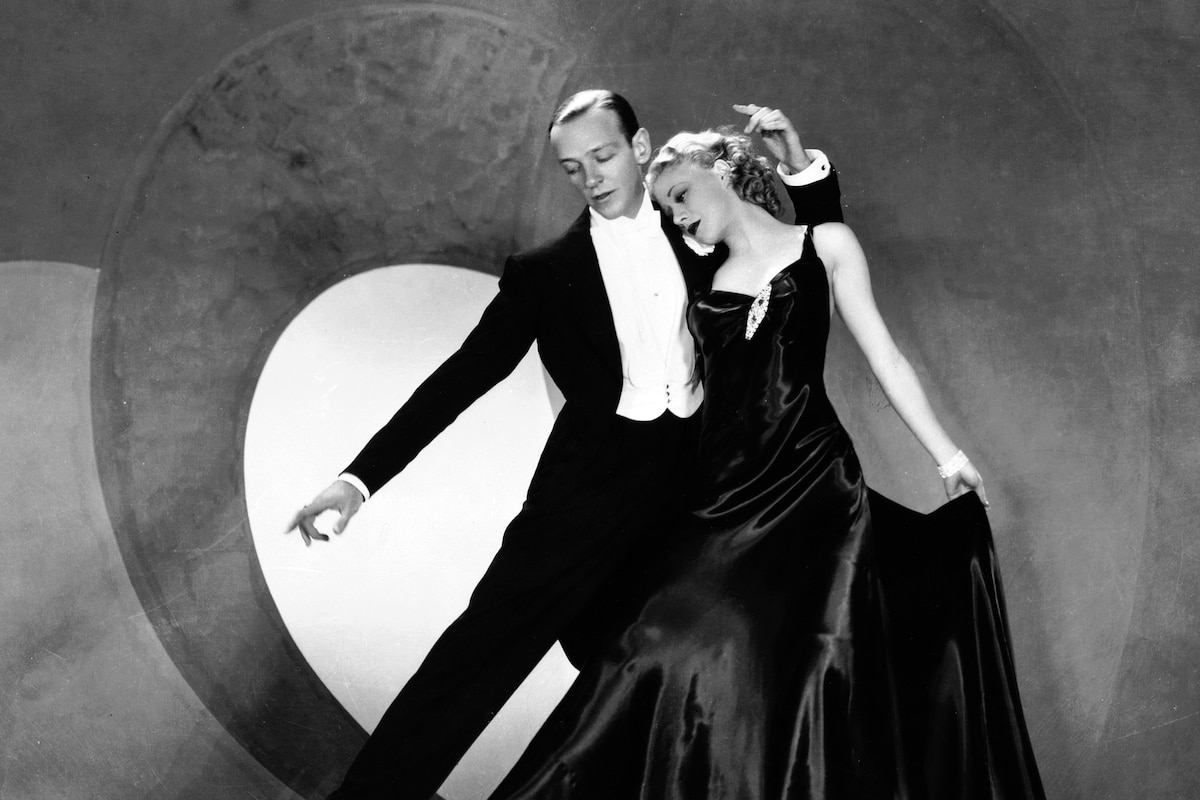
After three films together, Fred Astaire and Ginger Rogers officially
became a team in Roberta (1935), an adaptation of the hit Broadway musical. The
two had scored with a novelty number, "The Carioca," in Flying
Down to Rio (1933), in which they only played supporting roles. Then the
studio tried them out together as stars in The Gay Divorcee (1934),
adapted from Astaire's stage hit The Gay Divorce. But their rise to
become the screen's top musical duo would not be clearly established until
advanced word on that film led RKO studio head Pandro S. Berman to re-shape
Roberta to incorporate his two new stars.
Roberta had been a stage success in 1933, before the Astaire-Rogers
team was even born. In fact, Berman bought the Jerome Kern show as a
vehicle for the studio's reigning star, Irene Dunne. Despite a recent
decision to cut expenses, he outbid MGM and Paramount for the screen rights
to the tune of $65,000. Dunne was set to play a Russian princess who has
carved a new career as a fashion designer in Paris when she falls for the
bumptious American nephew of her elderly employer. With strong advance
word on The Gay Divorcee, Berman got to work developing a new
vehicle for the Astaire-Rogers team. Meanwhile, he combined two
supporting roles from the stage version of Roberta to create a
stronger part for Astaire (He combined the bandleader character originally played by Bob Hope with the dancer played on the stage by George Murphy). For Rogers, he transformed the bogus Polish countess played by Lyda Roberti from a minor romantic complication for the
leads to a new love interest for Astaire. Jane Murfin, who had crafted
many of RKO's most successful women's pictures, was assigned to shape the
romantic story, while Sam Mintz, Glenn Tryon and Allan Scott were hired to
punch up the gags. Scott would go on to contribute dialogue and scenes for the next five
Astaire-Rogers films at RKO.
The film retained four numbers from the original Jerome Kern score,
including "Smoke Gets in Your Eyes," which would provide both a vocal solo
for Dunne and a dazzling dance duet for Rogers and Astaire, and "I'll Be
Hard to Handle," a comic number that provided the dancers with their first
big number in the film. That duet was a rarity in the team's films
together. It's improvisational nature, with the two trading steps as the
band rehearses the song in the background, presented them as equally
skilled dancers, something that occurs in only one other Astaire-Rogers
musical (The Barkleys of Broadway, 1949). In most of their films
together, Astaire is always presented as the better of the two. To keep
the number's improvisational feel, they recorded the music live on film (as
opposed to pre-recording it and playing it back while shooting the sequence
without sound). Although some of the taps aren't as crisp as in other
numbers, the live sound retains Rogers' spontaneous yelps of joy as they
trade steps.
The score also included two Kern numbers not heard in the stage version. For the
fashion show, he wrote "Lovely to Look At," teaming with lyricist, Dorothy
Fields for the first time. They would win an Oscar® nomination for
Best Song and go on to several successful collaborations, including the
Oscar®-winning "The Way You Look Tonight," written for Astaire and
Rogers a year later for Swing Time. Also new to the film was "I
Won't Dance," though the number had been around for a few years.
Originally, Kern had written it with Oscar Hammerstein, Jr. for The
Three Sisters, a musical that had flopped in London. Fields supplied
new lyrics, including a reference to the earlier Astaire-Rogers dance hit,
"The Continental," and it provided Astaire with a dazzling dance
solo.
RKO produced Roberta on a lavish scale with a budget of $750,000, a
good portion of which went to the film's costumes. In addition to the
picture's climactic fashion show -- which includes a very young, very
blonde Lucille Ball in her first on-screen close-ups -- Roberta
featured a $6,000 fur coat worn by Dunne. Press releases revealed to viewers
that the star had to be followed around the lot by a fireman to protect one
highly flammable haute couture creation.
The extravagance paid off when Roberta opened at the Radio City
Music Hall to rave reviews and socko box office. But for decades, those
1935 audiences and a few art-museum patrons were the only ones lucky enough
to see the film. MGM bought re-make rights in the mid-'40s, though it took
them until 1952 to release their own version, Lovely to Look At.
The re-make stars Kathryn Grayson in Irene Dunne's role, with Red Skelton
and Ann Miller as the bandleader and his dancing girlfriend. To protect
their investment, MGM kept Roberta in the vaults for decades except
for occasional screenings at art museums. The picture was not sold to
television until the '70s.
Producer: Pandro S. Berman
Director: William A. Seiter
Screenplay: Jane Murfin, Sam Mintz, Allan Scott, Glenn Tryon
Based on the Musical by Jerome Kern and Otto Harbach and the novel Gowns
By Roberta by Alice Duer Miller
Cinematography: Edward Cronjager
Art Direction: Van Nest Polglase, Carroll Clark
Music: Max Steiner
Principal Cast: Irene Dunne (Stephanie), Fred Astaire (Huck Haines), Ginger Rogers (Countess Scharwenka/Lizzie Gatz), Randolph Scott (John Kent), Helen Westley (Roberta/Aunt Minnie), Victor Varconi (Ladislaw), Claire Dodd (Sophie), Luis Alberni (Voyda), Lucille Ball (Mannequin).
BW-106m. Closed captioning.
by Frank Miller
Roberta
by Frank Miller | July 30, 2003
SIGN UP FOR OUR NEWSLETTERS

CONNECT WITH TCM