There have been a number of films with the title Moulin Rouge, including a 1944 French release with Josephine Baker, a 1934 Hollywood comedy with Constance Bennett and Franchot Tone, and of course Baz Luhrmann's 2001 over-the-top re-imagining of the musical genre, appropriately fitted with an exclamation point at the end of the title. But although the latter film had John Leguizamo in a supporting role as a cartoonish Toulouse-Lautrec, John Huston's 1952 release is the only one to delve into the life of the famous French painter and chronicler of the Parisian belle époque. Not that the facts of this bio-pic are to be taken as the gospel truth. Moulin Rouge (1953) is based on Pierre LaMure's fictionalized account of the life of Henri de Toulouse-Lautrec, descendent of a prominent old aristocratic family who in the mid-1880s moved to Montmartre, the center of Parisian bohemian life. In the few years left in his short life (he died at 36 in 1901), the artist painted the world of the cabarets, dance halls, and brothels; pioneered the art of poster design; and became a fixture of local night life, particularly at the nightclub of the title, which opened in 1889 and immediately became one of the city's most popular and scandalous entertainment spots.
Director-screenwriter Huston was interested in making a film of Toulouse-Lautrec's life, and contacted Jose Ferrer about playing the lead. He was surprised to find Ferrer had already optioned the rights to La Mure's novel to develop it into a play. The two worked together to create a fuller, more complex portrait than the character in La Mure's book, but some of the more flamboyant, outrageous aspects of the artist's life are absent in Huston's screen version.
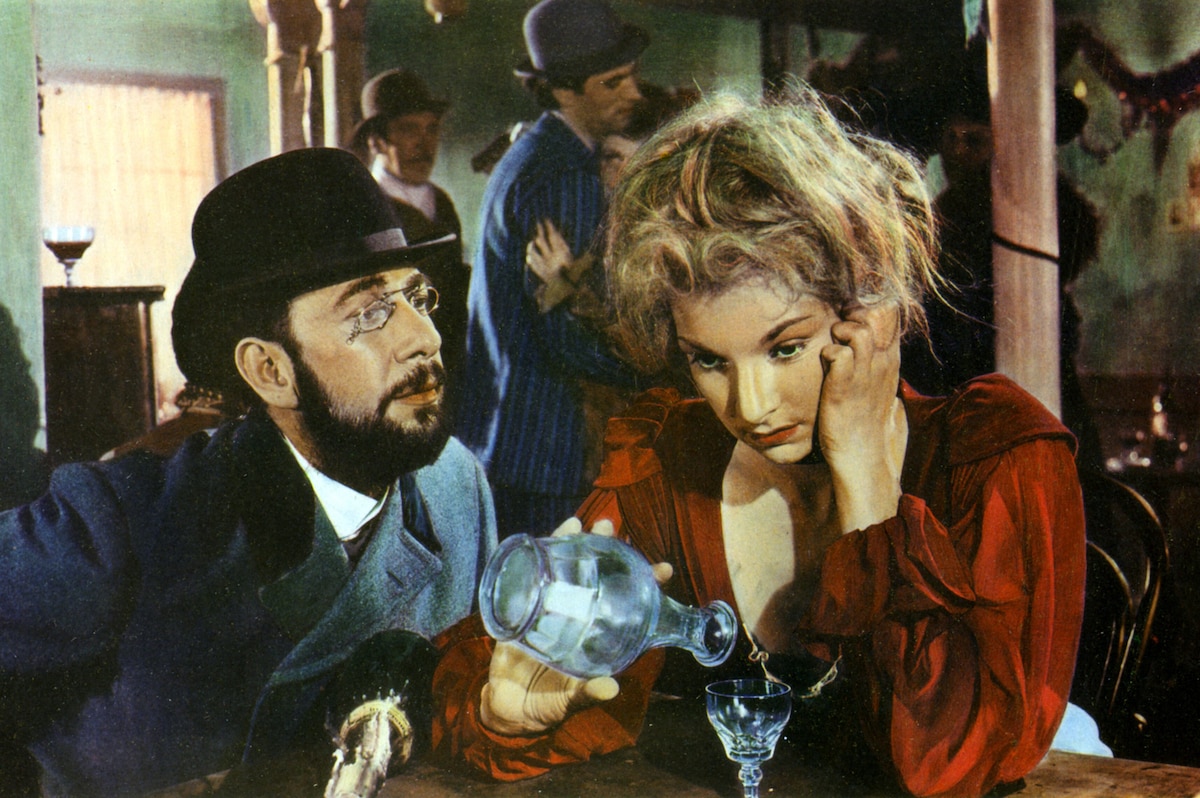
What is more outstanding than any question of biographical verisimilitude is the way Huston and his crew evoked the period and Toulouse-Lautrec's art through costumes and cinematography. Huston claimed to have spent a year in Paris as a starving young artist (an assertion open to dispute) and he certainly had a deep interest in painting. In fact, it may have been his enthusiasm to recreate the look and feel of Toulouse-Lautrec's paintings on screen that attracted him to this project more than the details of his subject's life. With the help of Life magazine photographer Eliot Elisofon as special color consultant, director of photography Oswald Morris worked at capturing the quality of the artist's work through the use of color filters and blue-green backgrounds splashed with orange, yellow, and pink. Huston found Technicolor too sharp in its contrasts, so he had Morris use an array of spotlights in a wide range of colors to tint each shadow and highlight. Morris' critically praised work was overlooked in the film's seven Oscar nominations, but Marcel Vertes' costume design and Paul Sheriff's art direction (along with Vertes' set decoration) brought home awards. Other nominations included Best Picture, Best Director, Best Actor (Ferrer), Best Supporting Actress (French ballerina Colette Marchand in the role of a prostitute who almost drives Toulouse-Lautrec to suicide), and Best Editing (Ralph Kemplen).
The production was very grueling for Ferrer, who went to great pains to achieve a physical likeness to the character. Toulouse-Lautrec suffered from a congenital bone disease that stunted his growth to under five feet - the top of his body developed into adulthood but his legs never did. To create the illusion that the nearly six-foot actor was tiny, Ferrer bent his knees and relaxed his legs for medium and close shots. In several sequences requiring full body shots, the actor had his legs painfully strapped behind him as he walked on his knees. At such times, frequent breaks would have to be taken in filming while Ferrer had his legs massaged extensively to restore circulation.
Huston, who had a reputation for being a heavy drinker, a womanizer, and often difficult to get along with, drove his actors hard, pushing them to their limits on this production. A physically daring, driven man, he was quite different than the more cerebral Ferrer, and the two were rumored to be at odds through much of the shoot. Typical of the way he was accused of abusing people to the breaking point to test their worthiness, Huston forced Marchand to play a scene over and over again in a too-tight corset, driving her to near hysterics over her inability to breathe properly. When he was satisfied he had the scene he wanted, he hugged the young woman and presented her with flowers and champagne. But there was very little even Huston could do with Zsa Zsa Gabor, who was cast in the part of singer Jane Avril, one of Toulouse-Lautrec's most famous subjects. Huston wanted to replace her, but it was decided to keep her since her singing voice was dubbed anyway. Not much could be done about her acting, however, and the director resorted to getting Marchand to show her how to walk because "she moved like a tank," according to cinematographer Morris. At one point, Huston threatened her by saying, "If you go dead again on the end of a line, I'll shoot you." Oddly enough, the two eventually became friendly because of their mutual love of horses.
Look for future British horror movie stars Peter Cushing and Christopher Lee in small roles. Lee has an uncredited bit as famed pointillist painter Georges Seurat.
Director: John Huston
Producer: John Huston
Screenplay: John Huston, Anthony Veiller, based on the novel by Pierre La Mure
Cinematography: Oswald Morris
Editing: Ralph Kemplen
Art Direction: Paul Sheriff
Original Music: Georges Auric
Cast: Jose Ferrer (Toulouse-Lautrec), Zsa Zsa Gabor (Jane Avril), Suzanne Flon (Myriamme Hirman), Colette Marchand (Marie Charlet), Theodore Bikel (Milo IV, King of Serbia), Peter Cushing (Marcel de la Voisier), Jill Bennett (Sarah), Claude Nollier (Countess de Toulouse-Lautrec), Katherine Kath (La Goulue).
C-120m.
By Rob Nixon
Moulin Rouge (1952)
by Rob Nixon | August 07, 2008
SIGN UP FOR OUR NEWSLETTERS

CONNECT WITH TCM