Ingmar Bergman famously said his films were about Gods silence. In Bergmans The Virgin Spring (1960), Gods silence is resounding. It and Bergmans more celebrated The Seventh Seal (1957) are his only films with medieval settings, The Seventh Seal having been drawn from a series of fierce primitive paintings in an ancient Swedish church, The Virgin Spring from a grim 14th century ballad about a spring gushing spontaneously from where a murdered farmers daughter, on her way to church, lies lifeless in a forest after two goatherds rape and kill her.
At the center of the grandly stylized The Seventh Seal is Max von Sydows knight, looking for answers to lifes big questions, playing chess against a robed, hooded Death. While not naturalistic in fact, its highly ritualized, its characters emblematic The Virgin Spring is literally earthier, its characters mired in a brutal life centered on a muddy barnyard and a nearby forest bearing a surprising resemblance to the one in Kurosawas Rashomon (1950). Both locations look more like sets than the real thing, although Von Sydow looks convincing as the roughly clad farmer working alongside his own laborers. His iron version of Christianity, we learn, does not involve turning the other cheek.
The film begins, however, with the farmers pregnant, unmarried drudge of a stepdaughter, fanning flames and invoking the pagan god, Odin. Gunnel Lindbloms Ingeri, as dark and unkempt as her sister is blond, radiant, and spoiled, calls down the forces of the older god upon the favored head of her princess of a sister. It cannot be an accident that the dark, destructive forces of Odin seem in the end to prevail and convey Bergmans own skepticism in no uncertain terms. What is a spring against the life taken from an innocent girl whose worst crime is that shes spoiled, smug and in todays parlance, a bit full of herself as she rides on horseback to town, a virgin bearing candles to honor the Virgin Mary? Birgitta Valberg is as fair and beaming as Lindbloms Ingeri is grimy and resentful. But we identify with characters through their flaws, and so it is Ingeri whos most approachable.
If Lindbloms Ingeri were less cowardly and superstitious, less fearful and recessive, shed steal the movie simply because her unhappy soul is the films most intense, the one who comes closest to breaking beyond the narrow schema of the characters. But shes not fierce enough. In fact, she cringes at the croak of the black crow seen at the beginning and end of the film. Yet Valbergs Mareta is simply too blandly pretty to register strongly enough or work her way into our hearts. Still, she doesnt deserve what befalls her only because she has led a sheltered life, one that has given rise to a naiveté that kills her after she stops to share her lunch with two hungry itinerant goatherds and their adolescent brother.
The rape scene was graphic enough to be controversial in its time. But it has integrity. How can you sugarcoat or soft-pedal so heinous an act, even though Bergman makes it seem a crime of opportunity rather than premeditation, and has the boy throw up after he sees whats happened? (Ingeri, who also witnesses it all, drops the rock she had picked up to throw at the men, and stands frozen in inaction, clearly not happy that her prayer to Odin has been answered so fully.) Fearful, as the consequences of their deed sink in, the two older men flee, dragging the boy along, but not before stripping their victim of her rich garments. So far the score is Pagans 1, Christians 0.
Then comes retribution, inexorably, as unsparingly as the initial crime. The criminals stumble to the edge of the forest and, as night approaches, arrive at the farm, not knowing its where the girl lived. Theyre taken in, offered hospitality, and just before they bed down for the night in an outbuilding, the older one who can talk (his adult sibling is mute) offers to sell the murdered girls garments to the farmers wife who he doesnt realize is his victims mother. She puts him off until morning, saying she must ask her husband. Once alone, the composure she maintained while in the killers presence crumbles. She shows her husband the garments. He grows steely, locks the sleeping wanderers in by placing a heavy timber across the door from the outside, and goes to work.
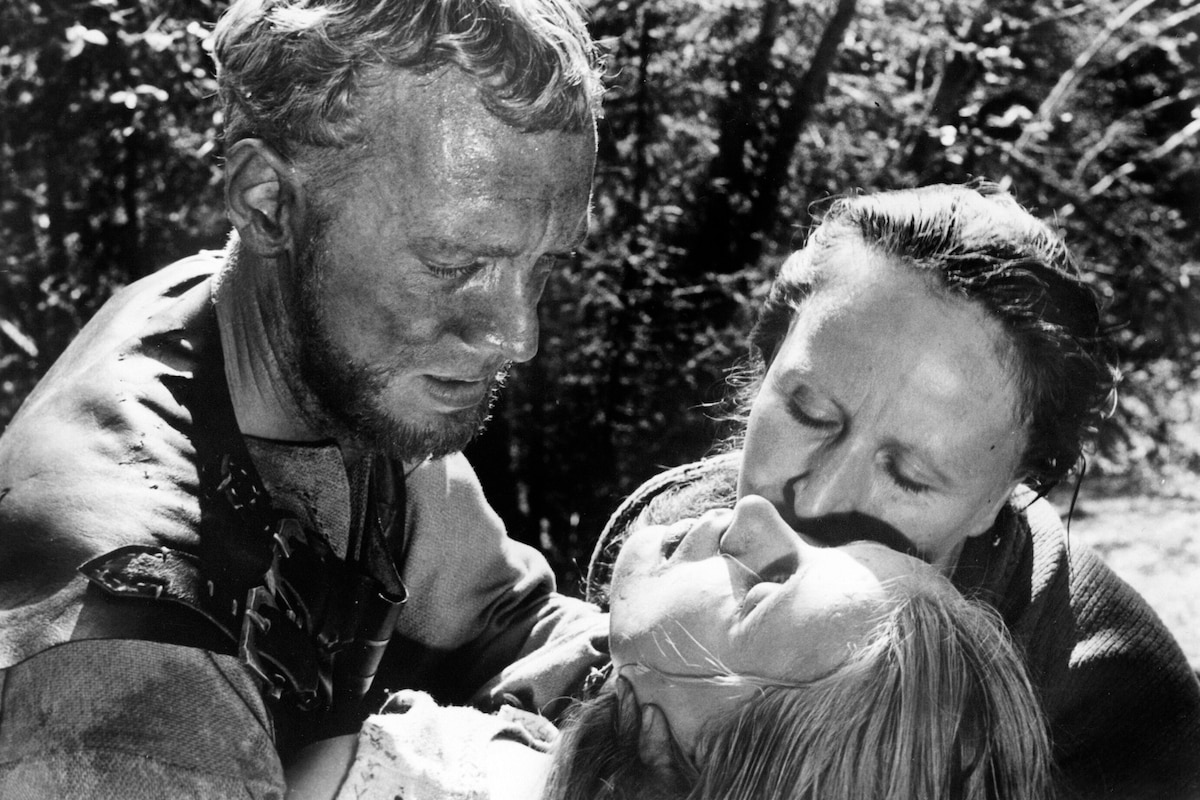
Ingeri crumbles, confesses her ill will and failure to attempt to rescue Mareta. Herr Tore, the father, appears not to hear her, doesnt react. Instead, he asks her to prepare a sauna and get him his butcher knife. Yanking a birch tree out of the earth, and stripping it of some branches, he bathes ritually in the sauna, dons a leather tunic, and methodically sets about his task, much as he might slaughter livestock. His daughters violators dont stand a chance. At close quarters, he butchers the two men and throws the boy against a wall, killing him, too.
In Bergmans first full-blown collaboration with Sven Nykvist, who was to become his steady cameraman, death is accompanied by an almost claustrophobic rendering of the death chamber, one of the farms work spaces with its pots, fires, pole propping up a roof window through which smoke leaves as swiftly as life departs the killers. None of the panoramic vistas of The Seventh Seal here, nothing picturesque. This is death in a cramped, domestic space. Its death in your face, stylized as the rendering of it may be. If the interaction between Death and the anguished knight in The Seventh Seal suggests a debate between theologians, death here is brutish and visceral.
Does the vengeance even the score to Pagans 1, Christians 1? Several things suggest not, despite Bergman stacking the deck a bit by replacing the incidental music played by a flute with an almost Hollywood-like hymn-singing choir at the end. The avenging father, having gone to retrieve his murdered daughters corpse, cries out, accusingly, to God: You see it, God. You allowed it. I dont understand you. We break the connection with him, and with the film, as God, given something to answer for, doesnt or, rather, answers in His inscrutable way, and is let off the hook. Christianity fails to distinguish itself from the old pagan code, even when the vengeful father adds, unconvincingly: Yet I still ask your forgiveness. He then asks God to cleanse his bloody hands and his sins, and promises to build a church. At which point, a spring gushes from the ground where the dead girls head had lain.
As filmmaking, The Virgin Spring is more than resourceful, as its low budget dictated it had to be. With the actors striding unswervingly through their preordained, emblematic roles in this morality play, its accomplished, and Nykvists black and white cinematography adds a stark visual power that color never could provide. But the Christianity celebrated by the film is much more Old Testament than New. And paganism surrounds it as the dark forest surrounds the cultivated land.
Producer: Ingmar Bergman, Allan Ekelund (producer uncredited)
Director: Ingmar Bergman
Screenplay: Ulla Isaksson
Cinematography: Sven Nykvist
Music: Erik Nordgren
Film Editing: Oscar Rosander
Cast: Max von Sydow (Töre), Birgitta Valberg (Märeta), Gunnel Lindblom (Ingeri), Birgitta Pettersson (Karin), Axel Düberg (Thin Herdsman), Tor Isedal (Mute Herdsman), Allan Edwall (Beggar), Ove Porath (Boy), Axel Slangus (Bridge Keeper), Gudrun Brost (Frida).
BW-89m.
by Jay Carr
Sources:
Bergman on Bergman, by Ingmar Bergman, Simon & Schuster
Images: My Life in Films, by Ingmar Bergman, Arcade
Ingmar Bergman: A Critical Biography, by Peter Cowie, Limelight Editions
Magills Survey of Cinema, essay by Timothy W. Johnson, Salem Press
Filmfacts, December 9, 1960
Ingmar Bergman: An Interview, by Charles Thomas Samuels, from Essays in Criticism, edited by Stuart Kaminsky, Oxford University Press
Inside Oscar, by Mason Wiley and Damien Bona, Ballantine Books
IMDb
The Virgin Spring
by Jay Carr | June 21, 2010
SIGN UP FOR OUR NEWSLETTERS

CONNECT WITH TCM