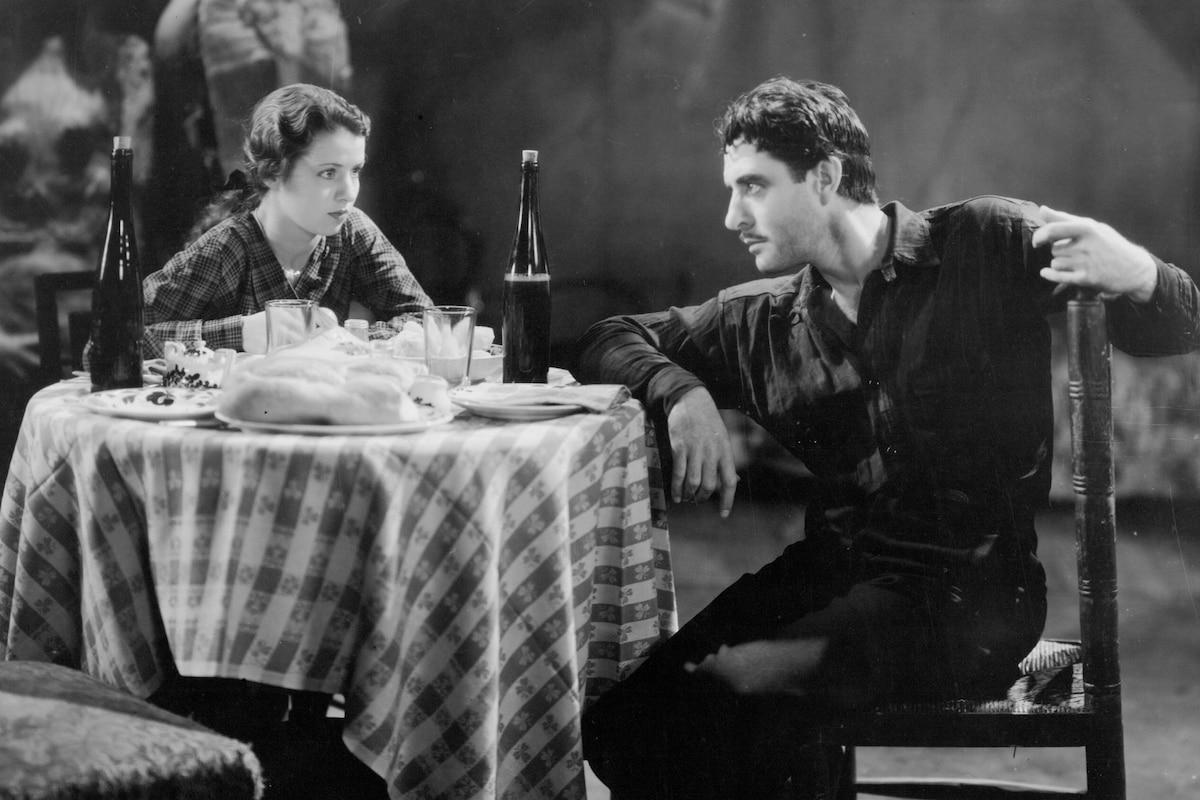
It was hoped by all concerned that the rapid downhill trajectory of John Gilbert's once stellar career would be temporarily stalled by The Phantom of Paris (1931), originally intended for Lon Chaney, which explains the title, an obvious ploy to cash in on Chaney's most famous role, The Phantom of the Opera (1925). Diagnosed with throat and lung cancer late in 1929, Chaney's rapid decline and death in August 1930 left MGM with four films in preproduction intended for one of their most important stars. The projects had to be quickly recast, and the studio decided to give this high-profile vehicle to Gilbert, whose career was faltering not, as legend once had it, because his voice was unsuitable for talkies (a misperception allegedly started by studio boss Louis B. Mayer). The debate about the star's tragic decline has gone on for years, attributed to changes in audience tastes, Gilbert's alcoholism and personal problems, and his famous falling out with Mayer that many insisted led to Mayer's deliberate sabotage of the actor's career. Whatever the reason, by the time he was cast in The Phantom of Paris, Gilbert had appeared in one bad role after another in pictures so lacking in quality and interest they would have been unthinkable only a few years earlier. But unlike a flop such as His Glorious Night (1929), the third least-expensive MGM production in the year of its release, The Phantom of Paris was given the full MGM gloss, allowing Gilbert to shine in a dashing, flamboyant role, considered one of the best of all his late films.
Based on the novel Cheri-Bibi by Gaston Leroux, who also wrote The Phantom of the Opera, the mystery-thriller centered on Leroux's eponymous hero, a famous magician and escape artist a la Houdini who falls in love with Cecile, the daughter of a nobleman. When the girl's father is murdered by her disreputable fiancé, Cheri-Bibi is accused of the murder. Using his considerable skills to escape imprisonment, he goes into hiding, eventually impersonating the real killer in a bid to clear his name and win back his love.
Gilbert was given a top-notch supporting cast. As his love interest, Leila Hyams continued her upward climb from pretty ingenue of the 1920s to in-demand actress of the early sound era. A year after the release of this picture, she would appear in two of her best roles, Freaks and Island of Lost Souls (both 1932). She was in line to play Jane in Tarzan the Ape Man (1932) but turned it down, and in 1936 she retired from acting, although she and her husband, agent Phil Berg, remained an important part of the Hollywood community most of their lives.
Lewis Stone, later famous as Judge Hardy in MGM's highly successful Andy Hardy franchise, played the police inspector, and English actor C. Aubrey Smith, who specialized in British aristocrats, was cast as Cecile's ill-fated father. Jean Hersholt, as Cheri-Bibi's faithful friend Herman, is best known today as the name attached to the film Academy's annual Humanitarian Award, but at the time he was a respected supporting actor and one of the stars of Erich Von Stroheim's notorious production of Greed (1924).
A pre-production news report noted that, in a departure from its usual procedure, MGM had begun work on a Spanish version of The Phantom of Paris prior to the English-language one. Leroux's story would be filmed again in France in 1938, under his original title, with Pierre Fresnay and Jean-Pierre Aumont, and in a 1955 French-Italian co-production.
The Phantom of Paris earned Gilbert his first good reviews in years, remarking on his elegance and grace and an "electrifying" performance. The New York Telegraph noted that, unlike previous films billed as "great comebacks" for the star, this one was "surprisingly good. No longer the great lover, Gilbert proves himself a darn good actor." It might have been the chance he needed to regain his former glory and establish himself in the sound era. He certainly had the support of many in the industry who were beginning to express openly their indignation over Mayer's vengeful and unjust treatment of Gilbert. According to the actor's daughter, Leatrice Gilbert Fountain (a leading proponent of the notion that Mayer's vendetta was the key factor in the star's failed career), there were "unconfirmable" stories going around that some of the studio's top personnel, among them art director Cedric Gibbons, refused to speak to Mayer or be in the same room with him. It was rumored that even Nicholas Schenck, head of MGM's parent company, Loews Inc. (and therefore someone with a vested interest in seeing Gilbert succeed at the box office), called Mayer and threatened to do to him what everyone felt Mayer was doing to the actor. Whatever the reason, Gilbert was given this opportunity and did his best to make the most of it. But due to the global economic crash, film attendance was down considerably, less than half what it had been a few years earlier, and The Phantom of Paris ended up almost a quarter million dollars in the red. His next assignment was the rather poorly received West of Broadway (1931). He made only four more pictures before his death of a heart attack in 1936. Only one of these could be considered a success - his small supporting role in Queen Christina (1933), opposite his co-star and romantic interest from his glory days in silents, Greta Garbo.
Director: John S. Robertson
Screenplay: Edwin Justus Mayer, John Meehan, based on the novel Cheri-Bibi by Gaston Leroux
Cinematography: Oliver T. Marsh
Editing: Jack Ogilvie
Art Direction: Cedric Gibbons
Cast: John Gilbert (Cheri-Bibi), Leila Hyams (Cecile), Lewis Stone (Costaud), Jean Hersholt (Herman), C. Aubrey Smith (Bourellier), Natalie Moorhead (Vera).
BW-74m.
by Rob Nixon
The Phantom of Paris
by Rob Nixon | June 08, 2010
SIGN UP FOR OUR NEWSLETTERS

CONNECT WITH TCM