After 40 years in show business spanning six different decades, Bob Hope showed no signs of slowing down when he appeared in I'll Take Sweden (1965), his 47th starring role in a feature film. The story of a father who moves his daughter to Sweden to prevent her from marrying a beach bum, the comedy was at once a typical Hope vehicle and a stab at updating his movie material to incorporate contemporary fads and social issues.
During the 1920s, Hope's stint in vaudeville established his comic persona, brought out his talent as an emcee, and honed his sense of timing for one-liners and verbal banter, all of which prepared him for any avenue of show business. From Broadway musicals to radio to film to television, Hope successfully adapted his comedy from one entertainment arena to another. On radio and television and in live USO shows for servicemen, Hope excelled at breezy monologues, one-liners, and ad libs that exploited his verbal dexterity. His quips were often corny or stale, but his delivery was so light and smooth that the lines were funny regardless. Hope's movies, which peaked creatively with the Road series with Bing Crosby, featured his persona as the cowardly smart-mouth, likable con man, comic dupe, or ineffective pretender who could crack wise with exquisite timing. He could banter with his costar with astonishing rapidity, or slow the momentum down with a calculated pause or double take. While Hope's talent was primarily verbal, he could milk the effect of a ridiculous costume, spryly handle a prop, take a decent pratfall, and react with just the right expression to his costars' dialogue or actions. Even the way he strolled into a scene could be funny, especially in his early films. Like his fellow actors who had also been vaudevillians or burlesque comics-Jack Benny, George Burns, Milton Berle-he knew the value of making an entrance.
Released in 1965, just after Hope's 62nd birthday, I'll Take Sweden represents the tail end of his film career, though he continued to make television specials, host the Academy Awards, and tour army bases for over two decades. Hope's films from the 1960s, which lack the magic and energy of the Road series, are universally panned by critics and film historians. Yet, they are still enjoyable to the comic's fans while serving as interesting artifacts of a remarkable social era.
In I'll Take Sweden, Hope stars as Bob Holcomb, a widower raising his teenage daughter in sunny Southern California. Tuesday Weld costars as JoJo Holcomb, a typical teen who likes to dance, listen to rock 'n' roll, and spend her days at the beach. When JoJo becomes engaged to beach bum Kenny Klinger, played by a hyperkinetic Frankie Avalon, Bob accepts a new position with his company in Sweden to keep JoJo and Kenny apart. In Sweden, JoJo matures into a sophisticate as she falls under the spell of Erik Carlson, a smooth-talking, well-dressed ladies man who uses charm, culture, and Sweden's more permissive view of sex to seduce young girls. Bob is aghast when JoJo and Erik consider going on a "pre-honeymoon" at a nearby resort without benefit of marriage. He quickly realizes that while Kenny may be a guitar-playing dropout adverse to work, he at least wants to marry JoJo before embarking on a honeymoon. Bob sends for Kenny in the hopes of distracting JoJo from Erik.
In the meantime, Bob woos interior designer Karin Granstedt, played by Dina Merrill. While pursuing Karin, he plans to take full advantage of Sweden's modern perspective on sex and relationships, not caring that his position is hypocritical when compared to his attitude toward JoJo and Erik. When JoJo discovers that her father has slipped off for a pre-honeymoon of his own, she agrees to Erik's proposition. Both couples end up at the same hotel, along with Kenny and his Swedish date, for a hectic sequence reminiscent of a French bedroom farce.
Because Hope is playing a parent in I'll Take Sweden, his character is more reserved and conservative than usual, and he also has less screen time. Yet, Bob Holcomb clearly fits into Hope's comic persona. Though not exactly a con man, Holcomb does maneuver his daughter away from Kenny, and he almost fools her into thinking he's away on business when he's really enjoying his illicit weekend with Karin. And, while Holcomb is not a comic dupe, JoJo does make a fool of him for comic effect by showing up at his hotel for her liaison with Erik. Most familiar to Hope's fans is the way in which Bob Holcomb is quick with the wise quip and comic aside. In the beginning, when Kenny shows an exasperated Bob his tiny trailer with the low ceiling, where he and JoJo plan to live, Bob grumbles, "Who designed this thing? Toulouse-Lautrec," in Hope's signature question-and-response style.
The film also includes the type of visual humor typically found in a Hope vehicle. In a dream sequence, Holcomb envisions JoJo as an impoverished, rag-wearing mother scrubbing the laundry on a washboard while lazy Kenny peters around the tiny trailer and a half-dozen dirty kids look on. Tinny piano music accompanies the sequence, which is artificially sped up, making the bit look like a silent film projected at sound speed. Elsewhere in the film, Hope - as usual- is the victim of many of the physical gags as when he lies down on Kenny's sofa bed, which quickly folds up, trapping dear old Dad inside.
I'll Take Sweden differs slightly from Bob Hope's usual film fare because of the topical nature of the content, particularly the focus on premarital sex. By the early 1960s, the Production Code had lost its control over onscreen morality just as the social mores of the era were changing as the result of the birth control pill and other influences. Youth-oriented movies from the first half of the decade were obsessed with the moral quandary of premarital sex. From Where the Boys Are (1960) to Palm Springs Weekend (1963), female characters debated on whether to give in to the boys, or hang onto being a good girl. I'll Take Sweden folds this issue neatly into the comic plotline via JoJo and Erik while pointing out the hypocrisy of a bed-hopping older generation too quick to condemn the changing morality (Bob and Karin). The subtext suggests that changing mores or not, children still model their behavior after their parents.
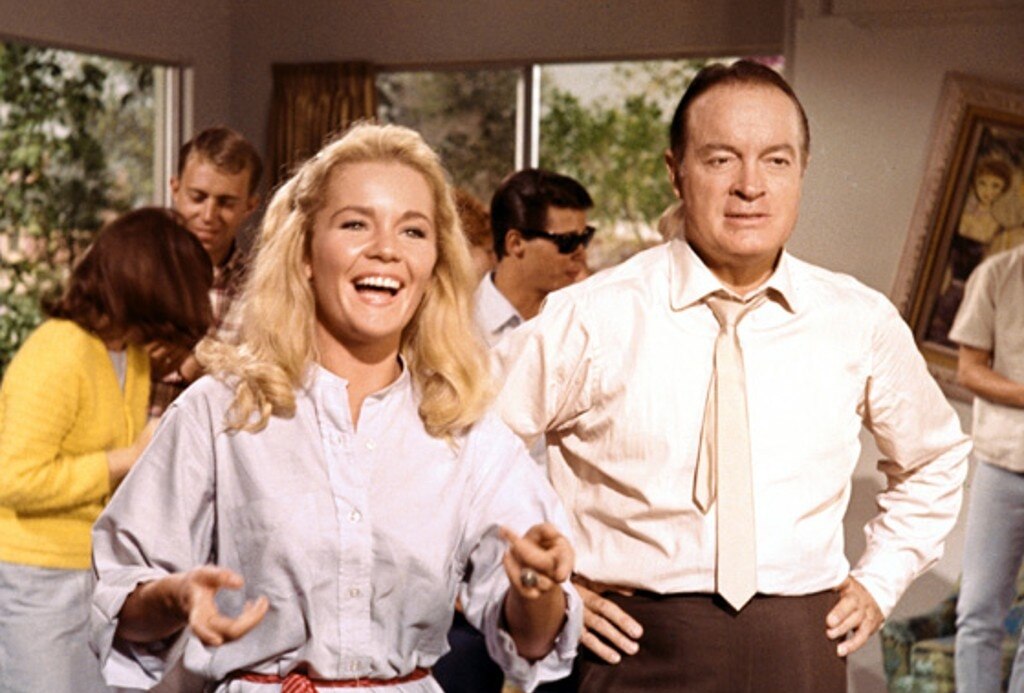
In hindsight, several critics who reviewed the DVD release of I'll Take Sweden referred to the story as reflective of the generation gap of the 1960s, but the movie's 1965 release date precedes the widespread adoption of that term by the mainstream public. There is no generational clash in I'll Take Sweden - only the exasperation of dealing with teenagers in a sexually active society and a parent's endurance of teen culture, which older generations generally find tasteless and alien. The latter theme has been part of youth-oriented movies since the rock 'n' roll musicals of the 1950s. In I'll Take Sweden, this idea is illustrated in the opening sequence when Bob Holcomb arrives home to find a houseful of teenagers dancing to some Hollywood executive's version of rock 'n' roll. Bob is bewildered as he watches the teens dance to a manic version of the Watusi in a spoof of the dance crazes that were part of the early 1960s. Because the viewer understands the scene through an adult's point of view, the exaggeration in the teens' music, dancing, and slang make them seem ridiculous. The exaggeration is magnified when Frankie Avalon as Kenny launches into a dismal song called "Would You Like My Last Name?" The lyrics are intentionally repetitive and vapid, and Avalon overworks the syncopation of the words in a comic imitation of Elvis Presley's original rockabilly style. While singing and banging on a guitar, he continuously shakes all over, echoing but not copying Presley's 1950s performing style. Avalon steals this send-up of contemporary music and dance crazes, which is the only scene of sustained comic energy in the entire film.
Hope prided himself on reaching out to all audiences. Whether he achieved that goal is debatable, but the casting of Avalon and Weld in this film represent Hope's desire to entertain all ages, much like his television specials included young performers such as Ann-Margret. Avalon had costarred with Annette Funicello in five Beach Party movies by the time I'll Take Sweden hit the big screen. Beach Blanket Bingo, which had been released in April 1965, was still in the theaters when I'll Take Sweden debuted. His popularity as a teen idol had probably peaked by this time, but he was still an icon of youth culture. At this time, Tuesday Weld specialized in portraying wayward teenagers or sex kittens, and in this film, her character references that image without entirely embracing it. Hope steps back in this film to let Avalon, Weld, and Jeremy Slate, who plays Erik Carlson, dominate several scenes in a bid to appeal to young viewers.
A weak screenplay by long-time Hope writers Nat Perrin, Bob Fisher, and Arthur Marx and lackluster direction by television veteran Frederick De Cordova prevent I'll Take Sweden from being a truly funny comedy. Because the storyline involves premarital sex, the potential existed for the dialogue to crackle with double meaning along the lines of French farces or bedroom comedies, but the writers apparently lacked the gift for sexual banter and double entendres. Instead, the forgettable dialogue stumbles along until Hope offers his trademark one-liners, which are fewer and farther between in this film. Likewise, the film's conclusion at the hotel, where Bob Holcomb madly dashes in and out of every room on his floor looking for JoJo, is a strong set-up for running gags or physical humor that might tease the viewer with a touch of the risqué. Instead, the methodically paced sequence lacks the energy or imagery to live up to its potential.
Bob Hope starred in five more comedies after I'll Take Sweden, ending his feature film career in 1972. By that time, Hollywood was actively recruiting a new generation of directors, stars, and screenwriters who embraced the counterculture and used popular film as a medium of personal expression and social change. It was a generation that the comedy of Bob Hope did not reach.
Producer: Alex Gottlieb, Edward Small
Director: Frederick De Cordova
Screenplay: Nat Perrin, Bob Fisher, and Arthur Marx
Cinematography: Daniel L. Fapp
Editor: Grant Whytock
Art Director: Robert Peterson
Music: Jimmie Haskell, 'By' Dunham
Cast: Bob Holcomb (Bob Hope), JoJo Holcomb (Tuesday Weld), Kenny Klinger (Frankie Avalon), Karin Granstedt (Dina Merrill), Erik Carlson (Jeremy Slate), Marti (Rosemarie Frankland), Olaf (John Qualen), Spinster (Maudie Prickett), Electra (Beverly Hills).
C-97m. Letterboxed. Closed Captioning.
by Susan Doll
I'll Take Sweden
by Susan Doll | June 08, 2010
SIGN UP FOR OUR NEWSLETTERS

CONNECT WITH TCM