RKO Pictures declared war in 1942 with the release of their film, Joan of Paris.
A tense story of downed flyers in Occupied Paris working with the Resistance to escape the Germans, the film had actually been completed before the Pearl Harbor attack of December 1941. Held on the shelf until a month after the infamous attack, the picture cleaned up with audiences already eager to see stories about World War II. It was also one of the first Hollywood films to couple its marketing campaign with the war bonds drive, with stars Paul
Henreid and Michele Morgan hawking shares in the future while they traveled
around the nation promoting their picture.
Even without its topical appeal, Joan of Paris still holds strong
fan appeal thanks to a quartet of leading performances from actors destined
for still greater things: Paul Henreid, Michele Morgan, Laird Cregar and
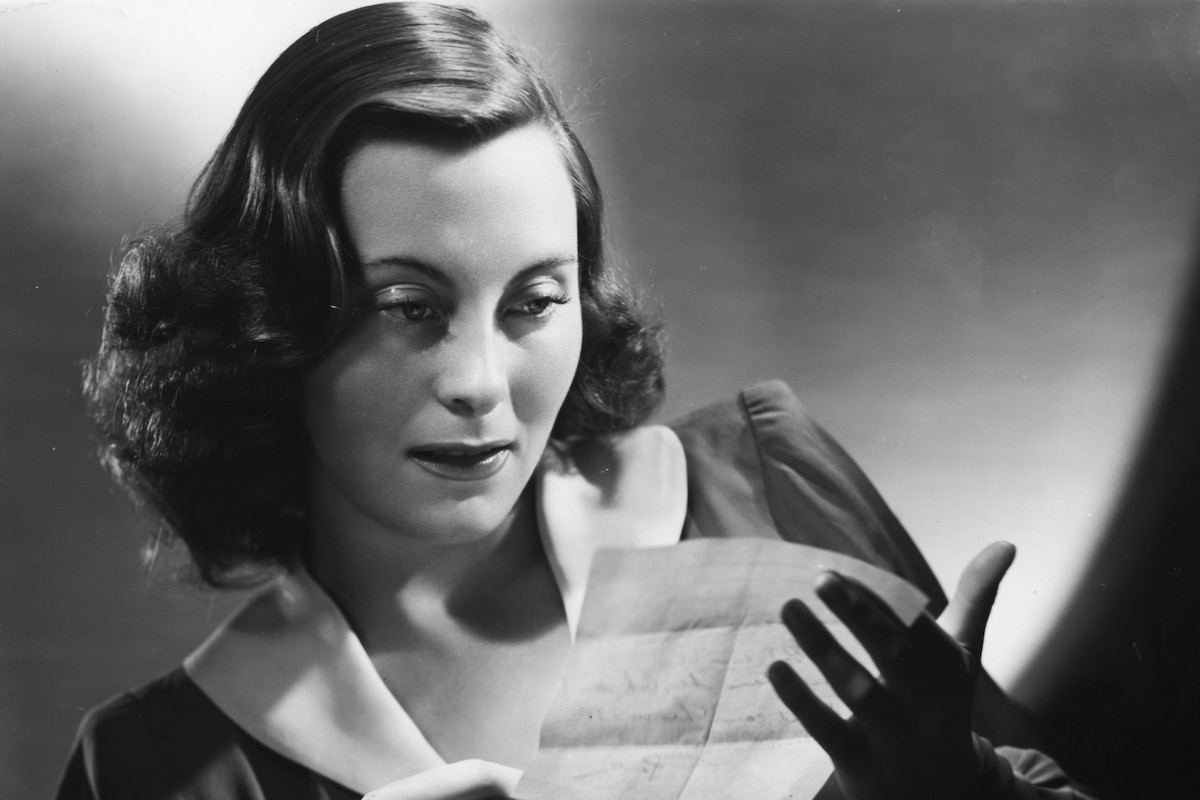
Alan Ladd. Morgan was the most established of the four, having given a
legendary performance in the French classic Port of Shadows (1938),
starring Jean Gabin. Her sultry image in that precursor of the film noir
was so strong Henreid was surprised to meet her off-screen and find her as
clean-cut and wholesome as any American bobbysoxer. Morgan spent most of
the war years in Hollywood, where she made her American debut in Joan of
Paris as the French waitress who idolizes Joan of Arc and gives her
life to rescue the downed flyers. Most of her other American films were
less notable, though she was briefly considered for the lead in
Casablanca. On her return to France, she scored a personal triumph
in La Symphonie Pastorale (1946) and got to play St. Joan for real in
Daughters of Destiny (1953).
Henreid had recently emigrated to America from his native Austria and had
scored a hit on Broadway in Elmer Rice's play Flight to the West.
That brought him a contract at RKO, which was supposed to start with a
co-starring role opposite Ginger Rogers, but when she saw the script, the
film was cancelled. Instead, he made his U.S. debut in Joan of
Paris. From the start, he never quite fit in with the Hollywood
publicity machine. The studio thought his real name, Paul von Hernreid,
too long and Germanic and wanted him to change it. He agreed to drop the
"von," but balked when they wanted him to change his last name to "Hammond"
or "Henry." Finally, they agreed to simplify the spelling to "Henreid,"
the name he bore as a star. Then the publicists wanted him to pretend not
to be married so they could send him out on arranged dates with Hollywood
glamour girls and turn him into a matinee idol. Instead of outright
refusing, his wife suggested that they'd have to pay her a salary equal to
his so she could hire hot young actors to take her out on dates, too. As a
result, Henreid rose to stardom as a married man - though not at RKO. After
the success of Joan of Paris, he moved to Warner Bros., where he hit
pay dirt making love to Bette Davis in Now, Voyager (later in
1942).
Lower down in the cast list were two American actors playing their best
roles yet in Joan of Paris. Portly character actor Laird Cregar,
cast as the Nazi agent dogging Henreid's tail, had only been in Hollywood
two years. Alan Ladd had been around for a decade and though his wife,
actress-turned-agent Sue Carol, had gotten his freelance fee up to $750 per
week, he had yet to get a studio behind him. His role as the flyer who
dies in a sewer while priest Thomas Mitchell recites the Lord's Prayer
changed all that. Reports as to the scene's immediate impact vary: some
say there wasn't a dry eye on the set; Henreid and director Robert
Stevenson thought he played the whole thing with a one-note glassy stare.
But the scene captured solid reviews and had fans demanding to see more of
him. RKO offered the actor a contract at $400 a week. By that time,
however, Paramount had tested him for the role of a paid killer in This
Gun for Hire (1942). Although they were only offering $300 a week, Carol and
Ladd chose the Paramount offer, knowing the film would make him a star
(which it did). She later said that she would have made him do the picture
for free if necessary. After This Gun for Hire scored a hit, RKO
re-issued Joan of Paris, with Ladd advertised as the star.
This Gun for Hire would be a breakthrough for Cregar as well, who
won his villainous role in that film on the strength of his performance in
Joan of Paris. It would lead to his typecasting as rotund crooks
and psychopaths for five years. Then, in an effort to make himself a
leading man, Cregar went on a severe crash diet that sent him into an early grave at the age of
28, proving that the quest for fame can sometimes be hazardous to your health.
Producer: David Hempstead
Director: Robert Stevenson
Screenplay: Charles Bennett & Ellis St. Joseph
Based on a story by Jacques Thery & Georges Kessel
Cinematography: Russell Metty
Art Direction: Albert S. D'Agostino, Carroll Clark
Music: Roy Webb
Principal Cast: Paul Henreid (Paul Lavallier), Michele Morgan (Joan),
Thomas Mitchell (Father Antoine), Laird Cregar (Herr Funk), May Robson
(Mlle. Rosay), Alan Ladd (Baby), Alexander Granach (Gestapo Agent).
BW-92m. Closed captioning.
By Frank Miller
Joan of Paris
by Frank Miller | February 26, 2003
SIGN UP FOR OUR NEWSLETTERS

CONNECT WITH TCM