The Day I Became a Woman, an Iranian movie that played at festivals in 2000 and opened commercially the following year, was the first feature directed
by Marzieh Meshkini, the wife of master filmmaker Mohsen Makhmalbaf, who wrote the screenplay. It's a portmanteau film telling three consecutive stories,
each named for its female protagonist. The stories are so complementary in setting, subject, and theme that despite their many differences they gracefully
merge into a single cinematic experience. Kudos to Olive Films for making it available on DVD, with an audio commentary by film programmer and professor
Richard Peña. (There's also a text essay hy Shirin Neshat, but I couldn't access it on my Mac.)
All three segments of The Day I Became a Woman take place on Kish Island, located in the Persian Gulf off Iran's south coast. Kish has been promoted
as a resort destination since the late 1990s, although you wouldn't guess that from the movie's frequently drab locations. The local population is ethnically
and racially diverse, and speaks a dialect of Farsi that Iranians from other regions find difficult to understand; according to Peña's lively commentary, the
island seems almost as culturally exotic to average Middle Eastern visitors as to moviegoers in other parts of the world. Meshkini makes good use of three
very different locales, but she is less interested in the island's geography than in the conflicts between tradition and modernity that confront Iranian
women at the beginning of the twenty-first century.
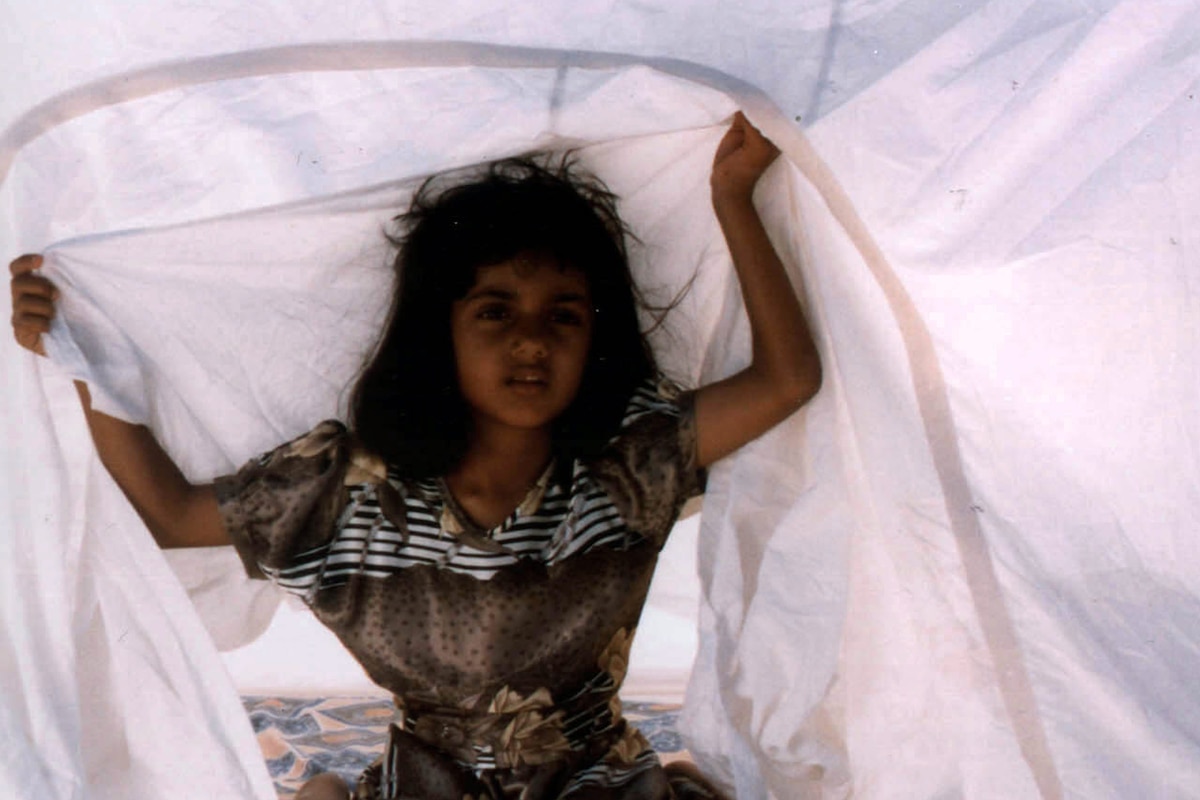
"Hava," the first story, is the one that relates most literally to the film's title. It's about a little girl of that name on her ninth birthday, which is
when she officially becomes an adult according to local Islamic tradition. From this day forward she will have to wear a chador, limit her contact with
males, and submit to many other rules and restrictions. Hava has a lawyerly streak in her personality, though. When her mother and grandmother say she can no
longer visit her favorite playmate when she feels like it, she's clever enough to point out that she was born in the afternoon, and since it's still morning,
she's entitled to visit him one last time.
Equipped with a stick to use as a sundial, Hava embarks on her final brief period of childhood freedom, visiting a black boy she enjoys playing with and
talking to a couple of other kids as well, giving them her headscarf in return for a toy. When the stick's shadow vanishes she wraps herself in a chador and
marches obediently back home, leaving viewers in more modern cultures to hope that her argumentative skills will resurface in later life, allowing her to
question perhaps even overcome the system to which she now must acquiesce. The end of the story returns to the boys who have her scarf, and we see them
using it as the sail for an oil-drum boat that floats them onto the sea. Meshkini has shot and edited this episode in the no-frills realist style familiar in
movies by Abbas Kiarostami, Jafar Panahi, and other Iranian directors who have made sensitive films about children.
"Ahoo," the second segment, is the most cinematically stunning. Unlike the first story, which was shot mostly from fixed camera positions, this one keeps the
camera in almost constant motion, which is entirely appropriate, since all of the action takes place during a women's bicycle race down a deserted stretch of
seaside highway. The race is already in progress when the story opens, and Ahoo is vigorously pedaling amid many other women, all wearing chadors and
focusing intently on the road and their competitors. It's exhilarating to watch, but a change occurs when Ahoo's husband suddenly turns up on horseback,
shouting that he'll divorce her if she doesn't come home and attend to her wifely chores. Ahoo doesn't respond or even slow down. Then a churchman arrives,
shouting that bicycles are "the devil's mounts" and declaring her a sinner if she doesn't hop off on the spot. Ahoo pedals on. Representatives of her clan
receive the same treatment, and she keeps on racing until her brothers appear, carrying a family power she's unable to ignore. She has no choice now but to
stop. The camera keeps up its pace, however, picking out another cyclist and zooming along with her, looking back at Ahoo and her brothers until they're lost
in the distance.
And there the story ends. Who are these women? What kind of race is it? What happens to Ahoo once she's off her bike? We never learn these things, and the
ambiguity makes this episode the most haunting in the film. It's also the most brilliantly crafted, with dynamic cinematography and evocative sound editing
that alternates among the race, the roadside, and the sea.
"Hoora," the third story, has a surrealistic tinge recalling movies by Federico Fellini, Jacques Tati, and others who have explored the bizarre sides of
modern life. The title character is an elderly woman who arrives in Kish's upscale shopping district with a good deal of cash, a plan to buy all sorts of
things, and strings tied onto her fingers as a sort of shopping list. Helped by local children, she purchases appliances, furniture, and the like, explaining
only that she's never owned these things before and has decided she wants them. Then she has the kids bring the items to the beach and set them up so she can
check them out.
Again the tale is ambiguous: Who is the ancient lady? What will she do with all these things? How are the electrical appliances able to work in the middle of
a beach? But hints of social satire shine through the story's magic realism. Meshkini and Makhmalbaf are poking fun at contemporary consumerism as a
longtime center for international trade, Kish is a good location for this and smiling at confusions that arise when traditional Middle Eastern values
collide with modern Western-style commercialism. How will this culture clash eventually be resolved? Nobody knows, so the movie ends on the most ambiguous
note of all, as the children float Hoora's new possessions and Hoora herself toward a distant ship, using small oil-drum boats just like the one Ahoo's
friend had at the end of the first episode.
The full ingenuity of The Day I Became a Woman becomes clear as Hoora's story unfolds. Her name holds a clue to the unity of the three tales: Hava +
Ahoo = Hoora. Other correspondences also enter the picture. Hoora reminisces about how a "witch" kept her away from a black person when she was child, and
that her life could have been different if this hadn't happened; perhaps this refers to Hava's visits with black boys in the first episode. Two young women
who were briefly glimpsed during the bicycle race come to the beach and tell how Ahoo had to stop riding against her will; but we still don't learn what
ultimately happened to Ahoo, because the women disagree as to whether she rejoined the race on someone else's bike and or was taken away by her brothers and
never seen again. In the end, The Day I Became a Woman is three stories and one, a drama and a comedy, a realistic movie with flourishes of the
fantastic. It's an outstanding film even by the lofty standards of today's Iranian cinema.
For more information about The Day I Became a Woman, visit Olive Films. To order The Day I Became a Woman, go to
TCM Shopping.
by David Sterritt
The Day I Became a Woman - Iranian Filmmaker Marziyeh Meshkini's Acclaimed 2000 Feature
by David Sterritt | May 05, 2010
SIGN UP FOR OUR NEWSLETTERS

CONNECT WITH TCM