Marion Hargrove's bestselling memoir of adjusting to army life during World War II,
See Here Private Hargrove (1942), had been made into a 1942 film and inspired a
sequel. After the war, Hargrove had become a screenwriter, and in the mid-1950s, Jack
Warner suggested he write a film about peacetime army draftees. Hargrove researched the
project, and wrote a novel that became the basis for The Girl He Left Behind
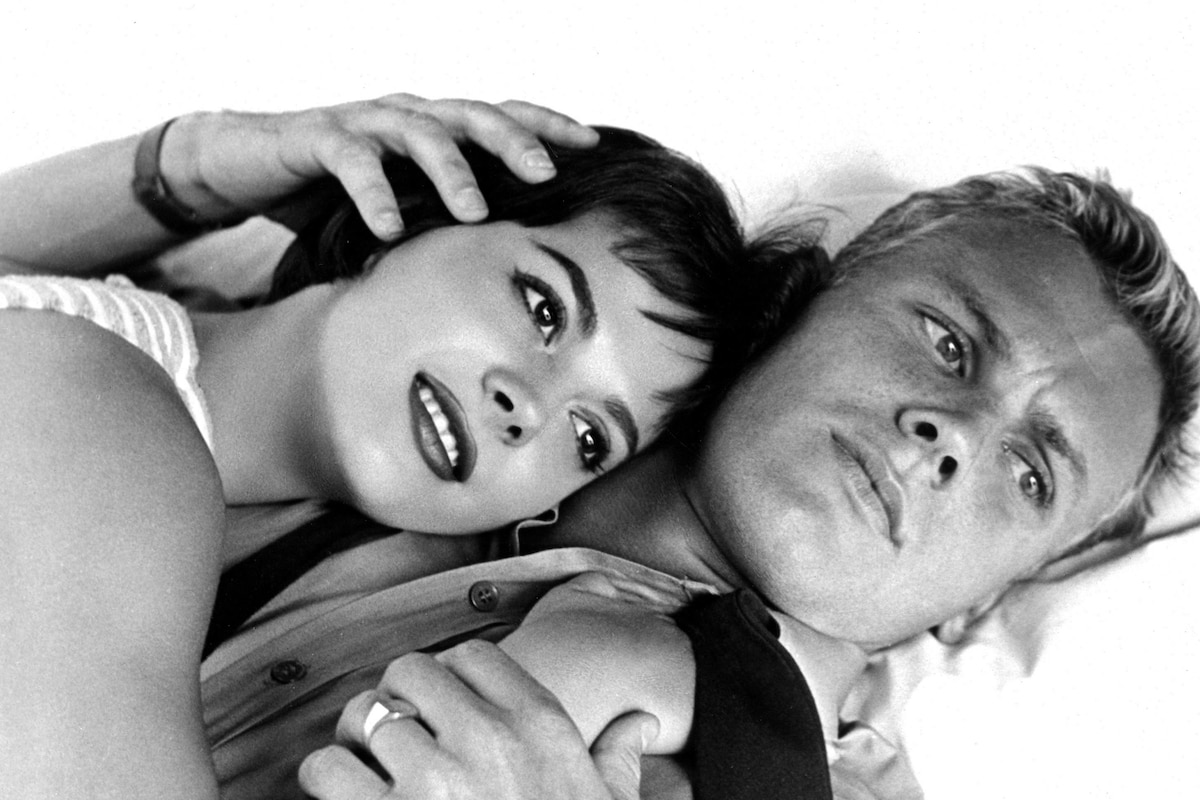
(1956). Spoiled rich college boy Andy Sheaffer (Tab Hunter), upset by his breakup with
his hard-working, down-to-earth girlfriend Susan (Natalie Wood), flunks out of school
and is drafted into the army. Predictably, after many misadventures, the army and Andy's
superior officers manage to shape him up and he salvages his relationship with
Susan.
By the mid-1950s, Warner Bros. had built up a stable of young stars who appealed to the
teenage market, and two of its brightest were Natalie Wood and Tab Hunter. Wood, who
made her screen debut at the age of four, had made the transition from child actor to
teen star quite spectacularly, in Rebel Without a Cause (1955), and segued easily
to an adult leading lady, although she was still in her teens. She was one of the
busiest young actresses on the Warner lot. Hunter had joined the Coast Guard at 15,
worked at a horse riding academy and as a competitive figure skater before he was signed
by talent agent Henry Willson. At the age of 24, he appeared in his breakthrough film,
Battle Cry (1955). That same year, both were at the peak of their popularity, and
were frequently seen together on studio-arranged dates and in fan magazine articles.
They became close friends, but their romantic interests lay elsewhere. Hunter was a
closeted homosexual, and the 17-year old Wood was frequently involved in inappropriate
relationships with older men such as Rebel Without a Cause director Nicholas Ray,
and her A Cry in the Dark (1956) co-star, Raymond Burr (himself a closeted
homosexual). She was also being pursued by Elvis Presley. Wood planned to attend the
1956 Academy Awards with Burr as her date, but the studio forced her to go with Hunter
instead, as they were being touted as a new screen team.
Warner Bros. co-starred Wood and Hunter in two 1956 films, The Burning Hills and
The Girl He Left Behind (which Wood mockingly referred to as "The Girl with the
Left Behind"), and announced plans for three additional co-starring pictures for them.
The two films opened within a month of each other and did well at the box office, but
were not popular with the critics. A Newsweek review of The Burning Hills
noted that "Warner Bros., haunted by the memories of those profitable romantic couples
of the '30s, is setting out to make the names of Natalie Wood and Tab Hunter as familiar
as Loy and Powell, Rogers and Astaire, and MacDonald and Eddy. Fortunately, both are
young enough to recover from their first joint excursion."
In a New Yorker review of The Girl He Left Behind, John McCarten wrote,
"Since Mr. Hunter discloses not one redeeming feature as an actor, the picture misses
fire when he's around." Other critics had kinder things to say about the script, and the
adept supporting cast. "Some of this nonsense is funny, especially when the sergeant
involved is a bucko played by Murray Hamilton," wrote Bosley Crowther in the New York
Times. "There are other funny people in this plaything, which we desperately trust
is a farce. They include Jim Backus as another sergeant (a sort of Mr. Magoo type) and
Alan King as an expert scrounger." But Crowther was just as hard on Hunter. " Really it
looks as though they labored to make this fellow a pluperfect punk, and Mr. Hunter does
nothing to endow him with a wisp of redeeming charm."
Stung by the criticism, Hunter refused the next film Warners had planned for him and
Wood, Bombers B-52 (1958), and chose instead to make Lafayette Escadrille
(1958) with the great director William Wellman. Sadly, the studio botched that World War
I flying epic by insisting on a happy ending. But Hunter's career continued to flourish
(for awhile, anyway), with a pop record hit, "Young Love," and the lead in the film
version of the musical Damn Yankees (1958).
Wood made Bombers B-52, and was rewarded with her dream project, Marjorie
Morningstar (1958). She became one of the top movie stars of the 1960s, starring in
West Side Story (1961) and earning Oscar® nominations for Splendor in the
Grass (1961) and Love With the Proper Stranger (1963). The "Dream Team" of
Wood and Hunter had lasted for only two films and less than one year.
Producer: Frank P. Rosenberg
Director: David Butler
Screenplay: Guy Trosper
Cinematography: Ted D. McCord
Art Direction: Stanley Fleischer
Music: Roy Webb
Film Editing: Irene Morra
Cast: Tab Hunter (Andy Sheaffer), Natalie Wood (Susan Daniels), Jessie Royce Landis
(Madeline Sheaffer), Jim Backus (Sgt. Hanna), Henry Jones (Hanson), Murray Hamilton
(Sgt. Clyde), Alan King (Maguire), James Garner (Preston), David Janssen (Capt.
Genaro).
BW-103m.
by Margarita Landazuri
The Girl He Left Behind
by Margarita Landazuri | April 07, 2010
SIGN UP FOR OUR NEWSLETTERS

CONNECT WITH TCM