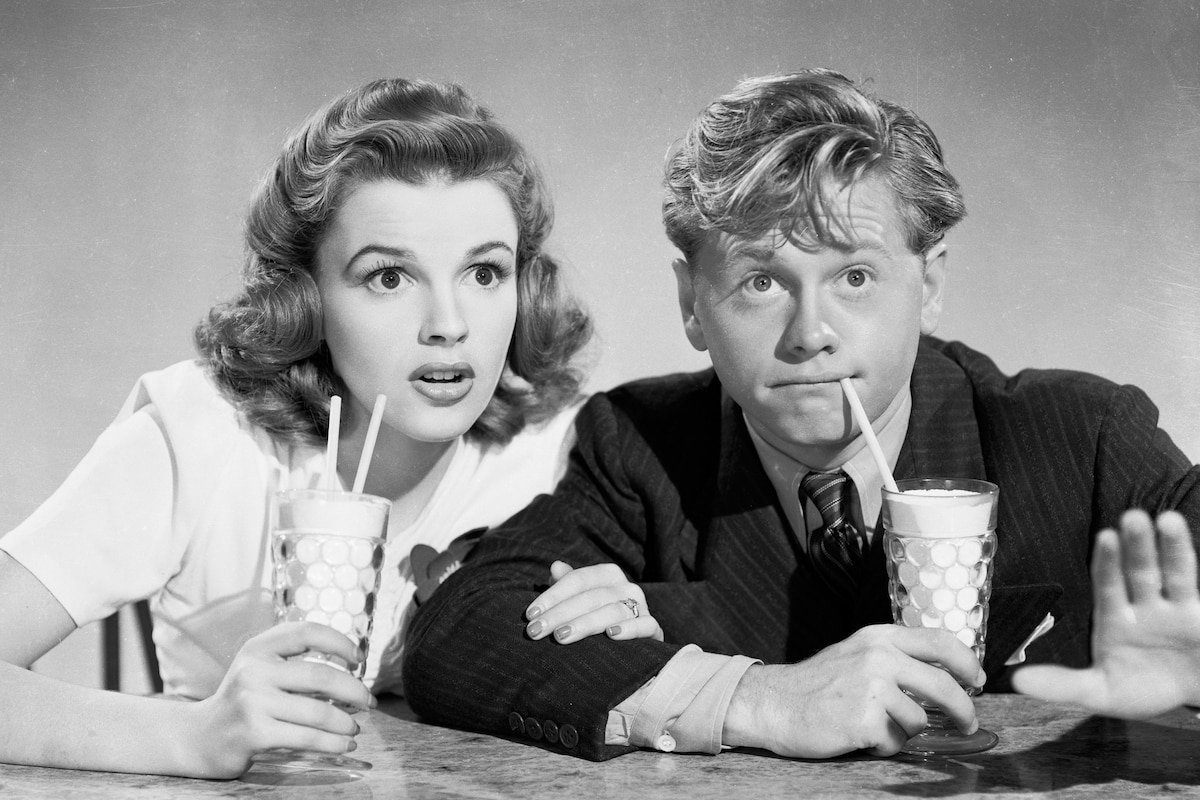
Teaming for the third time in Babes on Broadway (1941), Judy Garland, Mickey Rooney and director/choreographer Busby Berkeley brought MGM a third winner in the
spirit of their earlier hits, Babes in Arms (1939) and Strike Up the
Band (1940). Historians have dubbed the series of small-scale musicals
starring Garland and Rooney the "backyard musicals," though it must be
noted that small-scale for MGM would have been a major production for most
other studios. All three were about spirited teens putting on a show,
showcasing not just the leads but various other young entertainers coming
up through the studio system. By the third outing, however, critics were
beginning to notice that the stars were getting a bit old for this kind
of thing -- an observation borne out by the fact both were involved in
adult romances during shooting.
Producer Arthur Freed clearly wanted another Babes in Arms when he
started this film. He even chose a title that mirrored the earlier
films'. He enlisted Fred Finklehoffe, who had written the team's earlier
Strike Up the Band, to create a new story about youngsters trying to
break into show business. Then he hired Burton Lane to write music for the
songs, with his brother Ralph Freed and E.Y. Harburg as lyricists for
various numbers. Freed would write the score's biggest hit, "How About
You," but Harburg would have the more lasting relationship with Lane, with
whom he would later write the Broadway hit Finian's Rainbow. In order to introduce a wider variety of musical styles into the score, he assigned Roger Edens, Garland's longtime
mentor at MGM, to arrange a lengthy minstrel sequence with such standards
as "Swanee River" and "Waitin' for the Robert E. Lee." For that sequence
they also bought a song Harold Rome had written for the 1938 Broadway hit
Sing Out the News, "Franklin D. Roosevelt Jones." Then he asked his
newest protege, Vincente Minnelli, to conceive a sequence in which Rooney
and Garland visit an historic vaudeville house and re-create great moments
from the theatrical past. This allowed Rooney to impersonate Sir Harry
Lauder singing "She is Ma Daisy," Walter Hampden playing Cyrano de Bergerac
and George M. Cohan doing "Yankee Doodle Boy." For her part, Garland would
re-create Fay Templeton's performance of "Mary's a Grand Old Name," Blanche
Ring singing "I've Got Rings on My Fingers" and Sarah Bernhardt's
recitation of "La Marseillaise." And just to squeeze in one more number,
Rooney impersonated Carmen Miranda -- complete with platform shoes,
fruit-basket hat and fake breasts. As a result, this was one of the most
musical of all MGM's great musicals.
Berkeley kept things hopping with his elaborate staging of the production
numbers, most notably the large-scale "Hoe Down," for which co-star Ray
McDonald provided assistance. He spent nine days rehearsing and another
nine days shooting the minstrel finale at a cost of more than $100,000.
For Garland's big solo in the number, "Franklin D. Roosevelt Jones,"
Berkeley planned a single shot involving 38 separate camera moves. He
frightened the front office, however, when he spent an entire morning and
most of the afternoon rehearsing the shot. At one point, studio head Louis
B. Mayer even sent his minions to the set to see why he hadn't made a shot
yet. Berkeley got rid of them in his usual way: he climbed on the camera
boom and had technicians raise him so high the executives couldn't talk to
him, so they just left. Then he got the entire number on the first take,
releasing the company early for the day and saving the studio thousands of
dollars.
Though they were playing young show business hopefuls in Babes on
Broadway, Garland and Rooney were clearly growing up off-screen.
During the third week of filming, Garland eloped to Las Vegas with composer
David Rose. She asked for a few days off for a honeymoon, but Mayer forced
her back on set the next day, disappointed that she had deprived him of the
chance to garner publicity with a lavish wedding. At the same time, Rooney
met the actress who would become his first wife, Ava Gardner. She had just
arrived at the studio and visited the set during an introductory tour (some
sources say she has an unbilled bit). Rooney was smitten at once and asked
her for a date, but she turned him down, possibly because he was dressed in
full Carmen Miranda drag at the time.
Like many of the "backyard musicals," Babes on Broadway was filled
with talent on the rise. The partners in Rooney's dance act in the film
were Ray McDonald, who would go on to star in musicals at MGM and Universal,
and Richard Quine, who would become one of the most respected directors of
the '50s. The young Donna Reed played one of producer James Gleason's
secretaries. And in her screen debut, Margaret O'Brien turned up at an
audition as an over-dramatic child actress, a prophetic comment on her
later career as a tearful child star.
By the time Babes on Broadway was released in late 1941, critics
were tiring of the "backyard musicals," complaining that both stars needed to take on more adult roles. But audiences loved them regardless. The film premiered two weeks
after the Japanese attack on Pearl Harbor, providing audiences with an
escape to more innocent times. In addition, the picture featured Garland
singing the rousing "Chin Up, Cheerio, Carry On" to a group of British war
orphans, which boosted ticket sales in England. Babes on Broadway
made back four times its cost at the box office, spurring MGM to reunite
Rooney, Garland and Berkeley for Girl Crazy (1943) later that year.
Producer: Arthur Freed
Director: Busby Berkeley
Screenplay: Fred Finklehoffe, Elaine Ryan
Based on a story by Finklehoffe
Cinematography: Lester White
Art Direction: Cedric Gibbons
Music: Georgie Stoll, Burton Lane, Roger Edens, Harold Rome
Principal Cast: Mickey Rooney (Tommy Williams), Judy Garland (Penny
Morris), Fay Bainter (Miss Jones), Virginia Weidler (Barbara Jo), Ray
McDonald (Ray Lambert), Richard Quine (Morton Hammond), Donald Meek (Mr.
Stone), Alexander Woollcott (Woollcott), James Gleason (Thornton Reed),
Donna Reed (Secretary), Joe Yule (Mason), Margaret O'Brien (Maxine).
BW-118m. Closed captioning.
by Frank Miller
Babes on Broadway
by Frank Miller | June 24, 2003
SIGN UP FOR OUR NEWSLETTERS

CONNECT WITH TCM