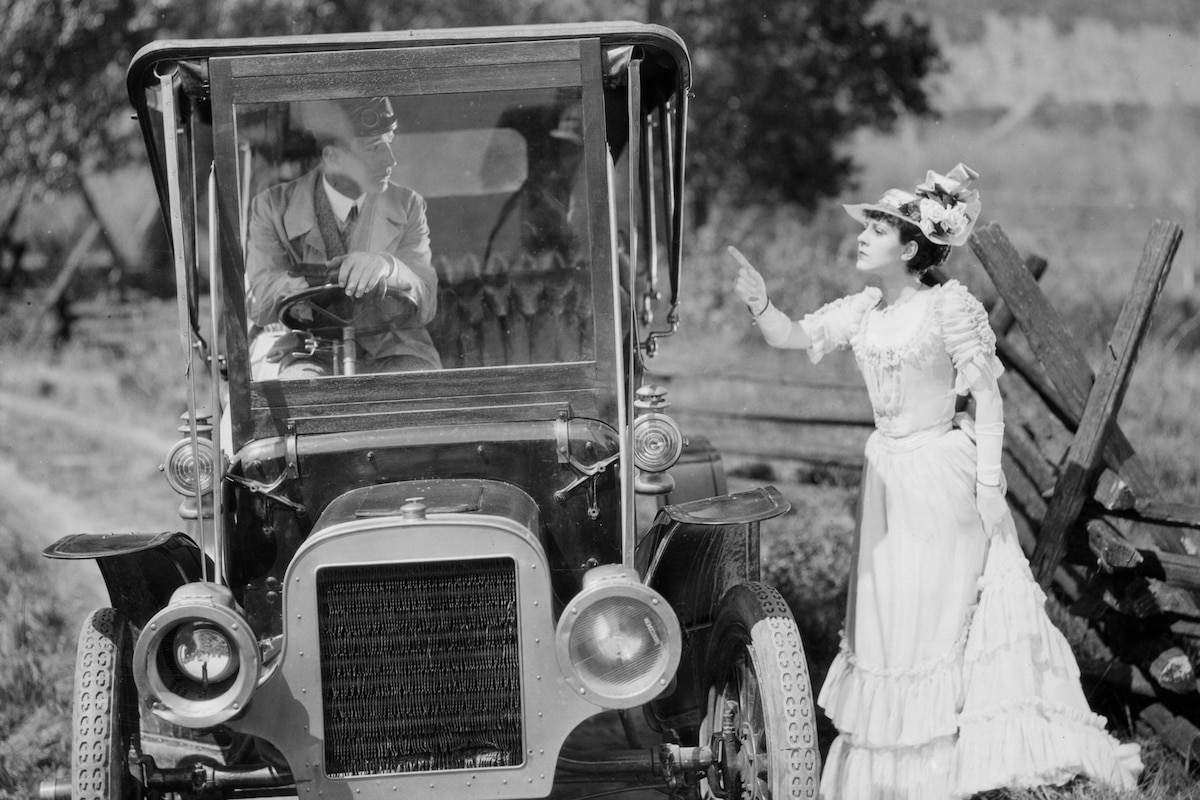
n 1927, it took only three spoken words and some sound effects to tell The First Auto, an otherwise silent story about the birth of the automobile. Director
Roy Del Ruth, one of Warner Brothers' most prolific directors at the time,
filled the picture with details about the birth of the horseless carriage.
He even cast legendary racecar driver Barney Oldfield in a small role. But
the film was far from a documentary, as writer/producer Darryl F. Zanuck
built the story around the conflict between a father who raises and races
horses and a son involved in the fast-rising automobile industry.
Del Ruth was a mainstay at every studio he worked for (including MGM and
20th Century-Fox), but he's probably best known for his work at Warner
Bros., where he labored from the mid-'20s until 1934. He was a major
influence on the studio's gritty fast-paced style before the arrival of
Production Code enforcement in 1934. Among his most notable films there
were the first screen version of The Maltese Falcon (aka Dangerous Female, 1931), which featured blatant depictions of all the sexuality John Huston was only allowed to
hint at in his classic 1941 version; the breakneck newspaper comedy
Blessed Event (1932); and three films that helped establish James Cagney's
tough-guy image, Taxi! (1932), Blonde Crazy (1931) and Lady
Killer (1933).
On The First Auto, he worked with a combination of established
players, future stars and one tragic might-have-been. Russell Simpson had
already made well over 60 films by the time he took on the role of the
father clinging to his old-fashioned ways. He would go on to become a
member of the John Ford stock company, playing Pa Joad in The Grapes of
Wrath (1940) and taking on small roles in Ford's My Darling
Clementine (1946), Wagon Master (1950) and The Horse Soldiers (1959). Rose, the
girl Simpson's son leaves behind as he rises through the auto industry, was
played by Patsy Ruth Miller, already a major silent star, most notably as
Esmeralda in Lon Chaney's The Hunchback of Notre Dame (1923). She would
retire from acting in 1932. Two years before playing a small role as the
village blacksmith in The First Auto, Gibson Gowland had scored his
greatest screen triumph, as the doomed dentist McTeague in Erich von
Stroheim's legendary Greed (1925). By contrast, William Demarest, cast as
the "Village Cut-Up," was still more than a decade away from his greatest
screen roles, in such classic Preston Sturges comedies as The Lady
Eve (1941), Sullivan's Travels (1942) and The Miracle of Morgan's
Creek (1944). In the '60s, he would win a new generation of fans as Uncle
Charlie on the family sitcom My Three Sons.
The film's one tragic question mark was Charles Emmett Mack, starring as
Simpson's up-and-coming son, who leaves behind the family business and his
childhood sweetheart for success in the auto industry. Mack had been
making films since 1921, and The First Auto, made when he was only
27, was one of his best roles. What might have followed is anyone's guess,
as he only made two more pictures before his death in a car accident on the
way to the studio, an ironic end considering his role in The First
Auto.
Producer: Darryl F. Zanuck
Director: Roy Del Ruth
Screenplay: Anthony Coldeway, Darryl F. Zanuck (story), Jack Jarmuth
(titles)
Cinematography: David Abel
Art Direction: Lewis Geib, Esdras Hartley
Score: Herman S. Heller
Principal Cast: Russell Simpson (Hank Armstrong), Charles Emmett Mack (Bob
Armstrong), Patsy Ruth Miller (Rose Robbins), Barney Oldfield (The Old
Driver), Gibson Gowland (The Blacksmith), William Demarest (The Village
Cut-up).
BW-78m.
by Frank Miller
The First Auto
by Frank Miller | June 25, 2003
SIGN UP FOR OUR NEWSLETTERS

CONNECT WITH TCM