Raoul Walsh found himself thrust into directorial duties at the last minute
for The Roaring Twenties (1939), replacing Anatole Litvak. It proved
to be an inspired choice, as James Cagney and Walsh found a mutually
rewarding working relationship. Walsh certainly had his hands full,
skillfully directing a story that covered several decades. The film was his
first for Warner Brothers, which had recently signed him to a seven-year
contract.
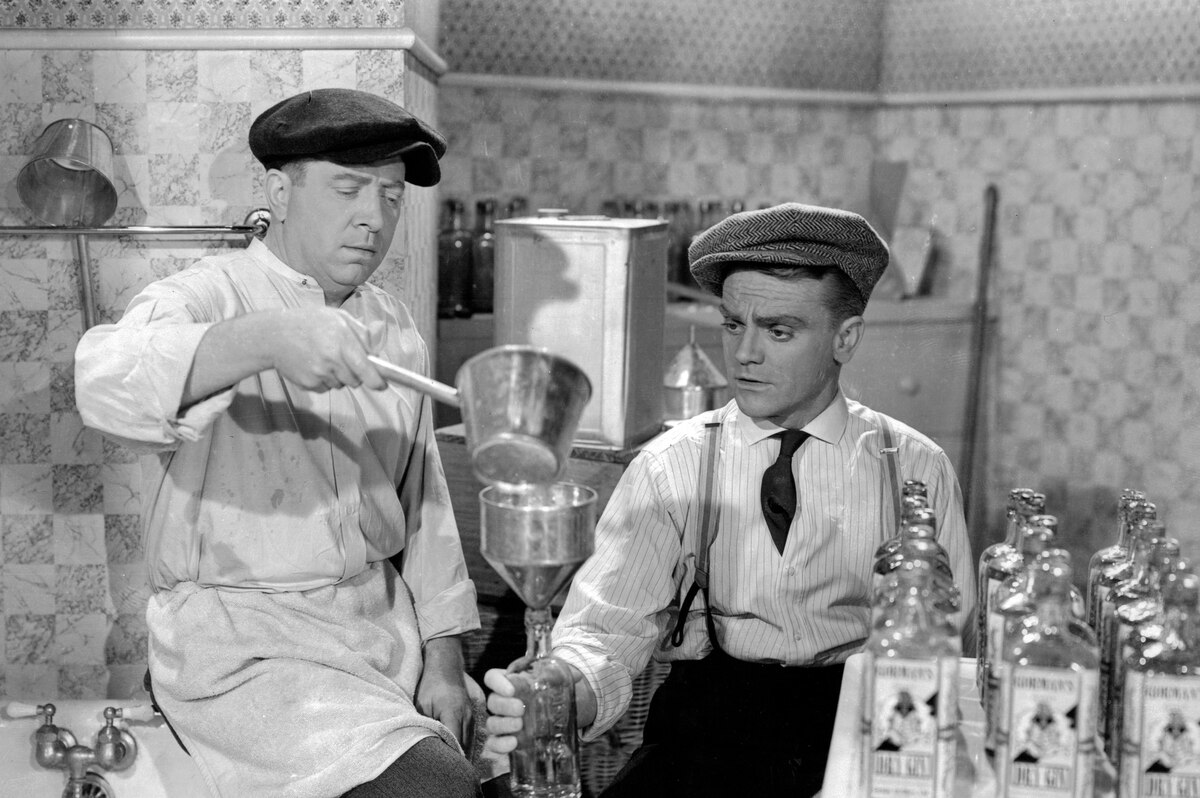
Characters in The Roaring Twenties were based loosely on actual
Prohibition-era personalities, such as nightclub hostess Texas Guinan
("Hello, sucker!" was her refrain to club patrons) and New York gangster
Larry Fay, who was reportedly the model for the literary character Jay
Gatsby.
Incorporating newsreel clips and popular music from the period, and a
voiceover by an omniscient reporter who assures the audience that what theyare about to see is based on true events, The Roaring Twenties has
something of a pseudo-documentary feel.
Humphrey Bogart co-starred in the film with Cagney; that year, they made
three memorable gangster films together for Warners, which specialized at
that time in gritty crime dramas. In addition to The Roaring
Twenties, their last film together, the two appeared in Angels With
Dirty Faces and The Oklahoma Kid, both in 1939.
Cagney found that the freedom to improvise that Walsh allowed him helped
boost the script into an above-average genre film. Cagney recalled the
collaborative atmosphere on the set, remembering how one actor, Frank
McHugh, suggested a different opening scenario than the one provided in the
script. All agreed to trash the opening scene and go with McHugh's
suggestion, thus providing the irreverent banter between Cagney and Bogart,
who meet as doughboys in a World War I foxhole.
Cagney reminisced later about the little touches that he felt "added flavor
to bland writing," including the addition of the hilarious exchange between
his character and Priscilla Lane's, in which his advances are turned down in
humiliating fashion. In another scene, Cagney spiced up a run-of-the-mill
fight by positioning one opponent to accidentally hit another adversary
after being punched by Cagney's character. The film also benefits from an
able supporting cast -- notably Gladys George (who inherited the part from
Ann Sheridan) as the Texas Guinan character, plus McHugh and Lane, as Cagney's romantic interest.
The film did extremely good box office and Cagney won a Best Actor award
from the National Board of Review -- quite an accomplishment in a year that
saw the premieres of such classics as Gone With the Wind, Mr.
Smith Goes To Washington, and Stagecoach.
The Roaring Twenties turned out to be a transitional film in Cagney's
career; his subsequent roles during the 1940s would focus on his
song-and-dance talents in such movies as Yankee Doodle Dandy (1942).
Walsh would work with Bogart again in They Drive By Night (1940) and
High Sierra (1941), in which Bogart started to create the world-weary
character that would be most identified with the Bogie legend. Ten years
after The Roaring Twenties, Cagney would reunite with Walsh for
White Heat (1949), in which he would revive the gangster character
that put him on the map.
Producer: Sam Bischoff
Director: Raoul Walsh
Screenplay: Richard Macaulay, Robert Rossen, Jerry Wald
Art Direction: Max Parker
Cinematography: Ernest Haller
Costume Design: Milo Anderson
Film Editing: Jack Killifer
Original Music: Ray Heindorf, Heinz Roemheld
Cast: James Cagney (Eddie Bartlett), Humphrey Bogart (George Hally), Priscilla Lane (Jean Sherman), Jeffrey Lynn (Lloyd Hart), Gladys George (Panama Smith), Frank McHugh (Danny Green), Paul Kelly (Nick Brown), Elisabeth Risdon (Mrs. Sherman).
BW-107m. Closed captioning.
by Genevieve McGillicuddy
The Roaring Twenties
by Genevieve McGillicuddy | June 25, 2003
SIGN UP FOR OUR NEWSLETTERS

CONNECT WITH TCM