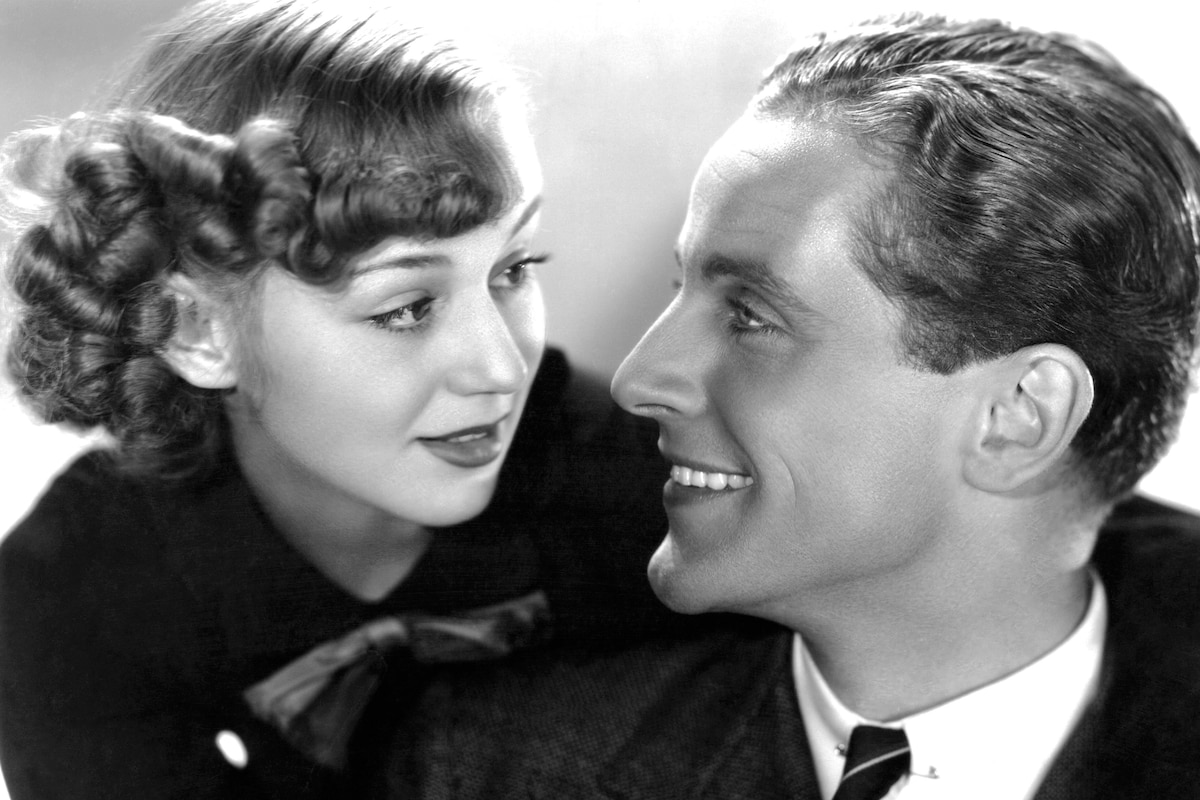
The thirst for fame and stardom provides unexpected heartaches and rewards for Anne Shirley's Jenny Yates in the 1936 comedy, Chatterbox. Dreaming of following in her late mother's footsteps as an actress, Shirley defies grandfather Edward Ellis' orders by first attending and then running off to New York to star in one of her mother's biggest successes, Virtue's Reward. What she doesn't know is that the New York production is intended as a spoof, with the eager but unsuspecting beginning actress as one of its biggest jokes. The opening night laughs clue her in and break her heart, but she fortunately has met a wealthy aspiring artist in her travels, offering the opportunity for a well-funded artistic future if she can get over her wounded feelings.
Leading lady Shirley, born Dawn Paris, did not share her character's ambitions. The former model and child actress only got into the business to support the family after her father died while she was still an infant. All of the ambition in the Paris clan lay with her mother, who fostered her career through various professional names. As Dawn O'Day, the young actress became something of a fixture in early talking films, usually playing the stars' daughter or the leading lady as a young woman. In So Big! (1932), she played the young Barbara Stanwyck five years before Stanwyck and she would play one of the screen's most memorable mother-daughter pairs in Stella Dallas (1937).
Shirley got her break, and her screen name, when she won the role of school girl Anne Shirley in RKO's hit adaptation of the Canadian classic Anne of Green Gables (1934). The role made her a star, won her a contract and prompted her to change her name to Anne Shirley. Her mother even changed her own surname to match her daughter's.
RKO decided that with Janet Gaynor's career fading, audiences were hungry for a new screen ingénue in the Mary Pickford tradition and saw Shirley as their ticket to success in that vein. They cast her as a series of small-town girls facing the world with wide-eyed innocence and initially positioned the 16-year-old as a child. Publicity focused on her doll collection and suggested the only man in her life was her pet Scotty.
By the time Chatterbox came along, the publicists had allowed her to grow up a little, announcing that the studio had rewarded her with her own car. But they didn't say much about dating. And her on-screen characters were still pure to the point of virtual idiocy. At least in Chatterbox she was allowed the hint of an adult love story. She rarely fought against the studio limitations of her type casting, even when they pulled her from the film version of the hit play Winterset (1936), which might have brought her more serious adult roles. For the most part, Shirley wasn't that interested in acting. She would later say that all she cared about was bringing her mother the little bit of fame her limited stardom supplied. After finally moving into adult roles, she retired with the end of her RKO contract, finishing her career as the good-girl heiress in Murder, My Sweet (1944).
There was one cast member in Chatterbox with the ambition to rise to the top. In fact, she would eventually become one of the world's most recognizable celebrities. Billed ninth as an actress in the company Shirley joins is Lucille Ball who was just at the start of her move from bits to featured roles. After contracts with Sam Goldwyn and Columbia Pictures which led nowhere, Ball signed with RKO in 1934. For two years she played unbilled roles, only registering briefly as a young heiress in I Dream Too Much (1935), the studio's attempt to turn opera singer Lily Pons into a film star. She only stayed at RKO through the intercession of Ginger Rogers' mother, Lela Rogers, who worked there as an acting coach and interceded every time the executives wanted to drop her option. Finally, through Rogers' persuasion and Ball's begging, she moved into more substantial roles with Chatterbox. It was the start of a very slow rise to the top as Ball worked her way through leads in B pictures before leaving RKO for MGM and finally achieving her greatest fame on television, but at least it was a move in the right direction.
Producer: Robert Sisk
Director: George Nicholls, Jr.
Screenplay: Sam Mintz
Based on the play Long Ago Ladies by David Carb
Cinematography: Robert de Grasse
Art Direction: Van Nest Polglase
Music: Alberto Colombo
Cast: Anne Shirley (Jenny Yates), Phillips Holmes (Philip 'Phil' Greene, Jr.), Edward Ellis (Uriah Lowell), Erik Rhodes (Mr. Archie Fisher), Margaret Hamilton (Emily 'Tippie' Tipton), Granville Bates (Philip Greene, Sr.), Lucille Ball (Lillian Temple).
BW-69m.
by Frank Miller
Chatterbox
by Frank Miller | February 24, 2010
SIGN UP FOR OUR NEWSLETTERS

CONNECT WITH TCM