Donna Reed must have felt a welcome wind of change blowing through her career when in 1950 she signed a contract with Columbia. Eight years at MGM had done little to bring her a truly important role or major hit, even after her success on loan to RKO opposite James Stewart in It's a Wonderful Life (1946). So, after taking time off following the birth of her son and following the termination of her Metro contract, she began to look around for better opportunities and found some cause for hope at Columbia. Studio boss Harry Cohn, always eager to one-up rival Louis B. Mayer at MGM, made it his personal task to find her a choice part, and he did just that by casting her, against director Fred Zinnemann's wishes, as the prostitute Lorene in From Here to Eternity (1953). It was a sought-after part and a much-needed change from her usual girl-next-door types. Unfortunately, the honeymoon didn't last long.
For some reason, Cohn immediately followed up Reed's breakthrough performance with roles in pictures that made even the worst of her MGM assignments seem like plums. She was mystified. Cohn was known to be a sometimes capricious, even vengeful boss, especially if he felt his contract players were not showing the proper degree of respect or gratitude. Yet Donna was reasonably sure she had thanked him for the chance in Eternity, and she had worked hard with no complaints, even when things on the set became less than ideal. But her future at Columbia immediately after playing Lorene included an unmemorable role in The Caddy (1953), a Martin and Lewis comedy, and a string of undistinguished Westerns. By the time the third of them was released, Three Hours to Kill, Reed had won a Best Supporting Actress Academy Award for Eternity, leaving reviewers and audiences wondering what had happened.
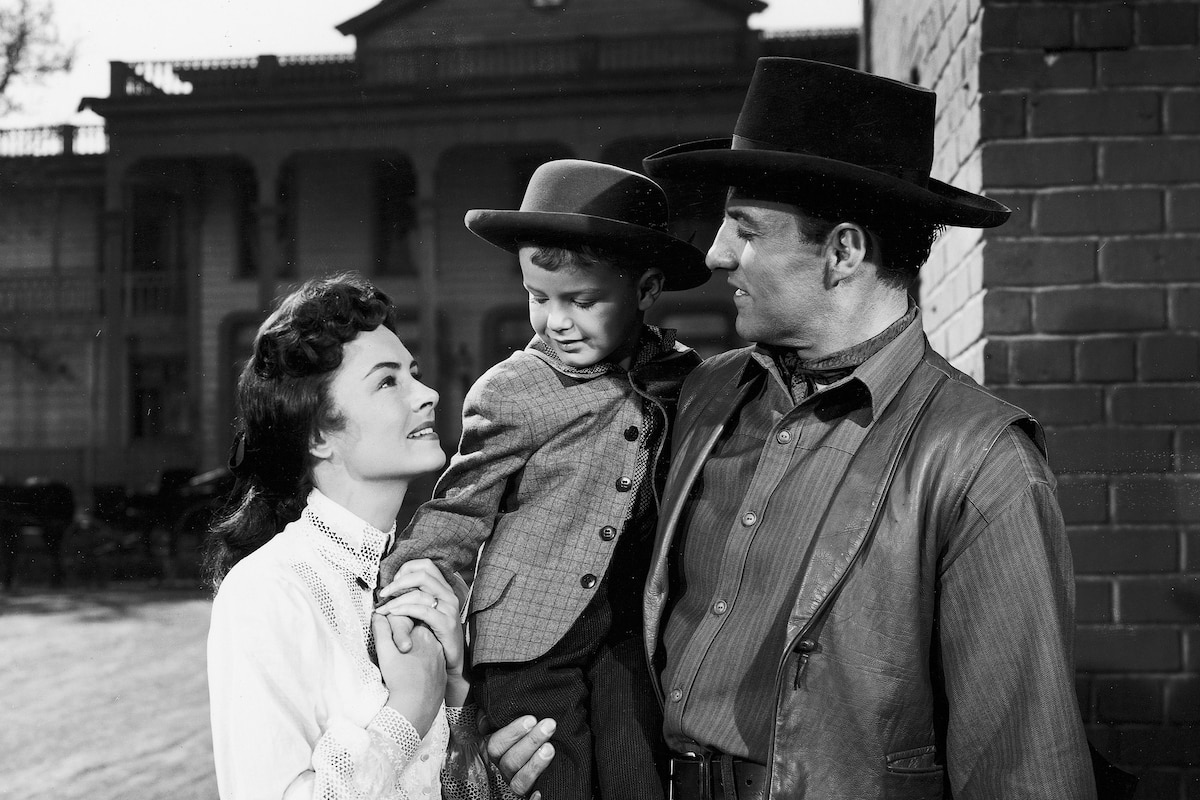
Actually, Three Hours to Kill was the best of the Westerns to follow in the wake of her acting triumph, even if it gave her precious little to do and under-the-title billing. In this tense and spare melodrama, which some compared to High Noon (1952), Dana Andrews stars as a man wrongly accused of murder who faces off with the real killer, his accusers, and the town that scorned and feared him. Reed plays his ex-fiancée, now married to another man and raising a boy who turns out to be Andrews's son. The film has been praised for effectively weaving together two time frames and for a strong sense of bitterness over injustice, but probably the kindest praise that Reed received for the film was the New York Herald-Tribune's remark that she was "appropriately teary as the girl left behind."
Cohn's choice of director for Three Hours to Kill could not have done much to buoy Reed's spirits either. Despite career high points with The Adventures of Sherlock Homes (1939) and the superior noir thriller He Walked by Night (1948), Alfred L. Werker's career was mostly confined to second-string productions. His Westerns of the 1950s were not without a certain style and interest, but they were decidedly B pictures. Columbia did little to promote Three Hours to Kill, and it faded away quickly. (Reed's children, according to one biographer, were not even aware their mother had made this picture.) Reed never even bothered to see her Columbia Westerns, and by the time this one was released, she had instructed her agent to get her out of her contract. This Western would be her last film for the studio.
Besides Reed and Andrews, most of the other actors in Three Hours to Kill were not well known at the time, and are even less familiar to audiences now. But the cast did include Carolyn Jones, who went on to create the role of Morticia on the hit TV comedy The Addams Family in the 1960s. Stephen Elliott, who plays the town sheriff, also had a long television career with occasional film roles. In fact, he appeared in a brief recurring role in the mid 1980s as Scotty Demarest on the primetime soap Dallas, mostly during the time Reed was in that cast as Ellie Ewing, temporarily replacing the ailing Barbara Bel Geddes. He also played the title character's father-in-law-to-be in Arthur (1981). An interesting bit of trivia: Elliott and another cast member here, Richard Coogan, were both busy and respected Broadway actors who appeared together for a time in the early Captain Video TV series.
Three Hours to Kill was shot in part on the same Northern California location (near Yosemite National Park) as The Adventures of Robin Hood (1938) and many other films by Charles Lawton, Jr., who was also responsible for the cinematography of another spare and tense Western 3:10 to Yuma (1957).
Director: Alfred L. Werker
Producer: Harry Joe Brown
Screenplay: Richard Alan Simmons, Roy Huggins, story by Alex Gottlieb, additional dialogue by Maxwell Shane
Cinematography: Charles Lawton, Jr.
Art Direction: George Brooks
Editing: Gene Havlick
Cast: Dana Andrews (Jim Guthrie), Donna Reed (Laurie Mastin), Dianne Foster (Chris Palmer), Stephen Elliott (Sheriff Ben East), Richard Coogan (Niles Hendricks).
BW-77m. Closed Captioning.
by Rob Nixon
Three Hours to Kill
by Rob Nixon | February 23, 2010
SIGN UP FOR OUR NEWSLETTERS

CONNECT WITH TCM