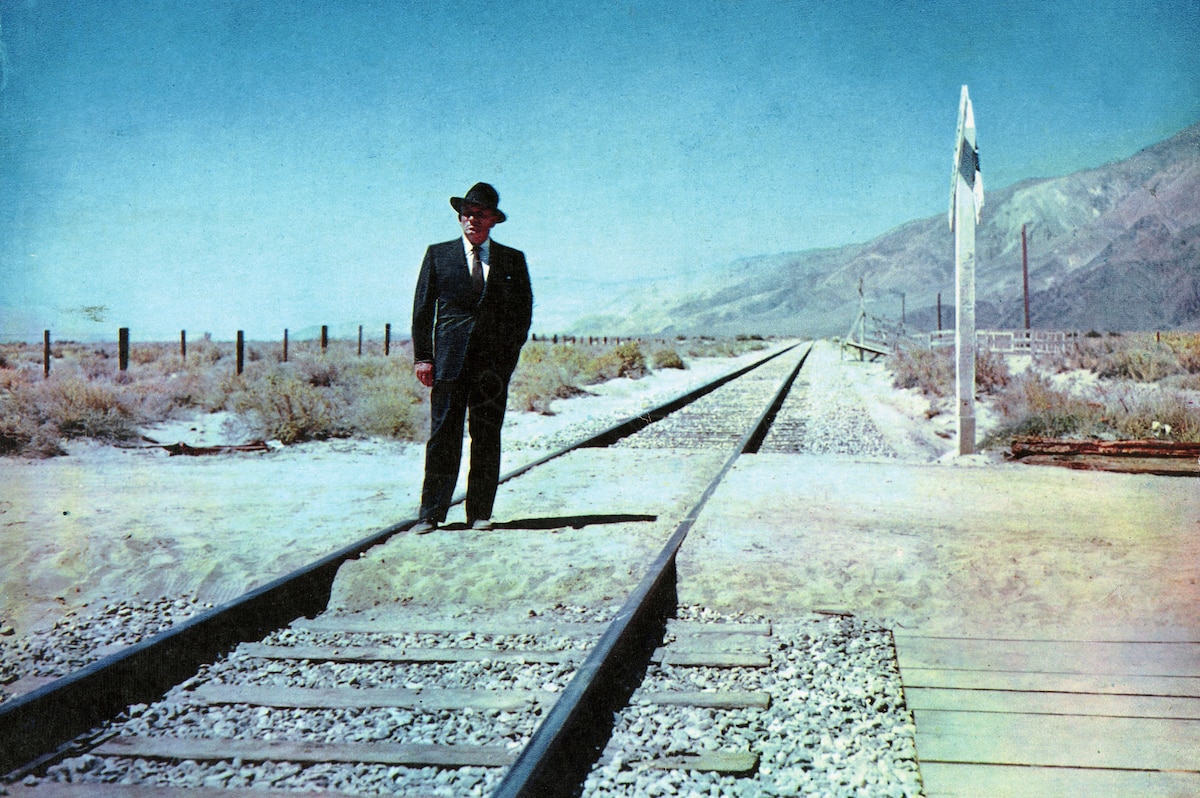
Although the exact location of the title town is never mentioned in Bad Day at Black Rock, Millard Kaufman specified in his screenplay that it was in the desert 156 miles from Phoenix and 211 miles from Los Angeles.
Spencer Tracy lost the Academy Award for Best Actor for this year to his co-star and nemesis in Bad Day at Black Rock, Ernest Borgnine, for his first starring role, Marty (1955).
In the first two previews in October 1954, audiences did not respond well to the film. Comment cards noted that Tracy was too old for his part, the omission of any music was not a favorable aspect, and for the first ten minutes they were confused about what kind of picture it was supposed to be. Complaints were made about the pace, the volume of the ambient noise ("The wind...was as loud as the hurricane in The Caine Mutiny [1954]"), even the title. The final release version, with the added opening footage and musical score, was previewed in December, and response was markedly better: out of 168 viewers, only 13 said they wouldn't recommend the picture to a friend, compared to 25 percent of the first preview audience. The film fared much better at its New York preview a few days later. Market Research reported the audience was "spellbound" and that 92 percent would recommend it.
State censor boards and the Catholic Legion of Decency were unhappy about the karate fight in the cafe and the sequence where one of the characters is burned to death by a Molotov cocktail. Studio executive Robert Vogel countered the objections by noting the enthusiastic response to both scenes by preview audiences. The Legion of Decency finally passed the film as acceptable for adults and adolescents, and the New York Censor Board gave a seal of approval but wrote a letter to MGM cautioning the studio to avoid certain types of violence in the future, particularly the mix of sex and violence they said was coming into the country with imported European films.
Bad Day at Black Rock was released on January 7, 1955, to very good critical reception. According to Sturges, however, it was not a big financial success. After 25 weeks in theaters in the U.S. and Canada, it had still not broken even, and had only inched up a little in box office receipts a year later. Just days before opening, Dore Schary announced there would be a sequel that would bring Spencer Tracy and Walter Brennan back to show "the restoration of morale" in the town. After the picture failed to capture a big audience, the plan was quietly dropped.
After seeing the film, the head of MGM's parent company, Nicholas Schenck, who studio chief Dore Schary claimed was initially opposed to the project, told Schary he was glad they made it.
"God he was a master. What a master!" Ernest Borgnine on Spencer Tracy
"Bad Day wanted to be made. Before the camera ever rolled or construction even started on the little town, everything fell into place, and it was all right on. Meaningful story, flawless script and casteverything.... And as a bonus we had full wide-screen photography-one of the very first. The background of stark mountains, huge Streamliner train, barren deserts, all became players in the story, integrated into the mystery and violence of its theme. I don't see how anyone could have blown directing this picture, but if they had, they should have shot me - not Komoko." director John Sturges, responding to Danny Peary's positive essay about the film on the Criterion Collection web site
Of all his films, Sturges remained proudest of Bad Day at Black Rock.
Tracy left the country right after the Oscars®, and when he came back to work at the studio, Borgnine went to see him. Tracy berated him for not having answered the congratulatory telegram he sent after the awards. Katharine Hepburn stuck her head out of Tracy's trailer and told him, "He won the Oscar®, not you, you dummy." Borgnine and Tracy had a good chuckle over that.
Bad Day at Black Rock marked the end of Spencer Tracy's long association with MGM, where he first signed on as a contract player in 1935. In the summer of 1955, he began work on another film at the studio called "Jeremy Rodock," a script that had caught his attention some time earlier. The picture began shooting in the mountains near Montrose, California, but Tracy left after disagreements with director Robert Wise. Furthermore, he said the high altitudes were a strain on him and insisted the sets be rebuilt at a lower altitude. On June 25, only a few weeks into production, he was removed from the cast. He never made another film for the studio. The picture was completed with James Cagney in the lead and released as Tribute to a Bad Man (1956).
John Sturges started in the business as a film editor at RKO. In the mid-40s, he moved to Columbia, where he directed several B-picture crime dramas and quickly built a reputation for taut action and suspense movies. His first Western was a Randolph Scott picture, The Walking Hills (1949). He first worked with Spencer Tracy in the legal drama The People Against O'Hara (1951). After Bad Day at Black Rock, they worked together once more on The Old Man and the Sea (1958), based on the Hemingway novel. Tracy received another Oscar® nomination for that role. Sturges's other notable films include Gunfight at the O.K. Corral (1957), Last Train from Gun Hill (1959), The Magnificent Seven (1960), and The Great Escape (1963).
Although never quite a major star, Robert Ryan had a long career of solid performances and successful movies, earning him much critical praise for his range and intensity. He is most remembered today for a number of roles in which he played unstable and/or menacing characters: Crossfire (1947, Academy Award nomination for Best Supporting Actor), Caught (1949), Beware, My Lovely (1952), The Naked Spur (1953), and Billy Budd (1962). Later in his career, he became a figure of no-nonsense military authority: The Longest Day (1962), Battle of the Bulge (1965), The Dirty Dozen (1967). He worked with Sturges again as Ike Clanton in the director's sequel to Gunfight at the O.K. Corral, Hour of the Gun (1967). He had memorable roles in Sam Peckinpah's The Wild Bunch (1969) and his final role in a screen adaptation of the Eugene O'Neill play The Iceman Cometh (1973), which starred his Black Rock henchman Lee Marvin (who also appeared in The Dirty Dozen). Ryan's performance won him a Best Actor award (tied with Al Pacino for Serpico, 1973) from the National Board of Review. He also received a posthumous Special Award from the National Society of Film Critics in 1974.
Ernest Borgnine was directed by John Sturges again in Ice Station Zebra (1955). He co-starred with Lee Marvin and Robert Ryan again in The Dirty Dozen (1967) and with Ryan in The Wild Bunch (1969).
Anne Francis has been in hundreds of movies and television shows since her debut at the age of 17 in an uncredited bit as a bobby-soxer in the Esther Williams movie This Time for Keeps (1947). Among her most memorable appearances are Blackboard Jungle (1955), the sci-fi classic Forbidden Planet (1956), and the hit mid-60s private eye TV series Honey West, which earned her a Golden Globe award and an Emmy nomination.
In addition to his Academy Award nomination for Bad Day at Black Rock, screenwriter Millard Kaufman was also nominated for a military comedy-drama, Take the High Ground! (1953) starring Richard Widmark and Karl Malden. Kaufman fronted for the blacklisted Dalton Trumbo on Deadly Is the Female/Gun Crazy (1950); in 1992 he officially requested the Writers Guild remove his name from the credits and restore Trumbo's. Kaufman's other credits include the screenplay for the Civil War drama Raintree County (1957) and co-creating the cartoon character Mr. Magoo in the late 1940s.
A decade after the film's release, Kaufman was awarded by the Japanese government for treating its people with uncommon dignity. "The whole thing was absurd because there were no Japanese in the movie," Kaufman said. "But I knew what they meant."
Don McGuire, credited for his adaptation of the original source material for Bad Day at Black Rock, was also an actor (mostly bit parts in films during the 1940s and 50s), producer and director (motion pictures and television). He was nominated for an Academy Award, shared with Larry Gelbart and Murray Schisgal, for the screenplay of Tootsie (1982).
Cinematographer William C. Mellor won Academy Awards for his work on A Place in the Sun (1951) and The Diary of Anne Frank (1959). His other notable films include the Anthony Mann Western The Naked Spur (1953), Giant (1956), and several episodes of the Ozzie and Harriet TV series. He died of a heart attack in 1963 on the set of The Greatest Story Ever Told (1965); the film was completed by Loyal Griggs
by Rob Nixon
Memorable Quotes from BAD DAY AT BLACK ROCK
JOHN J. MACREEDY: I'll only be here 24 hours.
CONDUCTOR: In a place like this, that can be a lifetime.
STATIONMASTER: First time the Streamliner's stopped here in four years.
DOC VELIE: He's no salesman, that's for sure. Unless he's peddling dynamite.
RENO SMITH: Japanese farmer. Never had a chance. Got here in 41 just before Pearl Harbor. Three months later, shipped him off to a relocation center.
COLEY TRIMBLE: You could get yourself killed like that, nosin' all over the countryside.
LIZ WIRTH: What do you care about Black Rock?
MACREEDY: I don't care anything about Black Rock. Only it just seems to me that there aren't many towns like this in America. But one town like it is enough. And because I think something kind of bad happened here, Miss Wirth, something I can't seem to find a handle to.
LIZ: You don't know what you're talking about.
MACREEDY: Well, I know this much. The rule of law has left here and the guerrillas have taken over.
SMITH: I believe a man is as big as what'll make him mad. Nobody around here seems big enough to make you mad.
SAM, CAFE OWNER: What'll you have?
MACREEDY: What have you got?
SAM: Chili with beans.
MACREEDY: What else have you got?
SAM: Chili without beans.
TRIMBLE: You're a yellow-belly Jap lover, am I right or wrong?
MACREEDY: You're not only wrong, you're wrong at the top of your voice.
CONDUCTOR: First time the Streamliner's stopped here in four years.
MACREEDY (boarding): Second time.
Trivia - Bad Day at Black Rock - Trivia & Fun Facts About BAD DAY AT BLACK ROCK
February 19, 2010
SIGN UP FOR OUR NEWSLETTERS

CONNECT WITH TCM