Bad Day at Black Rock began as a short story, "Bad Day at Hondo," by novelist and radio writer Howard Breslin, writing under the pseudonym Michael Niall. Some sources list the title as "Bad Time at Hondo" and others give the fictional locale as "Honda."
Although largely a thriller about one man coming up against the hostile citizens of a remote town, the story's background was based on the internment of more than 120,000 Japanese Americans in the Western U.S. following Japan's attack on Pearl Harbor. The executive order that allowed the military to round up people of Japanese descent, most of whom had been born and raised in the U.S., was signed by President Franklin Roosevelt in 1942. The decision met with little public dissent, in no small part because of hostility toward the growing Japanese immigrant population on the West Coast during the first half of the 20th century. Similar to anti-Latino sentiment prevalent in our own time, the new arrivals were seen as taking farm and labor jobs away from "Americans." Couched in national security terms, the action has been seen in the years since as clearly motivated more by racism.
In Breslin's original story, the Japanese farmer was not murdered directly but died of a heart attack the night the locals burned down his house to run him out of town.
Actor-writer Don McGuire came across the story in a 1946 issue of American Magazine and was attracted to how it dealt tangentially with something that had never been acknowledged on screen, the mistreatment of Japanese Americans during World War II. McGuire optioned the story for $15,000 and wrote an adaptation. Director Don Siegel, then at Allied Artists, read it and thought it was the finest screenplay he had read up to that point. He interested Joel McCrea in it, but the studio passed on it.
McGuire took it to Dore Schary, now head of MGM and a producer with a reputation for "message" films. Schary had also publicly spoken out against the Japanese interment camps during the war. "[Schary] liked the idea of dealing with the persecution of Japanese Americans in the so-called Wild West, that stronghold of democracy where the deer and the antelope play," noted MGM contract screenwriter Millard Kaufman.
As 1953 came close to an end, Schary was desperate to find a project quickly for Spencer Tracy, something the actor would agree to. He consulted Kaufman about Breslin's story as a possible vehicle. Schary liked what he later referred to as "a combination of toughness and hard intellectuality" in the former marine turned screenwriter. Kaufman read both the story and McGuire's screenplay and pronounced them both "terrible," but agreed to try to fashion it into something Tracy would agree to do.
Tracy not only thought the short story was terrible but was insulted that Schary even dared to consider it for him. "I'm supposed to be the best male actor in America," Tracy said, and promptly informed Schary exactly what he could do with the idea.
According to Kaufman, part of Schary's ploy to hook Tracy was to send the script to Alan Ladd's agent, who turned it down. Nevertheless, Schary told Tracy that Ladd was interested in it and that was enough to get Tracy to read the script and half-heartedly agree to make the picture.
Kaufman claimed Tracy was dead set against the project until Schary came up with the idea of giving the lead character only one usable arm. "I never knew an actor who could resist playing a cripple," Schary said, according to Kaufman. In his autobiography, Schary told the story a little differently, claiming Tracy had already tentatively approved the script but was concerned about his proposed role having no real character. Whatever the true sequence of events, apparently the one-armed man idea was what hooked Tracy. He also thought at age 54 he was too old for the role of the platoon leader who had just emerged from the war - he was - but the idea of using judo/karate (it was becoming more widely popular in the U.S. at the time) to take down much younger and apparently tougher men, eased his concerns.
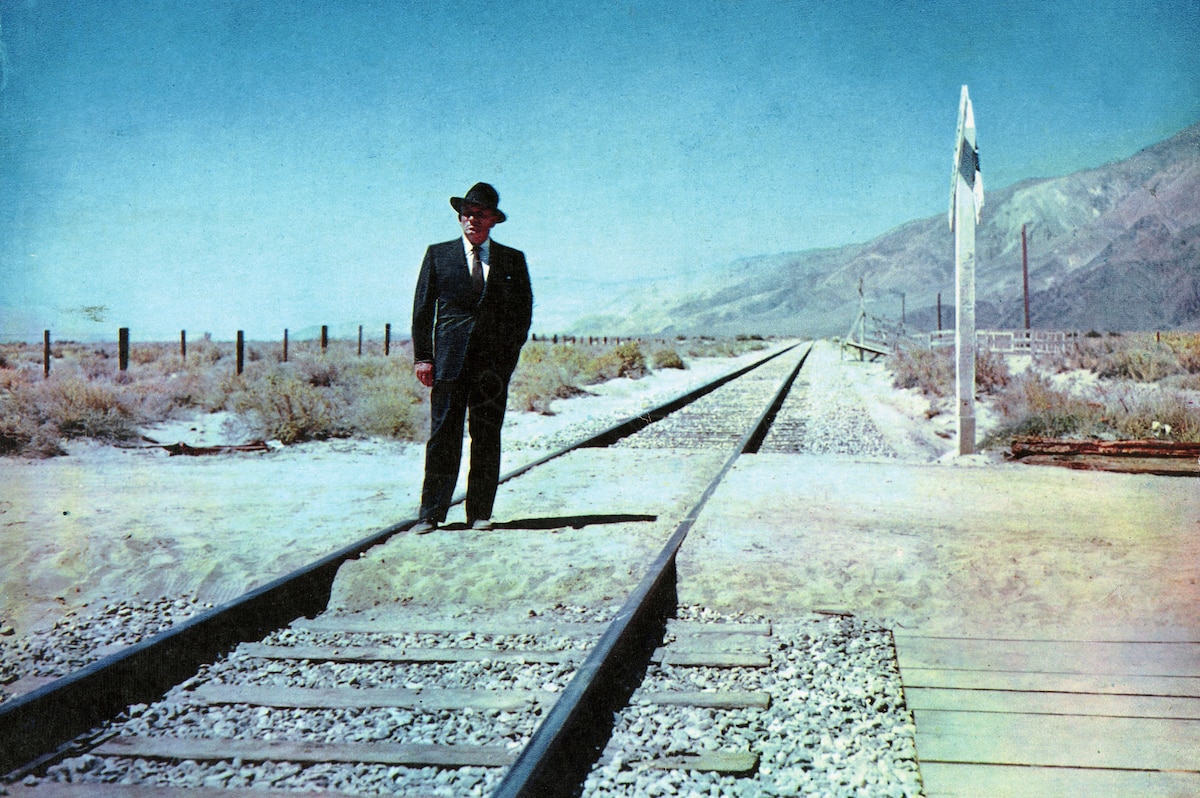
Kaufman made substantial changes to both McGuire's and Breslin's originals. (After contentious negotiations, McGuire settled for an adaptation credit.) Kaufman kept the theme of anti-Japanese violence and the time setting (shortly after V-J Day) but compressed the action into a single 24-hour period. He also wrote into the script a description of the town that would guide the cinematic approach to the story: "Town and terrain seem to be trapped, caught and held forever in the sullen, abrasive Earth." The lead character was provided with a new mission, to deliver a medal for bravery to the Japanese-American father of a fallen member of his platoon. Kaufman also created the chief nemesis character, the rancher Reno Smith.
The town of the title was changed from Hondo because there was already a John Wayne Western called Hondo (1953). At first, it was called Parma, but during a road trip that Kaufman took with a location scout they came across a tiny town which was barely an intersection in the highway called Black Rock and decided that would be the name.
Relations between Schary and Nicholas Schenck, head of MGM's parent company, were already very strained at this time. In his autobiography, Schary claimed Schenck ordered him to take Bad Day at Black Rock off the schedule, largely because the very conservative Schenck didn't like Schary's liberal politics, his propensity for issue movies, and the notion of making a film about anti-Japanese sentiment. When Schary refused, a shouting match broke out between the two. Schary told Schenck to fire him if he didn't have faith in his decision and threatened to quit if Schenck ordered the production halted. Schenck reluctantly let the matter rest, and Schary continued working on the project. The veracity of this version is debatable. According to John Sturges, who would eventually direct, there was never any resistance to the film. "Most people by that time sort of recognized the snap judgment of interning the Japanese Americans was wrong and done without justification," Sturges said.
Initially Charles Schnee was assigned as producer and George Sidney was announced as director. However, Sidney never began the assignment for reasons unknown, so Richard Brooks, another ex-marine with whom Kaufman had worked on Take the High Ground! (1953), was hired instead as director, thanks to his reputation for tough issue films, such as Crossfire (1947), about anti-Semitism, and Storm Warning (1951), about Klan violence.
Brooks had started as a writer and took great pride in his abilities, and when Kaufman's screenplay for their film Take the High Ground! got an Academy Award nomination while Brooks got neither recognition for his direction nor writing credit, he wasn't pleased. So during the first story conference the two had on Bad Day at Black Rock, he told Kaufman he would participate in the writing and expect co-screenplay credit. Kaufman agreed, providing Brooks actually did half the work.
Brooks quickly caused problems for the project by calling Spencer Tracy and telling him not to expect much out of this "piece of sh*t," although he and Kaufman would try to make it work somehow. Tracy immediately called Schary, who ordered Brooks into his office for a confrontation that included producer Charles Schnee and associate producer Herman Hoffman. An incensed Schnee, small as he was, challenged Brooks to a fistfight and ended up walking off the production. Later, Schary said he had approached MGM producers Pandro Berman and Sam Zimbalist to take on the production, but they both said no, and his other choice, John Houseman, was busy with Executive Suite (1954), so he decided to produce it himself.
The first thing Schary did was fire Brooks and hire John Sturges, who had worked very well with Tracy on The People Against O'Hara (1951). Sturges had no patience for front office politics. "He had that kind of sociality that was lacking in so many who were protecting their rears in the business," Kaufman said, who was happy to see Brooks go because "He was constantly and brilliantly kissing Dore's ass." Sturges told Schary, "I'll do it if you leave me alone."
With all these problems, Black Rock generated some negative press as being hopelessly stalled, which spurred Kaufman on with even more determination. "I wrote the damn thing in three weeks because I thought it would never be made. Not because of its political content, which I thought was negligible, but simply because it had this history of fights and giving bad luck a workout."
Sturges didn't get very involved in the screenplay process mainly because he was so pleased with Kaufman's work. "If you've got a script, making a picture is really fun," he said. "Black Rockbest script I ever had. It was a walk in the sun." Nevertheless, he spent as much time as he could with Kaufman talking about the picture. In fact, right after they were introduced, he insisted that Kaufman join him while he went shopping for clothes so they could discuss the project in further detail.
As was his habit, Kaufman tuned out everything else in his life, including his family, when he was in preproduction on Bad Day at Black Rock. "His ability to focus was scary," his daughter later commented.
by Rob Nixon
The Big Idea - Bad Day at Black Rock
by Rob Nixon | February 19, 2010
SIGN UP FOR OUR NEWSLETTERS

CONNECT WITH TCM