SYNOPSIS
A streamliner passenger train suddenly stops one day at the tiny, remote desert town of Black Rock, which it had bypassed for years, and deposits a one-armed stranger. John J. Macreedy is a war veteran looking for a local farmer, the father of a Japanese-American soldier who was a member of Macreedy's platoon, killed in battle. The people of this almost deserted town view him with suspicion and treat him with overt hostility. It soon becomes apparent this is more than just a mistrust of strangers. Something happened here, something the townspeople will go to any lengths to hide. Macreedy begins to realize that his life is in danger but there is no one he can turn to in this hostile place. He tries to unravel the mystery regardless of the risks, but the locals close in on him, while trying to learn his true identity and his business with the missing farmer.
Director: John Sturges
Producer: Dore Schary
Screenplay: Millard Kaufman, adaptation by Don McGuire, based on "Bad Day at Hondo" by Howard Breslin
Cinematography: William C. Mellor
Editing: Newell P. Kimlin
Art Direction: Malcolm Brown, Cedric Gibbons
Original Music: Andre Previn
Cast: Spencer Tracy (John J. Macreedy), Robert Ryan (Reno Smith), Anne Francis (Liz Wirth), Dean Jagger (Tim Horn), Walter Brennan (Doc Velie), John Ericson (Pete Wirth), Ernest Borgnine (Coley Trimble), Lee Marvin (Hector David).
C-82m. Letterboxed. Closed Captioning.
Why BAD DAY AT BLACK ROCK is Essential
As accustomed as we are these days to multi-million dollar blockbusters loaded with elaborate effects and extravagant production design, it's fascinating to watch a film that proves how much can be accomplished with so little: Bad Day at Black Rock is a thrilling suspense drama with only a few brief outbursts of action and very little blood (Chicago Reader critic Dave Kehr called it "an action film for people who don't like action films"). It's a suspense story in which the audience doesn't really know what's going on until nearly the end and a social-issues drama with a minimum of dialogue and posturing. With these elements, Bad Day at Black Rock emerged as one of the most distinctive films of the 1950s and has remained for more than a half century a favorite of audiences and critics alike.
On the one hand, this is very much a film of its time, an era celebrating American strength and optimism while harboring an undercurrent of paranoia and suspicion. The setting is immediately after World War II, and the story concerns a shameful episode in our history, the official sanctioning of long-festering hostility toward Japanese Americans. This was the first film to openly acknowledge the racism and fear that resulted in the wartime internment of hundreds of thousands of U.S. citizens of Japanese birth/ancestry, although it never directly deals with the government "relocation" camps set up for the duration. Instead, the story is boiled down to the primal tensions that arise between a mysterious stranger and the guilt-ridden citizens of a remote small town. In that respect, it's a movie that transcends its time and one that could easily work now with little updating: wars still occur, racial violence goes on, and anti-immigrant sentiment shifts from one ethnicity to another. Director John Sturges acknowledged how easily the basic premise could be adapted, and directors like Steven Spielberg and Ron Howard have commented on the appeal of remaking it.
Thematically, Black Rock packs a punch (or in this case, a karate chop), addressing a subject few wanted to recognize even ten years after the war and one which wouldn't receive an official government acknowledgment until 1988. Some have also read into it a response to the McCarthy anti-communist witch hunts occurring since the end of the war, which took particular aim at both the army and the film industry. Sturges dismissed the notion that his film had anything to do with that, but screenwriter Millard Kaufman, himself accused of communist sympathies by the "Red Channels" pamphlet, saw it as a companion to High Noon (1952), a widely acknowledged anti-McCarthy statement couched in a Western. Referring to a line in Black Rock ("The rule of law has been suspended in this townthe guerrillas have taken over."), Kaufman inscribed in a copy of the script: "So it wasso it seemed to mein Hollywood during the McCarthy Captivity when this screenplay was written. It is dedicated to those men and women who inspired it, who courageously held their ground against the onslaught of the guerrillas." Whether or not Kaufman's statement was merely a case of hindsight has only fueled the continuing debate about the allegorical nature of the film. But remove that aspectindeed, take out the historical background about the Japanese internmentsand you still have a brilliantly minimalist piece of cinema.
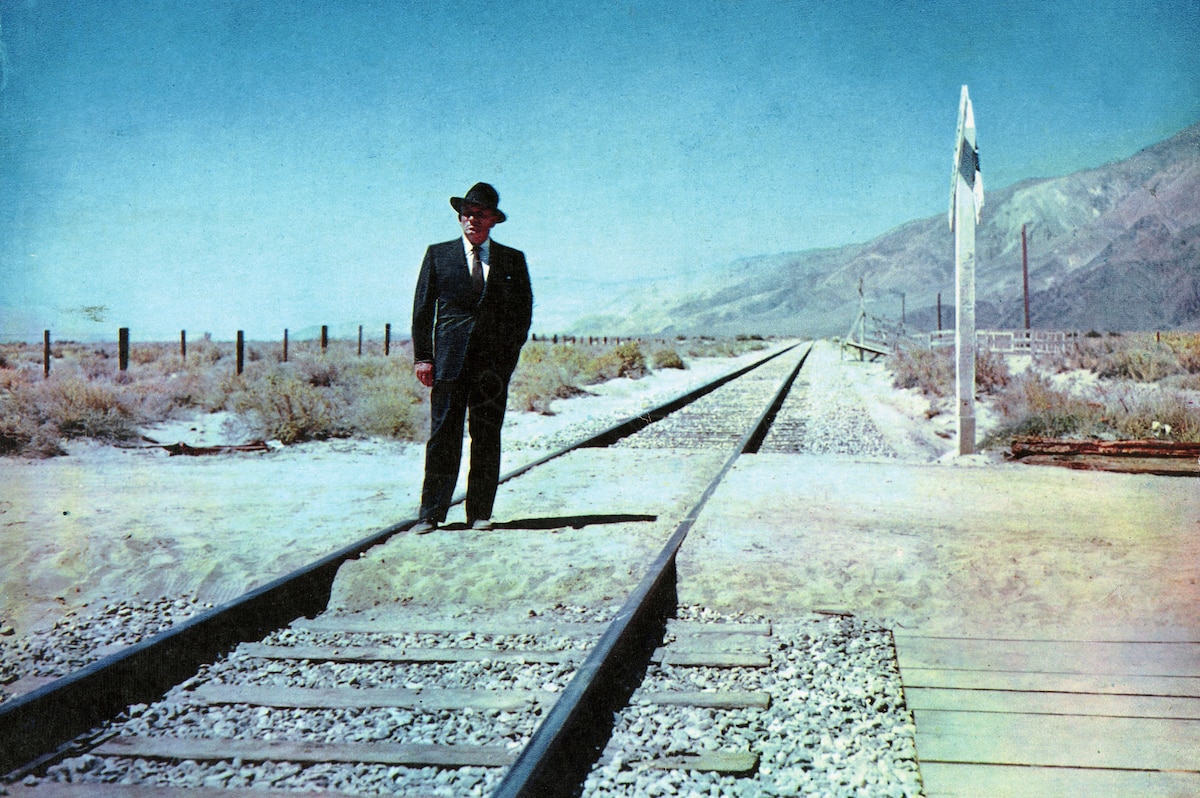
Although the story and the setting are ostensibly realistic, Bad Day at Black Rock is actually highly stylized, and extremely pared down in the spare, economical and underpopulated manner of a Road Runner cartoon, with the same sudden violence exploding in a barren landscape. The community of Black Rock has few buildings and seems to be inhabited by less than a dozen people. (At the end, when the local doctor-undertaker talks about renewing the town and rebuilding its community, you wonder who would repopulate the town; the only apparent female resident has been killed and it seems all the younger men have been hauled off to jail.) Although he has never had anything but the highest praise for Bad Day at Black Rock, one has to wonder if Sturges didn't slightly regret agreeing to the studio's decision to add a musical score and aerial train footage at the opening instead of starting it as originally shot and cut with Spencer Tracy descending from the modern Streamliner into this desolate area with only the wind on the soundtrack. As released, the film's opening is the only overstated and theatrical aspect in an otherwise extremely lean and muscular film.
Tracy's performance, often recognized as one of his most interesting, does much to add to the overall tone. His John J. Macreedy is a man of few words, concealing his intentions as thoroughly as the useless hand he keeps stuffed in one pocket throughout the picture. Tracy, at least by this point (age 54, overweight, and more than 20 years into his film career), was no one's idea of an action hero. He had his own trepidation about it, realizing he was too old for the part and unsure if the lethal black belt karate skills his character was given would be convincing to an audience. But it's precisely this playing against expectations that makes his character so arresting. We don't know until very far into the movie exactly what he's doing in Black Rock. Until then, he's just a stranger in search of a Japanese farmer who has reputedly run away, and Macreedy becomes increasingly aware of the web of deception enveloping the town and the grave danger he's in. Precisely because he is so tight-lipped, polite, and dignified, and because the Cinemascope screen (a relatively new process effectively validated by Sturges and cinematographer William C. Mellor) conveys an oppressive sense of dread, when Macreedy does erupt into violence, it is startling and unsettling. And we pull for him to win, even though we don't know precisely what he wants, because the townspeople are such a hateful bunch - the brutal Ernest Borgnine; Lee Marvin, coldly menacing; conniving Anne Francis; spineless, cynical Dean Jagger; and Robert Ryan, etching another perfect characterization of madness lurking just below an apparently composed surface.
Perhaps a contemporary filmmaker could bring Bad Day at Black Rock into today's world with very little changes. Considering recent trends, it's not hard to imagine that if it were, the citizens of Black Rock would be turned into zombies. Filmmakers and their audiences have long been attracted to stories centered on an outsider reluctantly drawn into a difficult and dangerous conflict whose positive outcome is the advancement of civilization into wild and lawless territory. Tracy's character is very much in this tradition, and the almost surrealistically minimalist telling of this story, the mounting odds against him amid frightening isolation, and the actions necessary to survive it, is obviously an influence on many of today's horror films. That the outcome of this version of the reluctant hero motif remains uncertain once the outsider has done his job and moved on only makes it even more contemporary. Timelessness like that is one important element in making a film essential.
by Rob Nixon
The Essentials - Bad Day at Black Rock
by Rob Nixon | February 19, 2010
SIGN UP FOR OUR NEWSLETTERS

CONNECT WITH TCM