My great-great-great grandfather's claim to fame, the story that he most likely passed around to people in the mud street of his small South Carolina town and repeated--with liquor-tinged breath at family gatherings--was that he went to school with the great Doc Holliday. Where Grandfather Augustus left dental school and started a small but steady practice extracting rotten molars and digging out cavities with a scoop handle blade, Holliday went west, crossing the great rolling plains and dry shrub of Middle America to gamble and fight alongside Wyatt Earp at the now legendary O.K. Corral. Almost six years later, awash in liquor, lungs heavy with tuberculosis and barely a coin to his name, Holliday died in a hotel room in Glenwood Springs, Colorado.
Holliday's story is one of the legends of the American West, one that's been disputed, backed up with fact, undergone a slew of rehashes and been put through a Hollywood filter ever since the first filmmakers, having made it all the way to the west coast, turned their cameras to the east and began to build a profitable industry out of gunslingers, tumbleweeds and dusty old saloons.
So, this was not new ground when Frank Perry, a stage director turned filmmaker, helmed another version of a familiar story in 1971. Perry was confident behind the camera and frankly seems forgotten these days, despite having directed Burt Lancaster in one of his finest performances in the sinister and unsettling adaptation of John Cheever's The Swimmer in 1968. Six years earlier, he picked up accolades for the groundbreaking romance David and Lisa (1962), though it was Eleanor Perry, his wife and frequent collaborator, who lent her background in psychiatry to give the story an extra dash of reality. Unfortunately, Perry's name is often linked to the no-holds-barred Faye Dunaway performance in his late career entry Mommie Dearest (1981), but maybe the less said about that picture the better.
Either way, Perry does a fine job handling material that's straightforward and to the point, as heavy on Western iconography and tropes as any other entry in the genre. The color palette doesn't stray from browns, mustards and lighter browns, and the camera doesn't miss a single grain of sand, twisted shrub or rocky, inhospitable mountain.
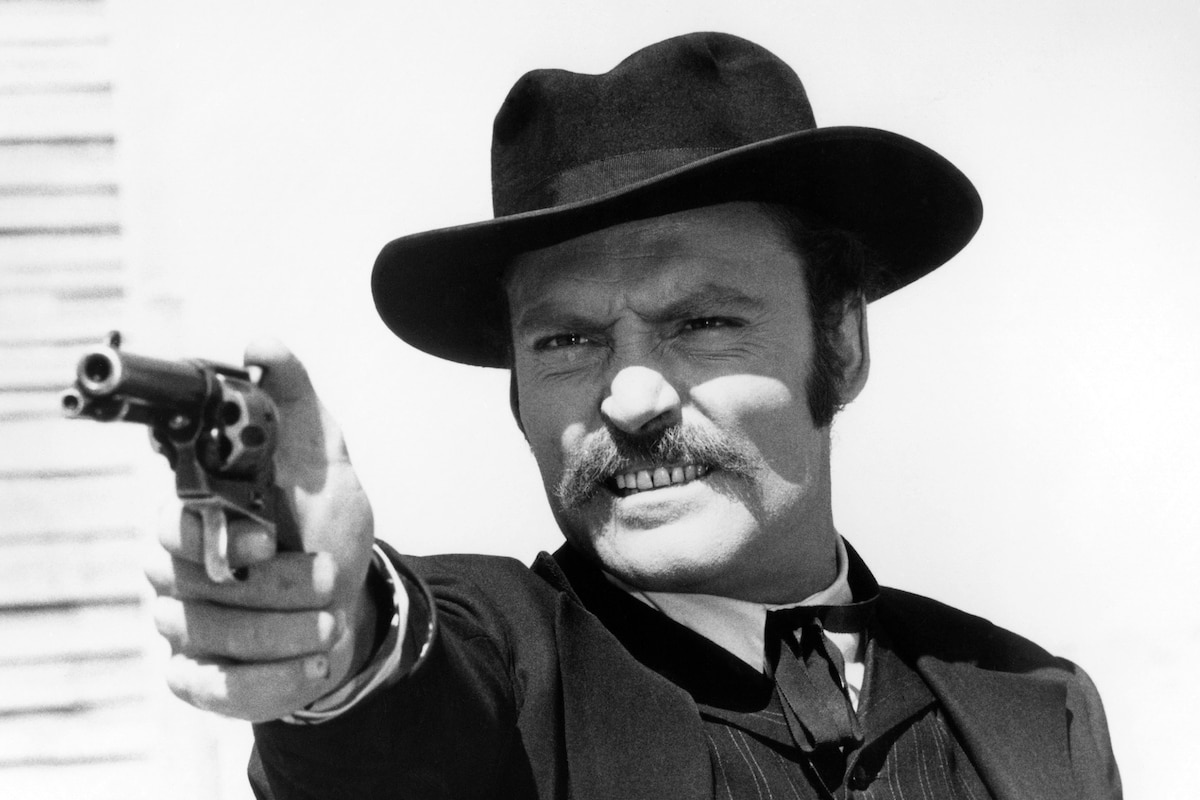
The true revelation in this version of Holliday's story is the central performance by Stacy Keach, who had yet to appear in his star-making role in John Huston's Fat City (1972). Oddly enough, the actor looks much older and more mature in Perry's film, but perhaps the mustache and the grimy forehead add a couple years of pain and gain. Keach doesn't crack a smile in this film, but he manages to win us over with his confident charm and self-assuredness while playing Holliday with the complexity of a man wrestling with his mortality (the story catches us as Doc is deep into his struggle with tuberculosis, staining handkerchiefs with blood and escaping the pain with opium).
There's some handling of female characters that's a little harder to swallow, with Perry and screenwriter Pete Hamill opting for a version of the West in which all women were prostitutes or madams, but thankfully Faye Dunaway lends her take on Katie Elder a depth of self-respect and pathos that moves her beyond archetype.
What's refreshing about Doc is seeing the grittiness of a new age of Westerns leaking into the frame. Peckinpah revolutionized the genre two years earlier with The Wild Bunch (1969) and without it one wonders if the gunshot wounds in Perry's film would be as bloody and visceral as they are. There's also a general dirtiness to the film that never wears off: Keach stays dust-covered and bloodied while Dunaway's matted hair and dry skin bear the weight and whip of the desert wind. There's also an interesting performance from Harris Yulin as Wyatt Earp, who plays the role with a lot less confidence and bravura than Henry Fonda did in My Darling Clementine (1946). While making comparisons, it's fair to say that Keach's Holliday is a far cry from Victor Mature's suave dentist turned gunslinger, too.
Doc deserves greater recognition, for its take on the harsh west and the legendary figures who gave it color, both in fact and fiction.
By Thomas Davant
Doc
by Thomas Davant | January 27, 2010
SIGN UP FOR OUR NEWSLETTERS

CONNECT WITH TCM