A leading light of art house theaters in the 1950s and the director who almost single-handedly brought international attention to Japanese cinema with such films as Rashomon (1950) and Seven Samurai (1954), Akira Kurosawa had, by the early 1970s, almost fallen off the global radar but also found it impossible to get backing for a planned epic even in his own country. Turning out smaller unsuccessful projects and working in Siberia with Soviet backing (on Dersu Uzala [1975]), the man generally considered Japan's greatest filmmaker was driven by this reversal of fortune (and deteriorating eyesight) to a failed suicide attempt. Then Hollywood directors Francis Ford Coppola and George Lucas stepped in, providing financing for the samurai epic he had long hoped to make, Kagemusha (1980). The sweeping, colorful story was a world sensation but not universally admired by critics. Today, some see it as a dry run for the masterpiece that would follow a few years later, Ran (1985), which restored him to the respect he once enjoyed, even if it wasn't a big financial success in relation to its $12 million budget.
It helped that he took as his narrative model another country's national treasure that had a universal impact. This wasn't the first time Kurosawa had borrowed from Shakespeare. Throne of Blood (1957, aka Kumonosu-jou) transposed Macbeth to medieval Japan with Kurosawa's frequent star Toshiro Mifune bringing his characteristic intensity to the role of a ruthlessly ambitious warlord. At 75, nearly blind and having come through the wilderness of rejection and depression, Kurosawa was now ready to tackle Shakespeare's great tragedy King Lear. For the leading role of an elderly lord who divides his realm among his sons with disastrous results, he cast his other frequent muse and one of Japan's biggest stars Tatsuya Nakadai (Kurosawa and Mifune were by then estranged). The result was a stunning 16th century tale whose combination of deep personal drama and epic battle scenes was called by critics "a great, glorious achievement" and "as close to perfect as filmmaking gets," winning numerous awards and legions of fans worldwide. Kurosawa had returned to his old glory, but the road there even after the success of Kagemusha was not that easy.
Kurosawa had been preparing this one for a decade, even before the production of Kagemusha, making hundreds of highly detailed storyboard illustrations, which was a career-long practice for the artist who had once trained as a painter. The scope of the picture, however, would be huge, and he began to despair once again that backing could ever be secured. It was finally made possible through a deal put together by Serge Silberman, the French producer of Luis Bunuel's later films, who risked his own money on what would become the most expensive Japanese film made up to that time.
To view Ran simply as a transposition of King Lear would be to sell it far short. Shakespeare's tragedy aims for a kind of emotional catharsis that Kurosawa never attempts; instead, he tells his story from the viewpoint of a silent deity, remote from the horrifying action unleashed upon the earth by the lust for power and blood of a wantonly greedy and ambitious humanity. In fact, Kurosawa didn't go directly to King Lear for inspiration but came to his story through the well-known history of the medieval Lord Mori who, according to legend, had three sons, each of whom was handed a single arrow and asked to break it. But when three arrows were held together, nobody could fracture them. "When I read that three arrows together are invincible, that's not true," Kurosawa said in an interview about the genesis of the screenplay. "I started doubting, and that's when I started thinking: the house was prosperous and the sons were courageous. What if this fascinating man had bad sons?" The link to the Mori legend is made obvious and shattered in a scene in Ran in which the third son smashes the three arrows across his knee. By going back to Japanese history, Kurosawa also took care of what he felt was a shortcoming of Shakespeare's play, the lack of a back story for the characters. Kurosawa gave the abdicating Lord Hidetora and his family a history that shapes and fuels the revenge and betrayal on which the narrative hinges.
Stylistically, Ran takes its cue from not only Kurosawa's earlier period action films (with the humor and robustness of, say, Seven Samurai, giving way to a bleaker and more dispassionately beautiful approach) but also to the traditions of classical Noh theater, whose highly symbolic stylization is evident in such aspects of the movie as acting, costume, and soundtrack. Sound is used as a particularly evocative device in the film, from the sliding of silk garments across a polished floor to Toru Takemitsu's majestic, mournful score, which replaces the ambient sound of battle to chilling effect; it won awards from the Japanese Academy and Los Angeles Film Critics.
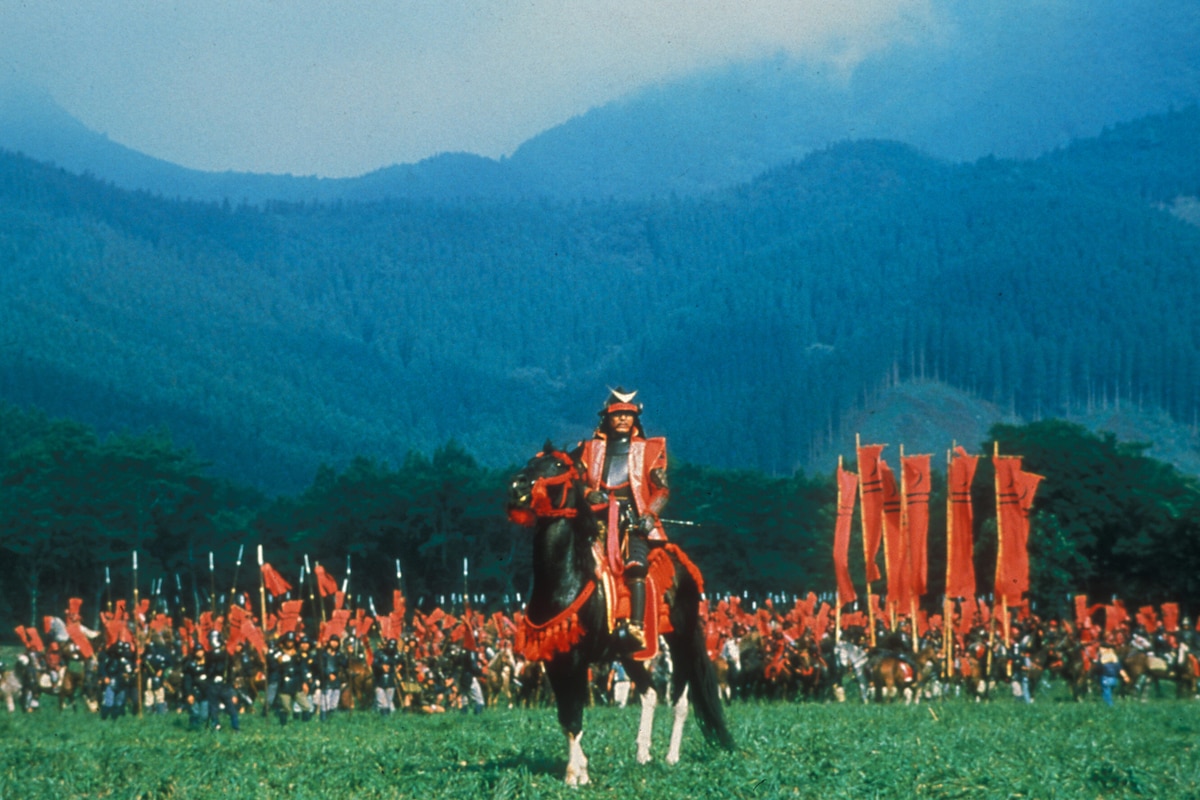
Almost 1,400 extras were employed for Ran, each requiring a uniform or suit of armor hand-made over the course of two years. The film also used 200 horses, many of which were imported from the U.S. Location work was done primarily in the mountains and plains around Mount Aso, Japan's largest active volcano. Kurosawa also got permission to shoot at ancient castles that are among the country's most famous historic sites. For the third castle of the abdicated Lord Hidetora, Kurosawa eschewed the use of miniatures and had a complete building erected on the slopes of Mount Fuji for the sake of burning it down in one of the film's most memorable scenes.
The title, Ran, is the Japanese character for "chaos" or "revolt." Chaos is a particularly apt word for a film whose subtext, as Kurosawa explained in a 1985 interview, is the threat of nuclear apocalypse a notion bolstered by the fact that the second-unit director here, Ishiro Honda, directed Godzilla (1956), Rodan (1956), and several others of the famous 1950s-60s series of Japanese atomic-age monster films.
Kurosawa's wife of 39 years, the former actress Yoko Yaguchi, died during production of Ran. He halted filming for one day of mourning before resuming work.
Director: Akira Kurosawa
Producers: Katsumi Furukawa, Serge Silberman
Screenplay: Akira Kurosawa, Hideo Oguni, Masato Ide
Cinematography: Asakazu Nakai, Takao Saito, Shoji Ueda
Editing: Akira Kurosawa
Production Design: Shinobu Muraki, Yoshiro Muraki
Original Music: Toru Takemitsu
Cast: Tatsuya Nakadai (Hidetora), Akira Terao (Taro), Jinpachi Nezu (Jiro), Daisuke Ryu (Saburo), Mieko Harada (Lady Kaede), Peter (Kyoami).
C-163m. Letterboxed.
by Rob Nixon
Ran
by Rob Nixon | January 26, 2010
SIGN UP FOR OUR NEWSLETTERS

CONNECT WITH TCM