The first color film for director Akira Kurosawa (Seven Samurai, 1954), Dodes'Ka Den (1970) is a departure on many levels for the director, who was at a difficult point in his career. A much-debated title among film scholars and reviewers, the picture is described as both a failure and a masterpiece.
"Dodes'Ka Den" comes from the sound a trolley makes ("Clickety-Clack") and is chanted over and over at the film's opening by Roku-chan (Yoshitaka Zushi), a retarded slum-dweller who spends each day conducting an imaginary trolley. Roku-chan's is only one story in a poor and troubled tar-paper village. Plagued by hunger, frustration and general want, these characters spend their days finding ways to cope with their dismal situations.
By 1970, five years had passed since Kurosawa had given audiences the well-received Red Beard (1965). He was temporarily involved in Tora! Tora! Tora! (1970) in 1968 and 1969, but was fired by Twentieth Century-Fox, resulting in a very public squabble. As he struggled for financial and artistic stability, Dodes'Ka Den stands out as an extremely personal project for Kurosawa, one that met with varied success.
The film is based on The Town Without Seasons a collection of short stories by Shugoro Yamamoto, whose work had been the basis for Sanjuro (1962) and Red Beard. The misery and deprivation on display in Dodes'Ka Den is a switch from the hero themes of Kurosawa's earlier work, which centered on a dominant leader, often played by Toshiro Mifune, against an epic backdrop. This time around, his focus is on the weak and forgotten, in a claustrophobic setting, with no force of deliverance at hand.
Though the subject matter is decidedly downbeat, Kurosawa claimed to be at his happiest while making the film. '[A]s you can see from the snapshots of me while working on the set, I was always smiling and never angry. I enjoyed it heartily,' he said of the experience in The Films of Akira Kurosawa by Donald Richie.
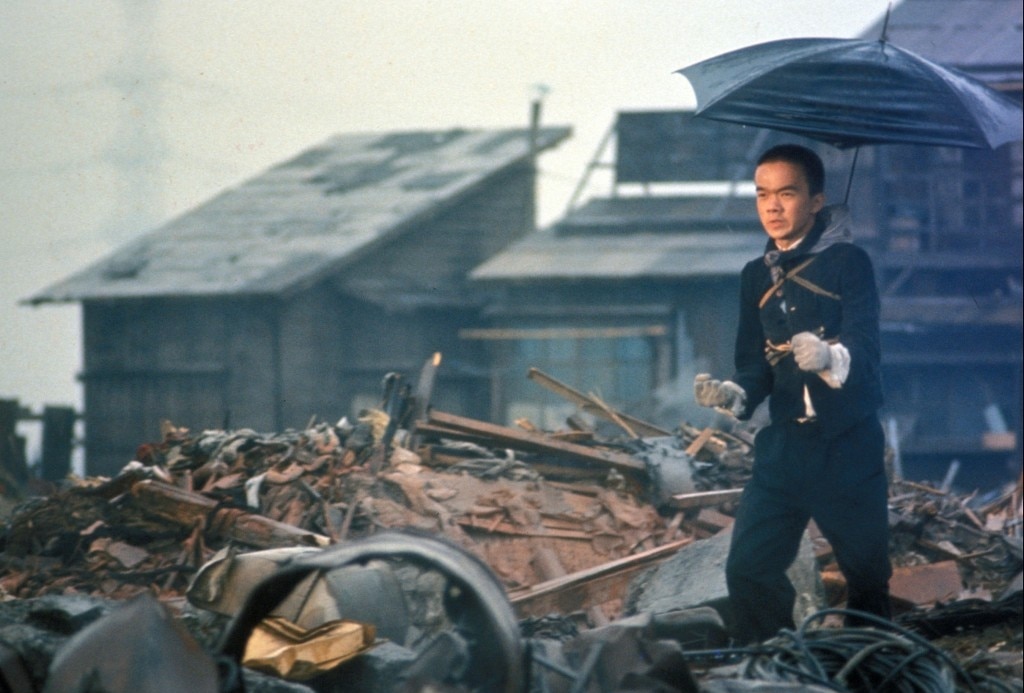
Dodes'Ka Den was shot in a Tokyo dump, using debris collected from the site for all of the outdoor sets. The exteriors were dyed with a spray gun to create vivid pinks, golds and greens-bright, saturated hues that contrast with the characters' bleak lives. Kurosawa shot the film in standard 35mm, rather than Cinemascope, which he had used in The Hidden Fortress (1958) and Red Beard, so that the colors would be distinct and the scenes immediate.
Though legendary for his lengthy production habits, Kurosawa eliminated rehearsals for his actors in Dodes'Ka Den, asking them to improvise. To further increase the realism of the project, he employed a "one scene, one cut" practice throughout the film, avoiding his trademark dissolves and wipes.
In preparation for the film, Kurosawa asked Japanese school children to send in drawings of streetcars, which would cover the inside of Roku-chan and his mother's shack. The response was huge and the final pictures, created by Kurosawa's art department, were inspired by more than 2000 submissions.
Kurosawa attempted suicide a year after the film's release, and despite his words to the contrary, viewers might wonder about the director's mood during the making of Dodes'Ka Den, as Roger Ebert did: "Kurosawa shot in color, he says, so that the closed lives of these people would not look too grim. But Dodes'ka-den is a tragedy in any case....Kurosawa seems to have been obsessed with pessimism, with dark thoughts about the aimlessness of human existence."
Producers: Akira Kurosawa, Yoichi Matsue
Director: Akira Kurosawa
Screenplay: Akira Kurosawa, Hideo Oguni, Shinobu Hashimoto; Shugoro Yamamoto (novel, "Kisetsu no nai machi")
Cinematography: Yasumichi Fukuzawa, Takao Saito
Art Direction: Shinobu Muraki, Yoshiro Muraki
Music: Toru Takemitsu
Film Editing: Reiko Kaneko
Cast: Yoshitaka Zushi (Roku-chan), Kin Sugai (Okuni), Toshiyuki Tonomura (Taro Sawagami), Shinsuke Minami (Ryotaro Sawagami), Yuko Kusunoki (Misao Sawagami), Junzaburo Ban (Yukichi Shima), Kiyoko Tange (Mrs. Shima), Michio Hino (Mr. Ikawa), Keiji Furuyama (Mr. Matsui), Tappei Shimokawa (Mr. Nomoto), Kunie Tanaka (Hatsutaro Kawaguchi), Jitsuko Yoshimura (Yoshie Kawaguchi), Hisashi Igawa (Masuo Masuda), Hideko Okiyama (Tatsu Masuda), Tatsuo Matsumura (Kyota Watanaka), Imari Tsuji (Otane Watanaka), Tomoko Yamazaki (Katsuko Watanaka), Masahiko Kametani (Okabe), Hiroshi Akutagawa (Hei), Tomoko Naraoka (Ocho).
C-140m. Letterboxed.
by Emily Soares
Dodes'Ka-Den
by Emily Soares | January 26, 2010
SIGN UP FOR OUR NEWSLETTERS

CONNECT WITH TCM