Yojimbo ("Bodyguard," 1961) was intended by the maverick Japanese writer-director Akira Kurosawa to serve as a rejoinder to the stoic, po-faced swordplay pictures (or chambara) being cranked out by such Japanese studios as Nikkatsu, Toei and Daiei. Stripping conventional notions of honor from his tale of a wandering samurai (Toshiro Mifune), who goes by the poetic alias of Sanjuro ("Thirty years old"), Kurosawa introduced to the international action genre the archetype of a scruffy but wily antihero who plays one side of a local struggle against the other to his own advantage. The success of Yojimbo both at home (it was the nation's third biggest money-earner) and abroad (Sergio Leone studied the film frame by frame on a Moviola prior to shooting A Fistful of Dollars [1964]) demanded a sequel.
Kurosawa had intended Sanjuro (1962) to be an entirely different film, which he had written prior to beginning Yojimbo as a project for Hiromichi Horikawa, his chief assistant director on Seven Samurai (1954) and Throne of Blood (1957). When Toho executives prevailed upon Kurosawa to helm the project himself, he worked with writers Hideo Oguni and Ryuzo Kikushima to fashion a new draft, shaping his protagonist as more Yojimbo-like, swift of sword and sharp of intellect. The original story had been based on a tale by Shugoro Yamamoto, whose writings would later serve as the basis for Kurosawa's hospital drama Red Beard (1965); by the time Kurosawa, cast and crew brought Sanjuro before the cameras in later 1961, only one-third remained of his original script.
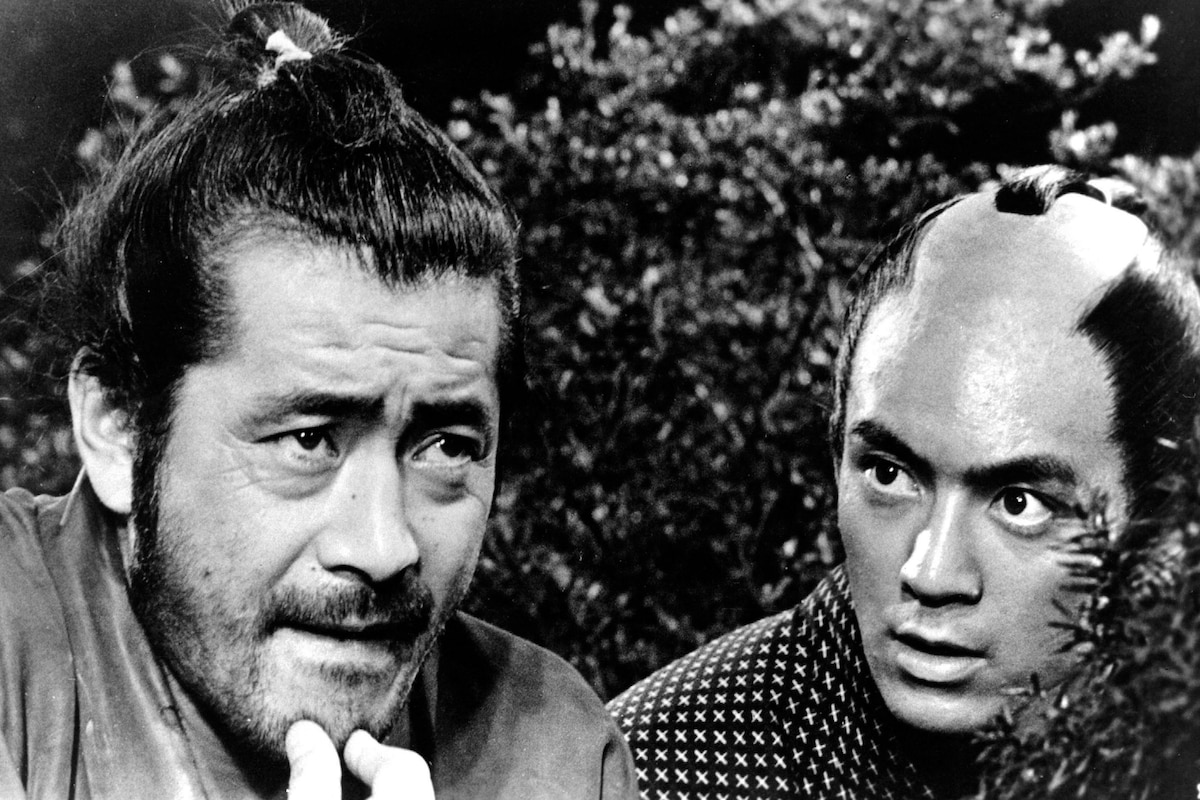
The making of Sanjuro was relatively easy for Kurosawa and reunited him with actor Toshiro Mifune, with whom he would make sixteen films between 1948 and 1965. Kurosawa had first clapped eyes upon the impoverished army veteran in 1946 while judging an open audition for Toho's "New Faces" program, a bid to replenish the studio's ranks, which had been thinned by wartime attrition. For the try-outs, candidates were asked to act out a single emotion. Mifune was given "anger" and his approximation of unbridled fury impressed Kurosawa. Yojimbo and Sanjuro afforded the pair a chance to lighten up between the more technically complex The Bad Sleep Well (1960) and High and Low (1963) and their enjoyment is communicated in this wry, playful film. Mifune once again brought to bear his gift for defining character through telling gestures. "Shrugging and scratching myself were my own ideas," the actor admitted in an interview with Film Daily. "I used these mannerisms to express the unemployed samurai, penniless, wearing a dirty kimono. Sometimes this kind of man felt lonely, and these mannerisms characterize the loneliness." Mifune had turned forty between the original film and its sequel and was no longer the boundlessly enthusiastic loose cannon whose unfettered wildness had almost cost him a Toho contract; though his performance appears effortless, the actor was left exhausted by scenes in which Sanjuro single-handedly dispatches multiple opponents in a manner of seconds. "I was young then," Mifune recalled in later years, "but I thought my heart would explode."
As Mifune was playing a subtly shaded variation on his Yojimbo protagonist, so does that film's villain, Tatsuya Nakadai, return to Sanjuro in the role of an entirely different nogoodnik. Nakadai's juicy comeuppance at the hands of Mifune's masterless ronin - an arterial eruption achieved with a highly pressurized blast of chocolate syrup mixed with carbonated water is no less unexpected or jarring today than it was in 1961. One of the hallmarks of Kurosawa's jidai-geki ("period dramas") was an insistence on realistic consequences for violence, down to the sound of a samurai sword being run through a man's abdomen. The filmmaker had sound editor Ichiro Minawa experiment with cutting through various kinds of meat to achieve the proper sound effect. Minawa's tests revealed that pork and beef were too tender (the sundered cuts were then prepared for the crew's lunch) and chicken won out as sounding best when stabbed. Kurosawa's patented geysers of blood took Japanese audiences by complete surprise, shocking moviegoers into hysterics nearly a decade before the same effect was popularized in the west by such directors as Arthur Penn and Sam Peckinpah.
Shot close to Toho, Sanjuro was inexpensive to make but yielded a huge return on the studio's modest investment, bettering the profit on Yojimbo. Toho Studios turned thirty in 1962 and enjoyed big returns on several of its productions, most notably Hiroshi Inagaki's Tatsu and his epic remake of Chushingura (both featuring Toshiro Mifune) and Ishiro Honda's King Kong vs. Godzilla.
The working relationship of Akira Kurosawa and Toshiro Mifune would suffer an irreparable rift mid-decade and the pair never worked together again post-Red Beard. It would be five years before Kurosawa realized a new film (the interim having been filled with abortive projects and a dispiriting gig with 20th Century Fox, directing battle scenes for Tora! Tora! Tora!, 1970) but he only made just two features during the whole of the next decade. Mifune, on the other hand, settled into an international career. The actor contributed iconic turns to John Frankenheimer's Grand Prix (1966), John Boorman's Hell in the Pacific (1968), Terence Young's Red Sun (1971) and Steven Spielberg's 1941 (1979) while continuing to appear in Japanese films. (Mifune tested for the part of martial arts mentor Mr. Miyagi in John Avildsen's The Karate Kid [1984] but was felt to lack the cuddly quality which Japanese-American actor Pat Morita brought to the movie.) Hobbled by strokes and suffering from the onset of Alzheimer's disease, Mifune was reunited with Kurosawa at the funeral for Ishiro Honda in 1993. The reconciliation came too late to make a difference professionally. Kurosawa had already directed his last film and Mifune had but two more film appearances in him. Predeceased by both his wife and younger brother and confined to a hospital bed, Toshiro Mifune succumbed to organ failure on December 24, 1997. Pressed for a statement by reporters, Akira Kurosawa spoke directly to his departed friend, saying "Thank you...and rest in peace." Kurosawa himself died nine months later, on September 6, 1998.
Director: Akira Kurosawa
Screenplay: Ryuzo Kikushima, Akira Kurosawa, Hideo Oguni; Shugoro Yamamoto (novel, "Peaceful Days")
Cinematography: Fukuzo Koizumi, Takao Saito
Music: Masaru Sato
Film Editing: Akira Kurosawa
Cast: Toshiro Mifune (Sanjuro Tsubaki/The Samurai), Tatsuya Nakadai (Hanbei Muroto), Keiju Kobayashi (The Spy), Yuzo Kayama (Iori Izaka), Reiko Dan (Chidori - Mutsuta's daughter), Akihiko Hirata (Samurai), Takashi Shimura (Kurofuji), Kamatari Fujiwara (Takebayashi), Takako Irie (Mutsuta's wife), Masao Shimizu (Kikui), Yunosuke Ito (Mutsuta the Chamberlain).
BW-96m. Letterboxed.
by Richard Harland Smith
Sources:
The Films of Akira Kurosawa by Donald Richie
The Emperor and the Wolf: The Lives of Toshiro Mifune and Akira Kurosawa by Stuart Galbraith, IV
Something Like an Autobiography by Akira Kurosawa
Sanjuro
by Richard Harland Smith | January 26, 2010
SIGN UP FOR OUR NEWSLETTERS

CONNECT WITH TCM