Synopsis: Kingo Gondo, an executive for a shoe manufacturing company in Yokohama, Japan, fights to gain control of the company when his colleagues pressure him to accept a flimsier but more profitable style of shoe. Soon after he mortgages his home in order to purchase a controlling share of stock, the chauffeur's son is kidnapped by mistake instead of his child. He faces a terrible choice: pay the ransom and lose his entire fortune, or refuse to pay and risk the boy's life. In the meantime, the city's police force is engaged in a systematic hunt for the elusive and intelligent kidnapper.
High and Low (1963) is a free adaptation of Ed McBain's (1959) novel King's Ransom, which is part of the author's 87th Precinct series. While the McBain novel provided the basic plot, Kurosawa deepened it with his own moral and social dimensions. The original Japanese title--Tengoku to jigoku--translated literally as "Heaven and Hell"--points to the growing class divide in Japanese society that accompanied its economic boom during the postwar era. As Steven Prince points out, Kurosawa used the kidnapping plot to draw attention to Japan's lax kidnapping laws and the increasing problem of kidnapping and child murders in the late Fifties and early Sixties. Partly because of the film's impact in Japan, the laws were changed a year later to allow life sentences for kidnapping for ransom.
The film's setting--the port city of Yokohama--is also significant. Rebuilt after being destroyed by firebombing during World War II, the city reflects the dramatic changes that Japanese society underwent in the decades immediately following the war. In the central section of the film, we see a crowded nightclub filled with foreigners, especially American military personnel. We also visit "drug alley," and see the city's squalid slums directly juxtaposed with Kingo Gondo's hilltop mansion, which sports rare amenities such as air conditioning. Finally, like Kurosawa's earlier The Bad Sleep Well (1960), the film as a whole touches upon the problem of corporate corruption.
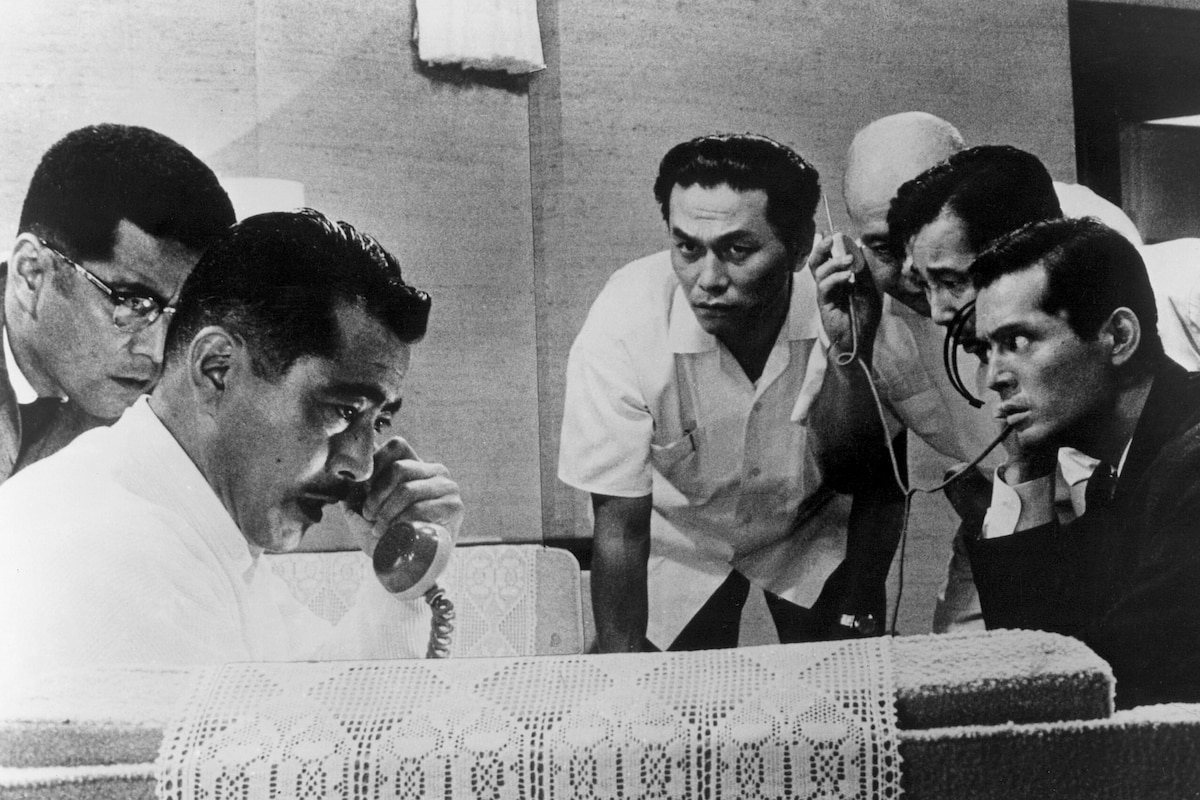
In terms of visual style, High and Low remains a remarkable achievement. In the first hour of the film the director stages the action as a taut chamber drama, taking advantage of the wide screen to create shifting visual arrangements of the characters as the drama unfolds. In particular, Gondo's positions often express his relationships with the other characters and their conflicting demands which he must sort out. In order to preserve the integrity of the actors' performances, Kurosawa filmed these scenes as single, uninterrupted takes, with two or sometimes three cameras filming the action simultaneously. The cameramen generally filmed from a distance to avoid interfering with the actors and to allow for maximum camera mobility. Telephoto lenses enabled them to move into close-ups without actually getting too close to the actors. Later, in the editing room Kurosawa cut back and forth between the different camera angles to give the film its deliberate, but insistent rhythms. In the documentary It Is Wonderful to Create, the actress Kyoko Kagawa (who played Reiko Gondo) recalls: "The atmosphere on the set was quite intense due to the long takes. Shooting a scene in one long take eliminates extraneous things and creates a concentrated energy." Kurosawa was pleased enough with the results to make this the primary shooting method in his later films. The mansion's interior was in fact filmed in two different sets--one with a view of Yokohama and an exact replica of the mansion's living room on a studio soundstage, with a nighttime view of the city constructed in miniature outside the balcony.
If the opening section is self-consciously theatrical, the train sequence is an intricately coordinated tour-de-force filmed with multiple cameras on an actual high-speed train. In yet another stylistic shift, Kurosawa stages the film's haunting final confrontation as a seemingly straightforward shot/reverse shot pattern that uses reflections in a glass window to comment subtly on the characters. Thanks to its compelling plot, rich social dimension and superb visual style, High and Low is now widely considered one of the greatest works of Kurosawa's career.
Director: Akira Kurosawa
Producers: Ryuzo Kikushima, Tomoyuki Tanaka
Screenplay: Hideo Oguni, Eijiro Hisaita, Ryuzo Kikushima, Akira Kurosawa
Adapted from King's Ransom by Ed McBain
Cinematography: Asakazu Nakai, Takao Saito
Production designer: Yoshiro Muraki
Music: Masaru Sato
Costumes: Miyuki Suzuki
Principal Cast: Toshiro Mifune (Kingo Gondo), Tatsuya Nakadai (Inspector Tokura), Kyoko Kagawa (Reiko Gondo), Toshio Egi (Jun Gondo), Tatsuya Mihashi (Kawanishi, Gondo's secretary), Yutaka Sada (Aoki, the chauffeur), Masahiko Shimazu (Shinichi Aoki), Tsutomu Yamazaki (Takeuchi, the medical intern), Isao Kimura (Detective Arai), Kenjiro Ishiyama (Head detective "Bos'n" Taguchi), Takeshi Kato (Detective Nakao), Yoshio Tsuchiya (Detective Murata), Takashi Shimura (Chief of Investigation Headquarters).
BW-144m. Letterboxed. Closed Captioning.
by James Steffen
SOURCES:
The Warrior's Camera and Criterion Collection DVD commentary track by Steven Prince
Akira Kurosawa: It is Wonderful to Create (2002), directed by Yoshinari Okamoto.
High and Low
by James Steffen | January 26, 2010
SIGN UP FOR OUR NEWSLETTERS

CONNECT WITH TCM