The Hidden Fortress (Kakushi Toride no Sanakunin, 1958) marks an important point in director Akira Kurosawa's career, and it represents a noteworthy twist on established Japanese storytelling traditions, but after a major re-release in 1984, the film has become mostly known in America as an influence on George Lucas's Star Wars (1977).
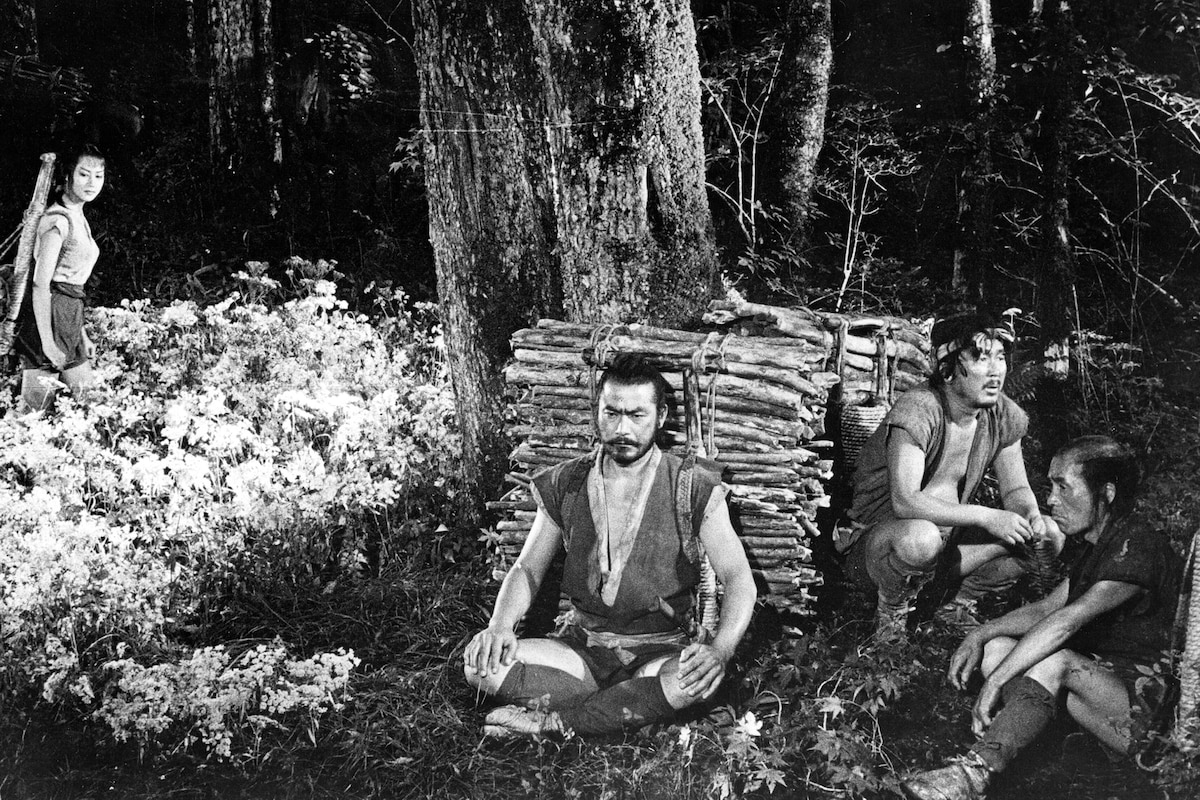
Set in the 16th-century, a time of civil war among Japanese clans, The Hidden Fortress chronicles the journey of a princess and her motley crew of protectors as they flee across hostile territory with her clan's gold treasure toward a friendly province where she will be safe. Princess Yuki, who is disguised as a mute girl, is protected by General Rokurota Makabe. The pair is joined by two bickering, bumbling farmers who are motivated by their greed for the gold, and a servant girl whom they rescue from the clutches of her cruel employer. Danger lurks down every path as enemy clans offer a reward for the Princess's capture, track the group relentlessly across harsh terrain, and plot to kill the princess in order to destroy her chance to reign. Fiery Princess Yuki, who is played by 20-year-old Misa Uehara, dresses like a man, brandishes a rod that she is not afraid to use on anyone, and shows no weakness. As played by Japan's legendary star Toshiro Mifune, Makabe seems a bastion of strength, courage, and loyalty. The two perpetually quarreling farmers are depicted with great charm and wit by Minoru Chiaki and Kamatari Fujiwara. The group's journey is marked by exciting adventures and remarkable feats of great courage punctuated by scenes of humor.
When considering the mythic nature of the heroic journey, with the fate of the princess's people hanging in the balance, the story's similarities to Star Wars become obvious. Likewise, the bumbling farmers and their incessant bickering recall the robots R2D2 and C-3PO, while a feisty, weapon-brandishing princess who is desperate to save her kingdom is the very description of Princess Leia. The dry, barren landscape of the enemy's territory brings to mind the harshness of the desert planet in Star Wars. Even Lucas's extensive use of unusual wipes, including a clock wipe, seems inspired by Kurosawa's measured horizontal wipes to signify major shifts in time and locale. Much has been made of the influence of western literature and films on Kurosawa's work and, in turn, the ways in which the Japanese filmmaker inspired the work of Hollywood directors. Gorky and Shakespeare inspired Kurosawa's The Lower Depths (1957) and Throne of Blood (1957); Kurosawa's Rashomon (1950) influenced Martin Ritt's The Outrage (1964) while his The Seven Samurai (1954) begot The Magnificent Seven (1960). The Hidden Fortress's impact on Star Wars is arguably every movie buff's favorite example of Kurosawa's appeal to western filmmakers, which added to his name recognition in America. Yet, to define The Hidden Fortress by its connection to a legendary Hollywood blockbuster is to simplify its complex use of various storytelling conventions and its important place in Kurosawa's career; it also reduces its stature.
The Hidden Fortress marked Kurosawa's first use of the widescreen format, and it would be the last film that he made for the Toho Company with whom he started his career. Widescreen had exploded in popularity in Japan the previous year when the anamorphic war epic The Emperor Meiji and the Great Russo-Japanese War (1957) from rival studio Shintoho became Japan's highest-grossing film. Other studios quickly embraced widescreen, and by the second half of 1958, 84% of Toho's films were slated to be shot in scope. Many Japanese directors who specialized in the historical dramas called jidai-geki and the fantasy adventures known as chambara took advantage of the widescreen format to showcase action sequences and to open up the choreography of sword-fighting scenes. The decision to shoot The Hidden Fortress in widescreen was prompted by the sudden vogue for this format, and the film became part of the parade of scope films that poured out of Japan in 1958. Though it was Toho that pushed for widescreen, the format certainly suited Kurosawa's style, with his preference for long takes and precise compositions, his use of deep-focus photography with multiple planes of action, and his tendency to block actors along diagonal lines. Most of all, widescreen exploited Kurosawa's use of movement in the frame, amplifying the sense of visual energy that had always marked his style.
In the opening scene of The Hidden Fortress, two farmers emerge from the bottom of the screen walking toward the horizon as the camera (and the viewer), tracks behind them. The position of the camera forces the viewer to become a part of their journey, which will likely be a long and difficult one, judging by the vast rocky terrain that lies ahead of us. From this opening shot, Kurosawa has established that moving forward, or traveling onward, will be a dominant idea in the film. As the farmers stumble along bickering, the frame is suddenly filled with movement when a desperate samurai steps in front of them pursued by a group of soldiers on horseback. The soldiers ride up and slaughter him, then leave as quickly as they came. In another example of exquisite onscreen movement, General Makabe races on horseback along a long, narrow road to catch up with three enemy soldiers who have recognized the Princess and her companions. The camera pans with the soldiers as they rush past and away, a shot that is repeated three times with the camera farther down the road each time. Edited together, the four shots are exhilarating. In the last shot, after the General has dispatched the last soldier, the camera races along with the General as he rushes through a gate and into the enemy's fort, unable to pull his horse up in time. Like General Makabe, the audience is shocked to have raced right into the enemy's hands.
Lighter in tone than Throne of Blood and The Lower Depths, Kurosawa's two previous films, The Hidden Fortress represented the director's deliberate efforts to focus on fun and entertainment. The film's rousing adventure, fairy-tale characters, and comic set pieces epitomize the formula for the chambara yet Kurosawa's control of filmmaking techniques and his sophisticated use of western and Japanese influences in the narrative elevate it to something more.
The basis for the storyline came from screenwriter Ryuzo Kikushima, who grew up in the Yamanishi Prefecture. Kikushima claimed that the area was home to a real hidden fortress, and his personal tale from his homeland provided the start of the story. Kikushima claimed the story was shaped by the American western. The plot also shares elements with previous Kurosawa projects, including his film The Men Who Tread on the Tiger's Tail (1945) and his script for Kazuo Mori's Advance Patrol (1957). More importantly, the structure of the narrative recalls that of a Noh play, a form of classical musical drama that is part of Japan's cultural tradition. The conventions of Noh dramas are highly codified with an emphasis on maintaining traditions rather than introducing new twists or innovations, and characters in Noh dramas are masked. In The Hidden Fortress, Princess Yuki is in disguise for most of the story, just like gods and demons are in disguise in Noh plays. At the conclusion, the princess is revealed to be her true royal self, which is similar to the endings of Noh dramas. Both the princess and General Mokabe maintain an expression of bold determination that rarely changes throughout the film-much like a mask. The princess's look in particular was based on a picture of a Noh mask that Kurosawa found in a book. The music in key scenes, including the scene in which Princess Yuki first appears and the conclusion when the princess and two generals are presented as heroes, recalls the specific sounds and notes of Noh music.
v
The Noh dramas are very much like myths, which are akin to the fairy-tale nature of Kurosawa's narrative. And, yet, the romance of the adventure, and the focus on loyalty, courage, and self-sacrifice are the stuff of legends and myths from all over the world, giving The Hidden Fortress a universal appeal.
Despite the help of some of Kurosawa's long-time cast and crew members, including actors Chiaki, Fujiwara, and Mifune, composer Masaru Sato, and art director Yoshiro Muraki, The Hidden Fortress was difficult to make. Weather conditions extended the shooting schedule, typhoons destroyed sets, and delays caused the budget to skyrocket. Fortunately, The Hidden Fortress proved to be a major box office success, earning just over $1 million. It won the Tokyo Blue Ribbon Prize as Best Picture, and the following year, Kurosawa was awarded a Silver Bear for Best Director at the Berlin International Film Festival.
In 1959, the director finally felt successful enough to establish his own production company, Kurosawa Productions, though his offices were on the Toho lot and the studio owned 55% of the company's shares. However, the new arrangement allowed Kurosawa total creative control and freedom from studio interference.
Producers: Masumi Fujimoto, Akira Kurosawa
Director: Akira Kurosawa
Screenplay: Shinobu Hashimoto, Ryuzo Kikushima, Akira Kurosawa, Hideo Oguni
Cinematography: Ichio Yamazeki
Music: Masaru Sato
Film Editing: Akira Kurosawa
Cast: Toshiro Mifune (General Rokurota Makabe), Misa Uehara (Princess Yuki), Minoru Chiaki (Tahei), Kamatari Fujiwara (Matakishi), Takashi Shimura (The Old General Izumi Nagakura), Susumu Fujita (General Hyoe Tadokoro), Eiko Miyoshi (Old Lady-in-Waiting), Toshiko Higuchi (Farmer's Daughter bought from slave trader), Koji Mitsui (Guard), Shiten Ohashi (Samurai), Kichijiro Ueda (Slave Trader), Ikio Sawamura (Gambler).
BW-139m. Letterboxed.
by Susan Doll
The Hidden Fortress
by Susan Doll | January 26, 2010
SIGN UP FOR OUR NEWSLETTERS

CONNECT WITH TCM