The title Kind Hearts and Coronets comes from the Tennyson poem Lady Clara Vere de Vere: "Kind hearts are more than coronets / And simple faith than Norman blood."
Much of Kind Hearts and Coronets was shot on location at Leeds Castle in Kent, England. The castle has a fascinating history that dates back to its original construction in 1119. It was the home to six medieval queens of England before becoming privately owned. Since its days attached to royalty, the castle has also served as a prison and a convalescent home. Currently Leeds Castle is a beautiful tourist destination that attracts visitors from all over the world.
Kind Hearts and Coronets was the first of four films total that Alec Guinness made with director Robert Hamer. The others were Father Brown (1954), To Paris with Love (1955) and The Scapegoat (1959).
Writer/director Robert Hamer also directed the wonderfully chilling mirror sequence in the classic 1945 British horror film Dead of Night.
Alec Guinness admitted that he had based his character of the D'Ascoyne Admiral who goes down with his ship on someone he knew. When Guinness had been in the British military, there had once been an admiral who had reprimanded him for wearing a scarf over his uniform on a freezing day. Guinness thought of him on the day they shot his Admiral character's demise into a watery grave. "I am ashamed to say it now," said Guinness, "but I had my little revenge and it tasted sweet."
When Kind Hearts and Coronets was released, it was well-received by critics and audiences who embraced the film's wicked but good-natured humor. Alec Guinness was quickly singled out in rave notices for his tour de force performance. The attention quickly elevated Guinness into the spotlight as one of Britain's most talented and versatile actors. The attention, while certainly deserved, unfortunately eclipsed Dennis Price's memorable turn as Louis, the main character of the story. Price's nuanced characterization of the unapologetic murderer was the glue that held the story together and contributed immeasurably to the film's overall success.
When Kind Hearts and Coronets was released in the U.S. the following year in 1950, the ending had to be slightly changed. The British version had ended on an ambiguous note with Louis realizing with horror that he has left his incriminating memoirs in his prison cell following his release. In order to clarify the situation and satisfy the U.S. censors for American theaters, a new sequence was added in which the executioner and prison head discovered the evidence, leaving no doubt that Louis would pay for his crimes.
Of all the feature films made at Ealing Studios under his direction, Michael Balcon always considered Kind Hearts and Coronets to be his personal favorite. The quality of the film, he felt, would always stand the test of time. He was right. Kind Hearts and Coronets has endured as a shining example of British comedy at its absolute blackest, funniest and best.
The British version of Kind Hearts and Coronets is the one most commonly seen today while the alternate version (featuring the different ending) still occasionally turns up on television.
Famous Quotes from KIND HEARTS AND CORONETS
"I shot an arrow in the air; she fell to earth in Berkeley Square." Louis Mazzini (Dennis Price) after killing Lady Agatha D'Ascoyne by shooting an arrow into her hot air balloon
"While I never admired Edith as much as when I was with Sibella, I never longed for Sibella as much as when I was with Edith." Louis Mazzini (Dennis Price)
"The Reverend Lord Henry was not one of those newfangled parsons who carry the principles of their vocation uncomfortably into private life." Louis Mazzini (Dennis Price)
"It is so difficult to make a neat job of killing people with whom one is not on friendly terms." Louis Mazzini (Dennis Price)
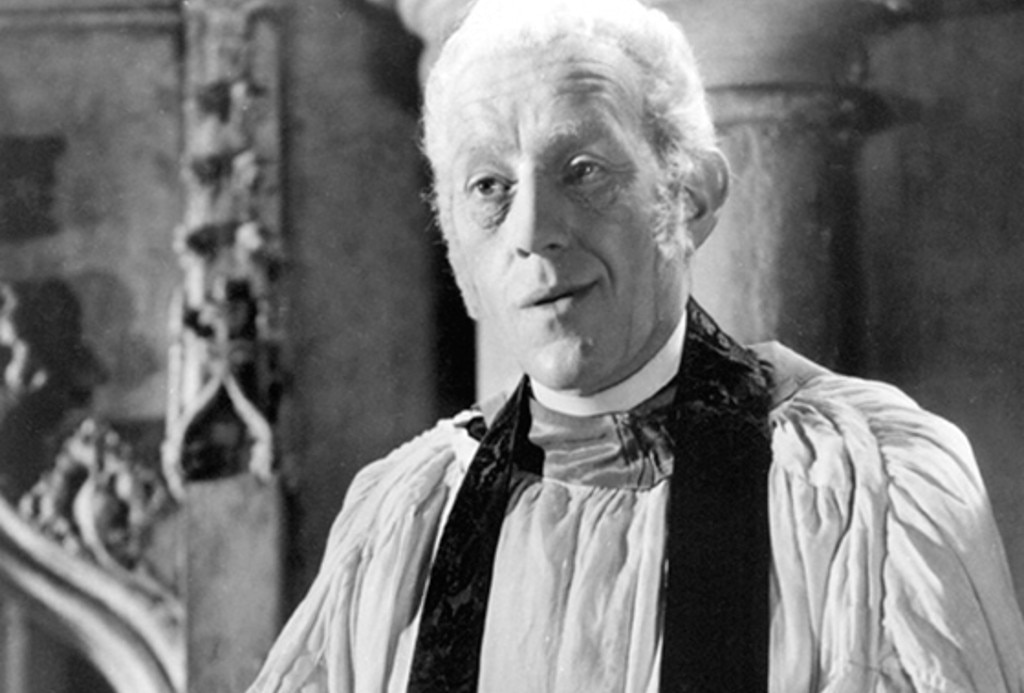
"I always say that my west window has all the exuberance of Chaucer without, happily, any of the concomitant crudities of his period." The Parson (Alec Guinness) to Louis Mazzini (Dennis Price)
"Even my lamented master, the great Mr. Benny himself, never had the privilege of hanging a duke. What a finale to a lifetime in the public service!"
"Finale?"
"Yes, I intend to retire. After using the silken rope, never again be content with hemp."
--Mr. Elliot (Miles Malleson) and Prison Governor (Clive Morton)
"Oh, Louis! I don't want to marry Lionel!"
"Why not?"
"He's so dull."
"I must admit he exhibits the most extraordinary capacity for middle age that I've ever encountered in a young man of twenty-four."
--Sibella (Joan Greenwood) and Louis (Dennis Price)
"He says he wants to go to Europe to expand his mind."
"He certainly has room to do so."
--Sibella (Joan Greenwood) and Louis (Dennis Price) talking about Lionel
"I had not forgotten or forgiven the boredom of the sermon of young Henry's funeral, and I decided to promote the Reverend Lord Henry D'Ascoyne to next place on the list." Louis (Dennis Price) reflecting on who he decides will be murdered next
"I couldn't help feeling that even Sibella's capacity for lying was going to be taxed to the utmost. Time had brought me revenge on Lionel, and as the Italian proverb says, revenge is a dish which people of taste prefer to eat cold." Louis (Dennis Price)
Compiled by Andrea Passafiume
Trivia - Kind Hearts and Coronets - Trivia & Fun Facts About KIND HEARTS AND CORONETS
by Andrea Passafiume | January 25, 2010
SIGN UP FOR OUR NEWSLETTERS

CONNECT WITH TCM