John Ford wanted to shoot My Darling Clementine in Monument Valley, on the southern border of Utah just dipping down into northern Arizona. It had proven to be the perfect site for Stagecoach (1939) and would quickly become his favorite location and the landscape most closely associated with his vision of the Old West. The real town of Tombstone, however, lies at the southern end of the state, closer to the Arizona-Mexico border. So he had a set for the complete town built at a cost of $250,000. Ford also chose Monument Valley because he wanted to bring some business to the economically depressed Navajo community there.
Ford contacted a priest from 86 miles away and brought him to the set, which was down a dirt road, to say Mass on Sundays, mandatory for all religions.
Nights on location for My Darling Clementine were very peaceful and quiet in this remote area of Utah. The only sound that could be heard most evenings, as on many other Ford pictures, was the accordion music played by Danny Borzage, the musician brother of director Frank Borzage and a Ford favorite.
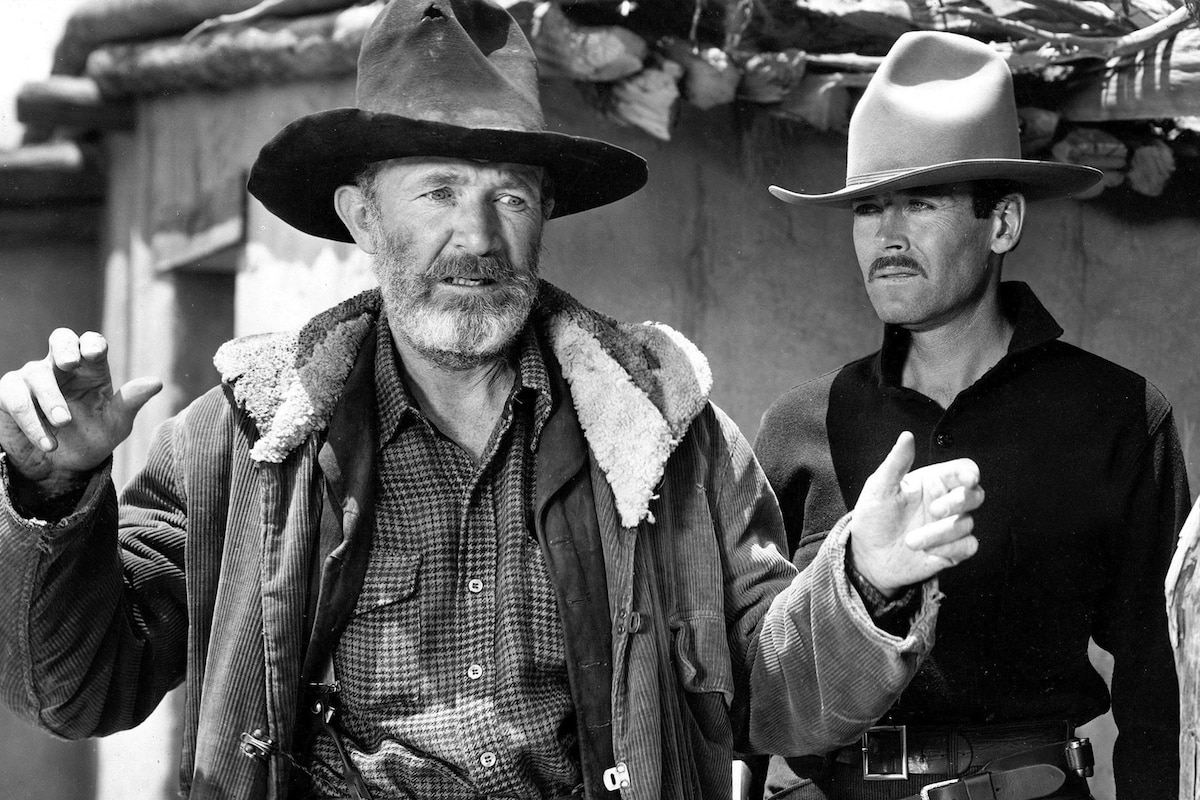
Walter Brennan, John Ireland, and Grant Withers as the Clanton men, were required to do their own riding and shooting in the scene where the clan rides into town during a dust storm. Ford used a powerful wind machine and told the actors to fire their guns close to the horses' ears to make them ride wild.
Home movie footage from the My Darling Clementine shoot shows some actors relaxing on location and others goofing off; Walter Brennan appears solemn and subdued. This was the first Ford picture for the noted character actor - and the last. He didn't like the director at all; it may have been this loathing that translated so effectively on screen into Old Man Clanton's hatred of Wyatt Earp. One time when Brennan was having a little trouble getting into the saddle, Ford yelled, "Can't you even mount a horse?" Brennan shot back, "No, but I got three Oscars® for acting!" Brennan had won Best Supporting Actor awards for Come and Get It (1936), Kentucky (1938), and The Westerner (1940), the most statuettes won by a single actor until Katharine Hepburn's third win (of four) in 1969.
Winston Miller didn't go on location, so minor dialogue changes were made as needed by producer Sam Engel, who later successfully petitioned for a writing credit, a move that angered both Ford and Miller. "I asked him once why he was trying to muscle in on my credit," Miller said. "He said, 'On a John Ford picture a producer credit doesn't mean a thing. Everybody knows he's the producer.'" Ford turned his anger back on Miller, accusing him of not thinking "a Ford credit was worth fighting for."
The location shooting of My Darling Clementine took 45 days.
Darryl Zanuck had sunk about $2 million into the movie's production and was concerned when he saw Ford's cut. "You have a certain Western magnificence and a number of character touches that rival your best work, but to me the picture as a whole in its present state is a disappointment," he told Ford. "If the picture does not live up to my own personal anticipation, it will not live up to the anticipation of a paid audience."
Zanuck insisted that My Darling Clementine would need recutting and felt there was enough raw footage to make most of the changes. He also insisted he be allowed to do it himself without Ford's input, saying "You trusted me implicitly on Grapes of Wrath [1940] and How Green Was My Valley [1941]. You did not see either picture until they were playing in the theaters and innumerable times you went out of your way to tell me how much you appreciated the Editorial work."
Zanuck's changes tightened the narrative and eased the flow of the story, sometimes by cutting only a few words out of a scene. But they also contributed to some odd continuity problems: Chihuahua's black stockings disappear just before she's thrown into the water trough; Wyatt's face is suddenly full of lather before the barber has had a chance to apply it.
Zanuck also forced a reluctant Ford to film the final kiss between Wyatt and Clementine.
Either because Ford objected or was unavailable, Zanuck had studio director Lloyd Bacon shoot the scene of Wyatt standing at his brother James' grave. It's an emotionally affecting scene and closely approximates Ford's pictorial style, but it violates Ford's presentation of Wyatt as a laconic man who doesn't explain or justify himself.
by Rob Nixon
Behind the Camera - My Darling Clementine
by Rob Nixon | January 22, 2010
SIGN UP FOR OUR NEWSLETTERS

CONNECT WITH TCM