SYNOPSIS
Tombstone, Arizona, 1882: Wyatt Earp and his brothers Morgan and Virgil arrive at the lawless boom town for a night of relaxation, leaving their youngest brother James behind to tend their cattle herd. When they return to camp, they discover James is dead and the cattle have been rustled. Determined to stay in Tombstone until he finds his brother's killers, Wyatt accepts the job as marshal and deputizes Morgan and Virgil. In his calm, quiet way, Earp brings a semblance of justice and order to Tombstone despite several tense run-ins with the vicious Clanton gang. He befriends the brooding, hard-living Doc Holliday and begins to fall for Clementine Carter, Doc's former love from back East who has been scouring the West to bring him back home. For a while it seems as if a peaceful life might be possible for Wyatt and the town. Then another brother is murdered by the Clantons and Wyatt vows to settle the score, resulting in the legendary gunfight at the O.K. Corral.
Director: John Ford
Producer: Samuel G. Engel
Screenplay: Samuel G. Engel and Winston Miller, story by Sam Hellman, based on the book Wyatt Earp: Frontier Marshal by Stuart N. Lake
Cinematography: Joseph (Joe) MacDonald
Editing: Dorothy Spencer
Art Direction: James Basevi, Lyle Wheeler
Original Music: Cyril Mockridge, David Buttolph
Cast: Henry Fonda (Wyatt Earp), Linda Darnell (Chihuahua), Victor Mature (Doc Holliday), Cathy Downs (Clementine Carter), Walter Brennan (Old Man Clanton), Tim Holt (Virgil Earp).
BW-97m. Letterboxed. Closed Captioning.
Why MY DARLING CLEMENTINE is Essential
Though still greatly esteemed by auteurists for technical expertise, economy of expression, and pictorial beauty, John Ford has been looked on less kindly by more recent critical analysis, such as that noted by film historian Michael Atkinson, which takes him to task for "clumsy staging, booze-sodden sentimentality, militaristic fetishism, vaudeville overacting, bar brawl camaraderie, and racist war-mongering." What is generally agreed upon is Ford's mastery as a mythmaker and, in his best films, an often breathtaking and expressive visual style; he was greatly aided by the top cinematographers with whom he worked, such as Joseph MacDonald's stunning black-and-white work on My Darling Clementine.
Although in his 50-year career, Ford made movies in almost every genre, he is known first and foremost as a creator of Westerns. He was the film artist who did the most to codify the myth that delineated our nostalgic views of the Old West for so long. His reputation in the genre rests almost exclusively on the last 20 years of his career, and that all began here, in a film that encompasses the finest of his talents, even in the estimation of many of his harshest critics.
There were, of course, his silent Westerns, which are rarely seen today, and Stagecoach (1939), which is still considered a landmark in the genre. But as critic-turned-filmmaker Lindsay Anderson remarked, Stagecoach is very good prose, My Darling Clementine is poetry. As such, fans of Western action may find this less satisfying, if what they most seek are the shoot-em-up thrills of posse pursuits, Indian raids, blazing gunfights, and the like. While the central event of the Wyatt Earp legend is the gunfight at the O.K. Corral, that moment is only the briefest climax to this story (as it was, even more briefly, in real life). What Ford and scenarist Winston Miller concentrate on in My Darling Clementine are the smaller, mundane moments of Earp's life in Tombstone - visits to the barber, a dance on the foundations of a new church, his budding friendship with the tormented and difficult Doc Holliday, his shy attraction to the genteel new woman in town (the Clementine of the title), the visit of a roving Shakespearian actor - even as the plot moves inexorably to the final showdown with the Clantons. So, when violence does occur, it's all the more startling, a necessary but unsettling rupture in the gradual encroachment of civilization into the wild frontier.
The triumph of civilization over the wilderness, so common to the Western and more broadly to the notion of Manifest Destiny, however misguided and damaging that may have been to the American experience, is at the core of My Darling Clementine. The narrative takes great liberties with the true history of Wyatt Earp. It was a more complex and compelling tale than the legend, more insightful of the real West than the popular image of the upstanding lawman, who was "brave, courageous, and bold" (according to the lyrics of the TV theme song for the long-running 1950s Western series about him). Earp's legend as we now know it and as presented here was built by one writer, Stuart Lake, in his 1931 book, Wyatt Earp: Frontier Marshall. It's a measure of Ford's achievement that he created something far superior and more resonant than any of the other movies based on Lake's work. Creating a legend is what Ford did best and, in his later Western The Man Who Shot Liberty Valance (1962), one of his characters makes the statement - "when the legend becomes fact, print the legend." That's why Ford took the town of Tombstone out of its factual setting in southern Arizona and placed it at the far northern border of the state, in his beloved and iconic Monument Valley.
It may be far too simplistic and sentimental an approach, but it's a motif that has driven so many American movies, not only in this genre but in those films Robert B. Ray has identified as "disguised Westerns." This "certain tendency of the Hollywood cinema" (to quote the title of Ray's book) - to build a story around an outsider hero reluctantly drawn into the service of the civilizing forces whose very triumph must always exclude him-has shaped films as apparently divergent as the Western Shane (1953), the war story Casablanca (1942), even a "woman's picture" like Raoul Walsh's The Man I Love (1947), and to an extent in Ford's own adaptation of Steinbeck's The Grapes of Wrath (1940). The motif is given its finest expression in My Darling Clementine, boosted in no small measure by the portrayer of Earp, Henry Fonda.
Critics Joseph McBride and Michael Wilmington have observed how Ford used Fonda's silences in the six films they made together. In his association with Ford, particularly in films prior to My Darling Clementine (The Grapes of Wrath and Young Mr. Lincoln, 1939), Fonda established himself as an icon of honesty and decency, conveying with few words a moral force that roots the narrative of Clementine (and would ossify into self-righteous rigidity in Ford's Fort Apache, 1948). Throughout script development, Ford kept hectoring Miller to pare away words, eliminating any verbosity that stated the theme or Earp's feelings in favor of letting the story unfold in Fonda's glances, his walk, his awkward high-stepping at the church social, his little trick in the chair outside the marshal's office. The one scene where Wyatt does speak of his hopes that "maybe when we leave this country, young kids like you will be able to grow up and live safe," uttered at the grave of his murdered brother, was not even Ford's but added by producer Darryl Zanuck and directed by Lloyd Bacon. It's a sweet scene, emotionally effective in Fonda's low-key delivery, but it isn't really needed. Without it, Fonda still creates an understated, beautiful portrait of a man marked by tragedy yet retaining a capacity for affection and optimism.
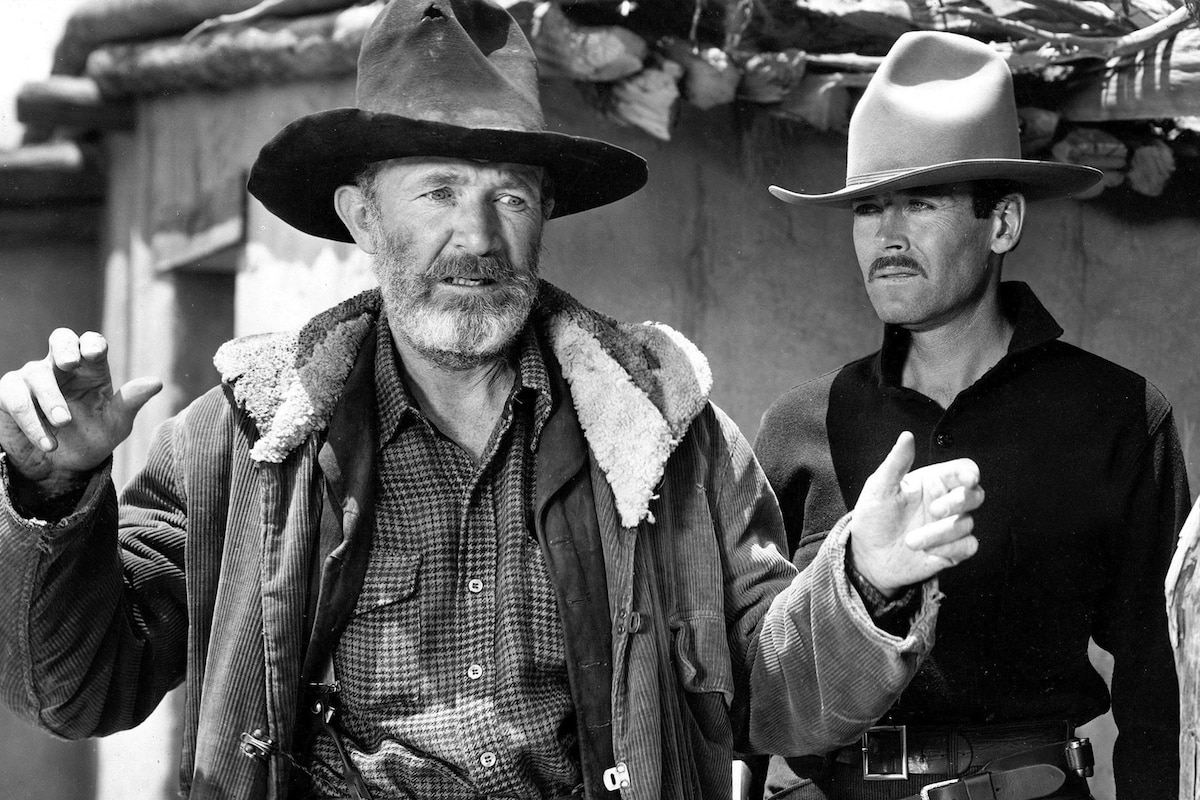
Henry Fonda's isn't the only performance of note. Unfortunately, Linda Darnell and Cathy Downs, the women in My Darling Clementine, while central to the plot, are negligible as characters (as they would be, regrettably, in too many of Ford's films). Victor Mature, however, known far more for his beefcake physique than his acting talents, is quite memorable as Doc, perhaps the best role of his career. Character actor Walter Brennan turns his usual rural roughness into something very dark and sinister as Old Man Clanton and Alan Mowbray evokes a mix of bravado and pathos even in his small bit as the traveling actor.
For students of film, then, My Darling Clementine is the perfect site to weigh the pros and cons of one of our most famous cinema artists. For observers of the American myth, it's an expression of the birth of American civilization where the necessities of survival in hostile territory are refined by traditional community values into an ideal society. For movie fans free of the more scholarly considerations, it's essential as simply a pleasurable story, a sweet and understated fantasy of the past marked by small but rich moments and sweepingly evocative visual images.
by Rob Nixon
The Essentials - My Darling Clementine
by Rob Nixon | January 22, 2010
SIGN UP FOR OUR NEWSLETTERS

CONNECT WITH TCM