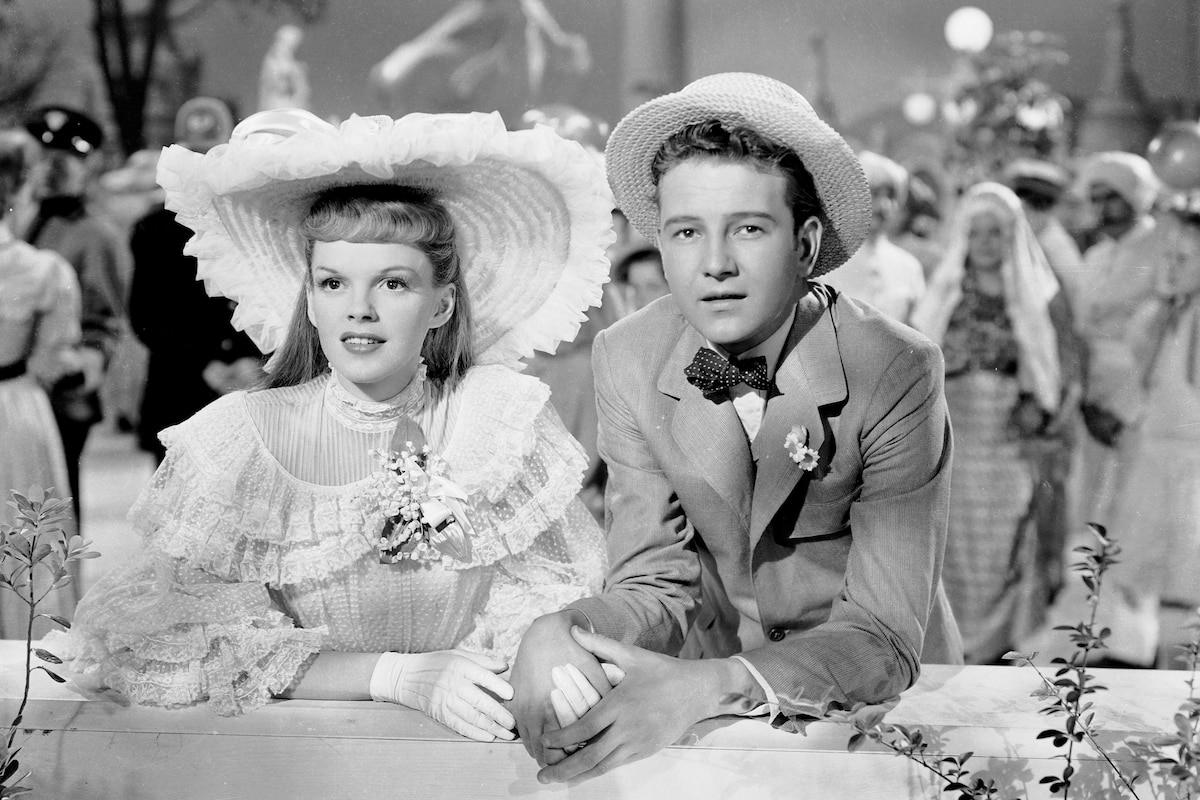
When shooting began on Meet Me in St. Louis in the Fall of 1943, director Vincente Minnelli had a very specific vision in mind to bring Sally Benson's quaint childhood reminiscences to life on the big screen. With a talented cast, a first-rate screenplay and a handful of charming new songs, Meet Me in St. Louis had all the ingredients to be a wonderful film.
The entire cast and crew were immediately impressed with Minnelli's attention to detail in every shot. He had consulted author Sally Benson on how the interiors of the Smith home should look, and she had provided a wealth of first-hand information. As a result, the look of each set was near perfection according to the time period. "The only anachronisms," according to actress Mary Astor in her 1967 memoir A Life on Film, "were the girls' long-swinging hairdos. Girls 'put their hair up' as soon as they got out of pigtails, the first instant they were allowed to by reluctant parents. It was a symbol, like the first long pants for boys."
Judy Garland, who at 21-years-old was transitioning into more adult roles, received a whole new look for Meet Me in St. Louis. She had always been insecure about her appearance, having begun her career in the movies during her awkward adolescent years and had faced much criticism for her fluctuating weight and imperfect features. By the time she played Esther Smith, however, Garland had slimmed down and was emerging as a natural beauty, even if she hadn't realized it yet. When she went to MGM makeup artist Dotty Ponedel, who was assigned to the film, Garland showed Ponedel the tricks she had been using up to then whenever she appeared on camera: caps for her teeth and rubber discs she inserted into her nose to change its shape. To Garland's surprise, Ponedel quickly disposed of the items. "You don't need all this junk," she told Garland. "You're a pretty girl. Let's see what we can do."
With that, Ponedel set about transforming Garland by enhancing the natural beauty that was already there. "I raised her eyebrows a bit, and gave her a fuller lower lip," said Ponedel. "I put on a makeup base that was pretty to the eye. I knew it would be pretty to the camera too. I tweezed out some of the hairline." The work was minimal, but the effect was stunning. Garland was the most beautiful she had ever been, which gave her a new confidence. She was so pleased with the results, that she made sure to use Dotty Ponedel from then on as her makeup artist on every feature she made for MGM.
Garland may have been happy with her new look, but she still wasn't pleased about making Meet Me in St. Louis. She didn't take her role very seriously at first. According to Vincente Minnelli, when they first started shooting, Garland was reading her lines in a way that poked fun at the script. At that point Minnelli believed that Garland's co-star Lucille Bremer was doing a better job than she because Bremer understood the role better and delivered every line with utter sincerity. Minnelli took Garland aside and asked her to do the same. "I want you to read your lines as if you mean every word," he advised her.
Judy Garland was also indulging in some bad habits during the making of Meet Me in St. Louis. She would complain of illnesses and headaches, often arriving late to the set and keeping the cast and crew waiting for hours. "Judy was no longer a rotund little giggler, but her growing up was not maturing," said co-star Mary Astor. Astor had played Garland's mother once before in the 1938 film Listen, Darling. "The fun was still there and she seemed to have great energy. But it was intense, driven, tremulous. Anxious. She was working way over the capacities of any human being. She was recording at night and playing in the picture in the day, and people got annoyed when she was late on the set, and when she got jittery and weepy with fatigue. Including myself. I often felt that her behavior during this period was due to bigshotitis and very unprofessional. Making a movie was a communal effort: Everyone depended on everyone else, and for one person to keep 150 other workers sitting around on a sound stage while she fiddled with her lipstick in her dressing room was just plain bad manners."
One day Mary Astor had had enough of the inconsiderate behavior and decided to give Garland a piece of her mind. "I walked into Judy's portable dressing room one tense morning," said Astor, "and she greeted me with her usual cheery, 'Hi, Mom!' I sat down on the couch while she went on primping, and said, 'Judy, what the hell's happened to you? You were a trouper once.' She stared at me. I went on, 'You have kept the entire company out there waiting for two hours. Waiting for you to favor us with your presence. You know we're stuck there's nothing we can do without you at the moment.' She giggled and said, 'Yeah, that's what everybody's been telling me.' That bugged me and I said, 'Well, then, either get the hell on the set or I'm going home.' She grabbed me by the hand, and her face had crumpled up, 'I don't sleep, Mom!' And I said, 'Well, go to bed earlier then like we all have to do. You're not so damn special, baby!' and stalked out in my own unthinking high dudgeon. It was some years later before I really knew what she'd been going through."
Garland also hated rehearsing for her scenes, and Vincente Minnelli liked to have a lot of rehearsals. She took to sneaking off the set early in order to avoid them. "She'd get in her car and zoom off before I had a chance to call a run-through;" said Minnelli. "I'd phone to the studio gate to intercept her."
Throughout the Meet Me in St. Louis shoot, Garland continued to have problems. Arthur Freed had a talk with her one day in her dressing room and then told Minnelli what was on Garland's mind. "She said she doesn't know what you want...She doesn't feel she can act anymore," said Freed. Minnelli was worried, but Freed reassured him. "Don't worry," Freed said. "It'll work out. I told Judy you know what you're doing and to trust you." Minnelli remained determined to coax a good performance out of her. "I didn't give up trying to reach her," said Minnelli. "I eventually could tell Judy what I wanted her to do with just a look, but at first I had to find the key words to get her to react. What seemed obvious to me was perplexing to her. Though the lines seemed silly to her, she had to believe in them. Each of Esther's crises, no matter how minor, had to be treated like the 1929 crash. Finally the message got to her...I still don't know how. Once she grasped the motivation, she was as brilliant in the dramatic scenes as she's been in the musical numbers. She was alternately wistful and exuberant, but always endearing."
A former child star herself, Judy Garland couldn't help but be concerned about young Margaret O'Brien. Garland was worried that O'Brien was being overworked on Meet Me in St. Louis and was missing out on her childhood. However, O'Brien herself said in a 2004 interview that while she appreciated Garland's concern, this was not the case. O'Brien loved her time acting, and the child labor laws had been strengthened in the time since Garland had been an underage star. "Tootie was fun because I could do a lot of the things I maybe wouldn't normally do myself," said O'Brien, "and she was really kind of bratty and mischievous, so I loved playing Tootie."
Margaret O'Brien was capable of being mischievous herself on the set of Meet Me in St. Louis according to Mary Astor. "Margaret O'Brien was at her most appealing (I might say 'appalling') age," said Astor. "And she could cry at the drop of a cue. Real tears, an endless flow, with apparently no emotional drain whatsoever. She was a quiet, almost too-well-behaved child, when her mother was on the set. When Mother was absent, it was another story and she was a pain in the neck."
According to Astor, O'Brien liked to have fun with the prop master - the person in charge of all of the movie props. For instance, when shooting a scene at the Smith family dinner table, all of the dishes and utensils had been laid out meticulously. "It was Maggie's favorite form of mischief, when his back was turned," said Astor, "to put things in disorder again, to reverse knives and forks, to put two napkin rings beside a plate. It would drive him nuts. And remember the strong caste system on the sets: she was a star and he was just a lowly property man, so all he could do was to smile and say, 'Please, Maggie dear!' when he'd have liked to have shaken her."
Vincente Minnelli was impressed with Margaret O'Brien's exceptional acting at such a young age, though he found some of her methods "enervating." Minnelli explained, "Her mother and aunt would whisper to her just before we shot the dramatic sequences and, like the salivating of Pavlov's dog, Margaret would get highly emotional and cry. I often wondered what they said to her to get that reaction. I was soon to learn." Minnelli, according to his autobiography, discovered one of O'Brien's techniques during the scene in which Tootie, upset over the thought of leaving St. Louis, tearfully takes a stick to the snow people in the backyard and violently knocks them down. "Her mother came to me," said Minnelli. "'Margaret's angry at me tonight. She doesn't want me to work her up for the scene. You'll have to do it.' 'But how?' I asked. 'She has a little dog,' her mother replied. 'You'll have to say someone is going to kill that dog.'"
Minnelli was reluctant to do something that seemed so harsh, but O'Brien's mother convinced him that it would elicit the emotional response that was needed for her to do the important scene. Minnelli eventually told O'Brien what her mother suggested about her dog, and on cue, the tears began to flow on camera. "She did the scene in one take...mercifully for me...and went skipping happily off the set," said Minnelli. "I went home feeling like a monster...I marvel that Margaret didn't turn out to be one too. That sort of preparation struck me as most unhealthy." In her mother's defense, years later Margaret O'Brien claimed that the story was false. "My mother would never have allowed that," said O'Brien in 2004. "June Allyson was also a big crier at the studio and so we had a little contest going: who was the best crier? So all my mother would have to say if I had a hard time crying was that maybe she'd better have the makeup man come over and spray the false tears instead of my crying the real tears, and that would upset me terribly, and then I would cry."
As shooting progressed on Meet Me in St. Louis, something unexpected and special was happening between Vincente Minnelli and Judy Garland: they were falling in love. "I found Judy's self-deprecating wit disarming," said Minnelli, "and the vulnerability she disguised with it all the more touching. Like everyone else at the studio, I wanted to protect and love her. And Judy was affectionate and loving right back." They had their first date towards the end of shooting with another couple. Soon the two were seeing each other exclusively.
Shooting wrapped on Meet Me in St. Louis in April of 1944. By the time Minnelli started editing the film in post-production, according to his autobiography, he and Judy Garland were living together.
by Andrea Passafiume
Behind the Camera - Meet Me in St. Louis
by Andrea Passafiume | January 22, 2010
SIGN UP FOR OUR NEWSLETTERS

CONNECT WITH TCM