Meet Me in St. Louis began as a series of short stories written by Sally Benson that first appeared in the New Yorker Magazine. Under the title "5135 Kensington," Benson's stories were published in the New Yorker from June 14, 1941 through May 23, 1942. Based on Benson's childhood memories, the stories were charming vignettes about the well-to-do Smith family and their adventures during turn-of-the-century St. Louis. Benson published eight stories total in the magazine. However, when they proved to be extremely popular with readers, she put them all together in a book called Meet Me in St. Louis published in 1942 that included four additional new stories, making a total of twelve - each chapter representing one month out of the year.
MGM producer Arthur Freed came across Benson's stories and found them delightful; he believed they would make the perfect subject matter for a film musical. He envisioned the project as a "sentimental mood piece," a film that would evoke the warmth and nostalgia of a bygone era - something that audiences were hungry for during the war-torn years of the early 1940s.
At first, Freed asked George Cukor to direct Meet Me in St. Louis. Cukor was interested, but was soon called to serve in World War II and was unable to get involved with the film. Next, Freed approached Vincente Minnelli, who was relatively new to MGM. He had directed Cabin in the Sky and I Dood It (both 1943) but hadn't yet solidified his reputation with the most powerful studio in Hollywood.
Vincente Minnelli read the book Meet Me in St. Louis and found it "affecting, humorous, and warm," according to his 1974 autobiography I Remember It Well. The book's Halloween sequence with the children was the clincher for him. "The burning of feet and slashing of throats they envisioned, almost a wistful longing for horror wasn't the sweet and treacly approach so characteristic of Hollywood," said Minnelli. "This was the type of fantasy that real children, raised as the grimmest of Grimm's fairy tales, would have. Yes, I told Arthur [Freed] I would gladly direct the picture."
Freed and Minnelli hired two writers to turn Benson's book into a screenplay. To their chagrin, however, the writers didn't think there was enough of a storyline for a movie so they added a subplot to Meet Me in St. Louis involving the blackmailing of Judy Garland's character, Esther Smith. "This is hardly the stuff of which lyrical evocations of an era are made," said Minnelli, "so I suggested we get another version."
Arthur Freed then hired Fred Finklehoffe to try his hand at a new draft of the screenplay. Finklehoffe wrote the majority of the new script with Irving Brecher, "tightening" it up along the way whenever Minnelli felt it was necessary. This time, the writers found their focus. "They took the very human values of the Benson work - the simple goodness of the time," said Minnelli, "the earnestness and purity of its people, the gentle humor and the laughs of recognition at their universality and constructed a story out of an episode in the book...It revolved around the imminent transfer of the husband to New York and the effect the prospective move has on his family..."
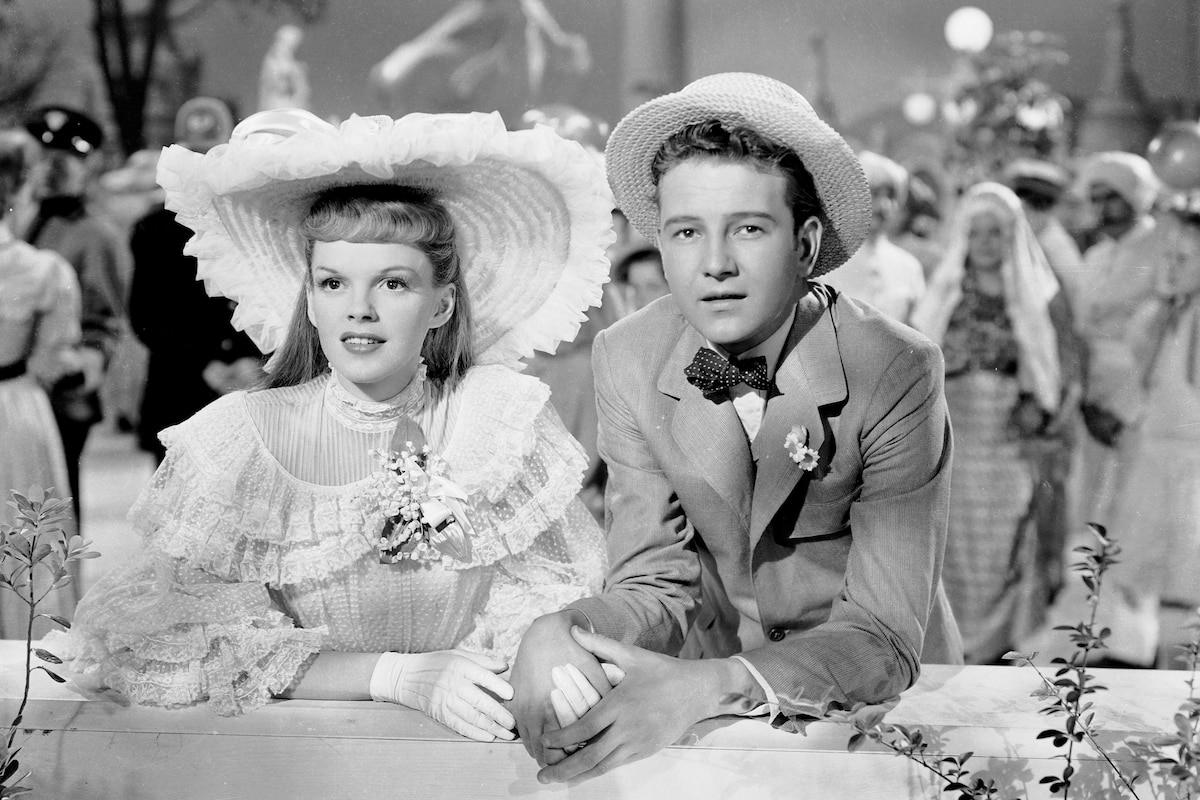
All along Arthur Freed had Meet Me in St. Louis in mind as a vehicle for MGM's top musical star at the time, Judy Garland. He envisioned the rising young actress as the second eldest Smith daughter, Esther, who at 17 is eager to find romance with handsome boy-next-door John Truett. Garland, however, was not interested. She had just turned 21 and had spent years playing adolescents. She saw the role of Esther as just another juvenile part and wanted to graduate to more mature roles like her recent turn in Presenting Lily Mars (1943). She believed that playing yet another teenager would set her career back and told MGM studio head Louis B. Mayer that she wouldn't do it. Mayer, in turn, called Arthur Freed. "Judy says she doesn't want to do the picture," Mayer told Freed. "For once I have to agree with her. I've read it and there's no plot."
Freed was adamant that Meet Me in St. Louis should have Judy Garland as its star. It was a fine part, he argued, in a film that would certainly be something unique and very special. The character was not a silly juvenile but a beautiful young woman whose emotions would run the gamut as she dealt with her first love as well as the threat of her family being uprooted from the only place she's ever called home. Freed's track record at MGM so far had been excellent, and Mayer decided to give him the benefit of the doubt. He told Garland that she was being assigned to star in Meet Me in St. Louis whether she liked it or not.
To play Garland's youngest sister, Tootie, a quirky tomboy with a dark side, MGM assigned one of their greatest assets at the time, child star Margaret O'Brien. Tootie was a significant and complex part requiring a young actress of great talent. O'Brien certainly fit the bill having already tackled some challenging roles in films such as Journey for Margaret (1942) and Jane Eyre (1944).
Actress Lucille Bremer was hand-picked by producer Arthur Freed to play Rose, the eldest Smith daughter. The striking Bremer was a former Radio City Rockette and had enjoyed some success with a nightclub act when Freed discovered her and put her under contract to MGM. According to Vincente Minnelli, Freed felt that Bremer had the makings of a major star. Meet Me in St. Louis would mark Bremer's film debut.
Rounding out the cast of Meet Me in St. Louis were Leon Ames as family patriarch Alonzo Smith, Mary Astor as his wife, Tom Drake as Esther's boy-next-door love interest, Harry Davenport as Grandpa, and Marjorie Main as Katie, the Smiths' no-nonsense maid.
The songs planned for Meet Me in St. Louis were to be a blend of old and new to fit the story's turn-of-the-century period. "Skip to My Lou," "Under the Bamboo Tree" and the title song were old tunes that had been popular during the film's time period which were given new arrangements to freshen them up for modern audiences. Ralph Blane and Hugh Martin (Best Foot Forward, 1943) were hired to write most of the film's new songs, which included "The Boy Next Door," "The Trolley Song" and "Have Yourself a Merry Little Christmas." A song written by Rodgers and Hammerstein that had been dropped from the musical Oklahoma! called "Boys and Girls Like You and Me" was also added to the mix. It was to be sung by Judy Garland as she toured the construction site of the World's Fair with beau John Truett. Although the "Boys and Girls Like You and Me" number was shot, it was ultimately dropped from the film.
Vincente Minnelli was a perfectionist and wanted every detail in Meet Me in St. Louis to accurately reflect its turn-of-the-century setting. MGM wanted Minnelli to use the already existing Andy Hardy street on the back lot as the Smiths' neighborhood. However, Minnelli was resolute that a whole new "St. Louis" street needed to be built in order to realize his vision. It was a great expense for the studio, but L.B. Mayer complied and Minnelli got his wish.
Meet Me in St. Louis would be Vincente Minnelli's first Technicolor film. As would become one of his signature stylistic traits, he looked to the art world for inspiration on the visual look of the film. "I felt the whole picture should have the look of Thomas Eakins's paintings," he said, "though not to the point of imitation." He divided the structure of the film into four seasons, each with a strong stylistic impact. "I decided to introduce each segment of the film by using the Smiths' American Gothic house at 5135 Kensington Avenue as a lovely filigreed illustration," he said, "like the greeting cards of that era. Each card would dissolve into the live action of the Smith family."
by Andrea Passafiume
The Big Idea - Meet Me in St. Louis
by Andrea Passafiume | January 22, 2010
SIGN UP FOR OUR NEWSLETTERS

CONNECT WITH TCM