SYNOPSIS
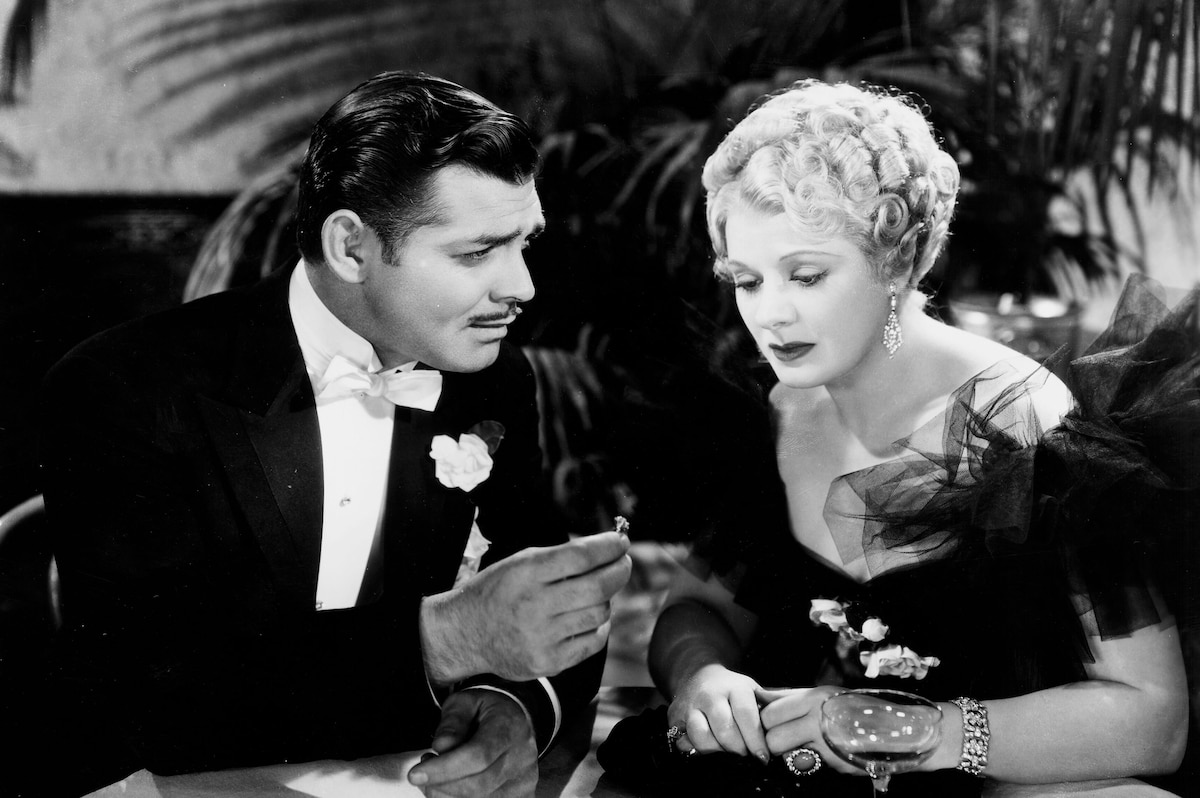
Blackie Norton is the rough-and-tumble owner of the Paradise, a sketchy saloon on San Francisco's Barbary Coast in 1906. Refined but down-on-her-luck Mary Blake dreams of an opera career, but is forced to take a job singing in Blackie's saloon to make ends meet. Wealthy aristocrat Jack Burley falls in love with Mary and wants to help her opera career. Blackie, however, is in love with Mary also and refuses to let her go. When Blackie begins to exploit Mary at the Paradise, his childhood friend Father Mullin encourages him to turn over a new leaf. The cynical Blackie, however, will have none of it, and his tumultuous relationship with Mary soon ends in separation. When the devastating San Francisco earthquake hits on April 18, 1906, the city is brought to its knees and Blackie finally finds himself on the path to redemption.
Director: W.S. Van Dyke
Producer: John Emerson, Bernard H. Hyman
Screenplay: Anita Loos
Based on a story idea by Robert Hopkins
Cinematography: Oliver T. Marsh
Art Direction: Cedric Gibbons, Arnold Gillespie, Harry McAfee, Edwin B. Willis
Editing: Tom Held
Music: Herbert Stothart (Music Director), William von Wymetal (Operatic Sequences Staged By)
Costume Designer: Adrian, Western Costume Co.
Sound: Douglas Shearer
Special Effects: John Hoffman, James Basevi
Cast: Clark Gable (Blackie Norton), Jeanette MacDonald (Mary Blake), Spencer Tracy (Father Tim Mullin), Jack Holt (Jack Burley), Ted Healy (Mat), Jessie Ralph (Mrs. Burley), Shirley Ross (Trixie), Margaret Irving (Della Bailey), Harold Huber (Babe), Edgar Kennedy (Sheriff), Al Shean (Professor), William Ricciardi (Signor Baldini), Kenneth Harlan (Chick), Roger Imhof (Alaska), Charles Judels (Tony), Russell Simpson (Red Kelly), Bert Roach (Freddie Duane), Warren B. Hymer (Hazeltine).
BW-116m. Closed Captioning.
Why SAN FRANCISCO is Essential
One of the most popular films of its day, San Francisco was one of MGM's crowning achievements and was nominated for 6 Academy Awards including Best Picture.
San Francisco marked the first time that two of MGM's greatest stars, Clark Gable and Spencer Tracy, ever worked together in a film. Audiences liked the way they played off each other so well that MGM paired them together in two more blockbusters, Test Pilot (1938) and Boom Town (1940). San Francisco is also the film that helped establish Spencer Tracy as a major star and one of Hollywood's finest actors. Tracy had been under contract at 20th Century Fox before moving to MGM. However, Fox hadn't been able to tap into his full potential and Tracy's career never got off the ground there. Quickly after moving to Metro, Tracy starred in Fritz Lang's electrifying Fury (1936) and San Francisco was released right on its heels. Tracy's two dynamic and completely different performances in each film made audiences and critics stand up and take notice. According to MGM, Tracy's fan mail went from 300 to 3,000 letters a week following the release of San Francisco.
San Francisco was the film that proved Jeanette MacDonald could handle a serious dramatic role. The film was a pet project of the singing actress, who up till then was known primarily for her roles in light operettas such as The Merry Widow (1934) and Naughty Marietta (1935). It was also the film where she first introduced the rousing title song by Bronislau Kaper and Walter Jurmann with lyrics by Gus Kahn, which has since been adopted by the city as one of its enduring official anthems.
San Francisco writers Anita Loos and Robert "Hoppy" Hopkins were both native San Franciscans who remembered the city by the bay before it was destroyed by the earthquake of 1906. They both wanted the film to pay tribute to the city that they deeply loved. The film was also intended as a loving tribute to larger-than-life Barbary Coast figure Wilson Mizner, on whom Clark Gable's character Blackie Norton was based, as well as MGM producer Irving Thalberg who had recently passed away.
The film's true star is, of course, the earthquake. It is believed that an uncredited James Basevi, one of MGM's resident special effects artist, did the major work in engineering the massive sequence in San Francisco, even though another special effects expert named Arnold Gillespie is actually credited. The following year Basevi moved to Fox Studios, where he created the horrendous storm that marks the climax of director John Ford's The Hurricane (1937). In 1939, Basevi returned to his original craft of art direction, subsequently working for Ford's later productions, including My Darling Clementine (1946), Fort Apache (1948), and Three Godfathers (1948). Basevi won an Academy Award for the art direction of The Song of Bernadette in 1943.
by Andrea Passafiume & Scott McGee
The Essentials - San Francisco
by Andrea Passafiume & Scott McGee | January 21, 2010
SIGN UP FOR OUR NEWSLETTERS

CONNECT WITH TCM