In 1787, the HMS Bounty left England for Tahiti on a mission to pick up breadfruit trees and take them to the West Indies, where the government hoped they would provide a source of cheap food for slaves. The ship's humane, accomplished captain, William Bligh, promoted his young friend Fletcher Christian to second-in-command during the voyage. When discipline slipped during the crew's stay in Tahiti, Bligh tried to reassert his authority back at sea, only to have Christian - who had left behind a pregnant Tahitian wife - join the ship's malcontents in a mutiny. Christian turned the captain and his supporters loose on a longboat and sailed the Bounty back to Tahiti. Miraculously, Bligh piloted the boat 3,618 miles to the nearest settlement. On his return to England, another ship, the Pandora, was sent to apprehend the mutineers. By that time, Christian and most of his supporters had fled to Pitcairn Island, where Tahitian tribesmen eventually murdered Christian. The men who remained in Tahiti were eventually arrested and taken back to England for trial. Four were acquitted, two convicted but pardoned, and three executed. Although, in accordance with Navy policy at the time, Bligh was court-martialed for losing his ship, he was pardoned and eventually rose to the rank of Vice Admiral.
The story of Captain Bligh and Fletcher Christian first reached the screen in Australia as the silent film The Mutiny of the Bounty in 1916.
Charles Nordhoff and James Norman Hall wrote three books about the historical event, Mutiny on the Bounty (1932), Men Against the Sea (1934) and Pitcairn's Island (also 1934). Although later research would contradict their rendition of the characters, they drew on legend to depict Captain Bligh as a sadistic tyrant and Fletcher Christian as his noble opponent. For the first book they invented the character of Robert Byam to serve as narrator. Byam was loosely based on Captain Peter Heywood, who was court-martialed for mutiny but pardoned.
In 1933, Errol Flynn made his film debut as Fletcher Christian in an Australian adaptation of the novel called In the Wake of the Bounty. When Flynn became a star, Warner Bros.' publicity department claimed he was a descendant of Christian. Actually, he was descended from Midshipman Young, who does not appear in MGM's 1935 version but is played by Tim Seely in the 1962 re-make.
MGM's 1935 version of the story, directed by Frank Lloyd, was one of the most successful films in the studio's history. With Clark Gable as Fletcher Christian and Charles Laughton as Captain Bligh, it was a box-office winner, taking in $4.5 million on a $2 million budget. It also captured the Oscar® for Best Picture and brought Laughton the first New York Film Critics Award for Best Actor.
With the success of their remake of Ben-Hur in 1959, which had wiped out the studio's deficit and saved MGM from bankruptcy, studio executives naturally wanted to find another past hit to remake that would lure people away from their television sets and into theatres. Director John Sturges suggested a wide-screen, Technicolor version of Mutiny on the Bounty. The studio announced it along with plans to re-make the silent World War I film The Four Horsemen of the Apocalypse (1921).
After a series of well-received films produced at Universal - including Winchester '73 (1950) and To Hell and Back (1955) - Aaron Rosenberg moved to MGM, where he had been promised the chance to produce the epic Western How the West Was Won (1962). When executives handed that project to Bernard Smith instead, they offered Rosenberg the chance to produce a remake of Mutiny on the Bounty as a consolation prize. The film was originally budgeted at $8.5 million.
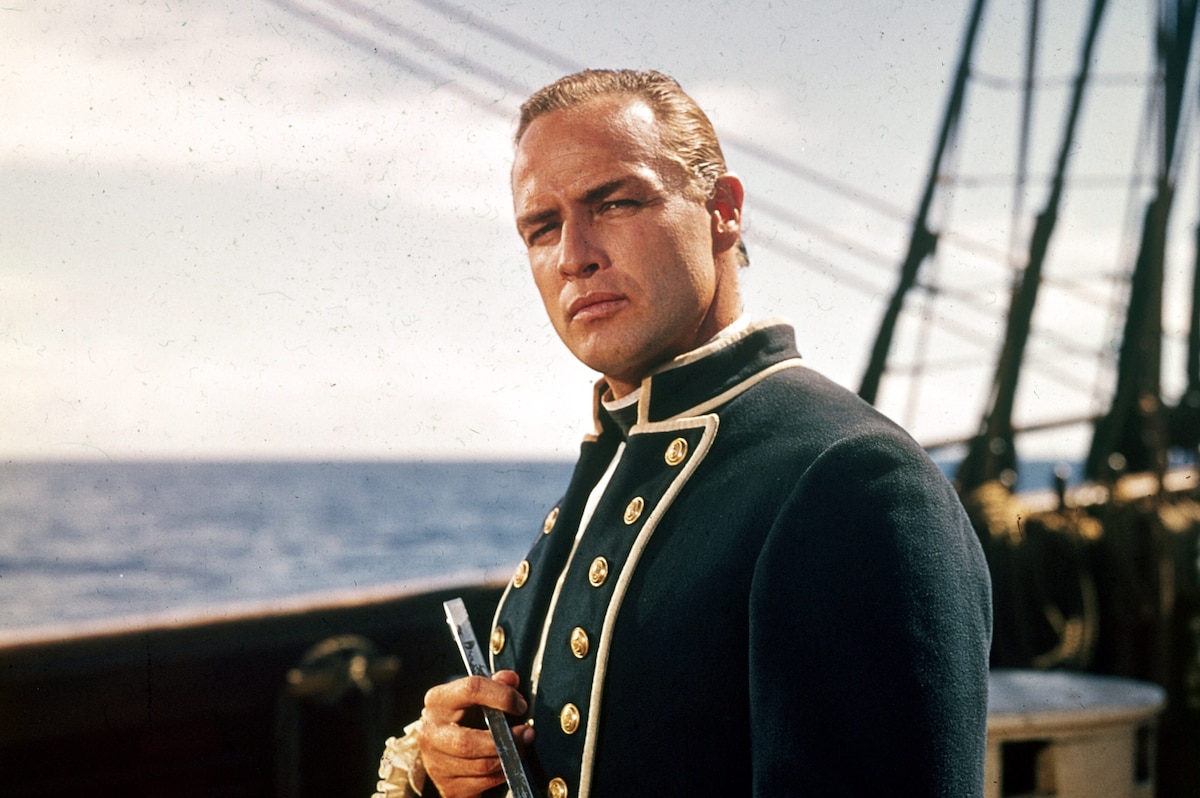
Sturges also suggested that Marlon Brando would be perfect for either leading role, Mr. Christian or Captain Bligh. At first the actor wasn't interested. But after doing some research he agreed to play Christian on condition that the film be more than just a remake. He wanted it to carry the story further and deal with what happened to the mutineers after they settled on Pitcairn Island, where many of them would kill each other within two years. "What is there in human nature that makes men violent even in an island paradise?" he wondered. "That's what would interest me." At the time, Brando had been offered the lead in Lawrence of Arabia (1962), but finally decided he preferred working at sea to spending two years in the desert. MGM gave him script approval, $500,000, ten percent of the gross and $5,000 for each day the film went over schedule.
The first writer assigned to the script was Eric Ambler, best known for such suspense novels as Journey Into Fear and A Coffin for Dimitrios. He had been originally approached about writing The 4 Horsemen of the Apocalypse (1962). Brando rejected two drafts by him, at which point William Driscoll and Borden Chase joined the project.
With no authentic 18th century ships available for filming, Rosenberg commissioned a Nova Scotia shipyard to build the Bounty for a little more than $500,000. When an early winter made it impossible to transport lumber by land, they had to ship it from New Jersey, running the cost up to $750,000. The ship arrived at the Tahitian locations two months late, after two fires at sea and numerous cases of crew members suffering from seasickness.
MGM engaged Sir Carol Reed, the director of such suspense classics as Odd Man Out (1947) and The Third Man (1949), to direct the film. Reed's reputation as an actor's director made him acceptable to Brando, and his success working with the temperamental Burt Lancaster on Trapeze (1956) had convinced the studio he could work with the star. Reed insisted that most of the cast come from England, including his friend and frequent leading man Trevor Howard as Captain Bligh, Richard Harris as Seaman John Mills, Hugh Griffith as Alexander Smith and Gordon Jackson as Seaman Edward Birkett.
During pre-production, Brando married Movita, the Latina actress who had played Clark Gable's Tahitian bride in MGM's first version of Mutiny on the Bounty. They had been dating on and off since she had played a small role in Viva Zapata! (1952) and married when she became pregnant.
by Frank Miller
SOURCES:
Marlon: Portrait of the Rebel as an Artist by Bob Thomas
The Big Idea - Mutiny on the Bounty ('62)
by Frank Miller | January 21, 2010
SIGN UP FOR OUR NEWSLETTERS

CONNECT WITH TCM