RKO budgeted The Hunchback of Notre Dame at $2.8 million, the second highest budget in the studio's history. Gunga Din (1939) ended up costing more, though that was partly the result of unanticipated production delays.
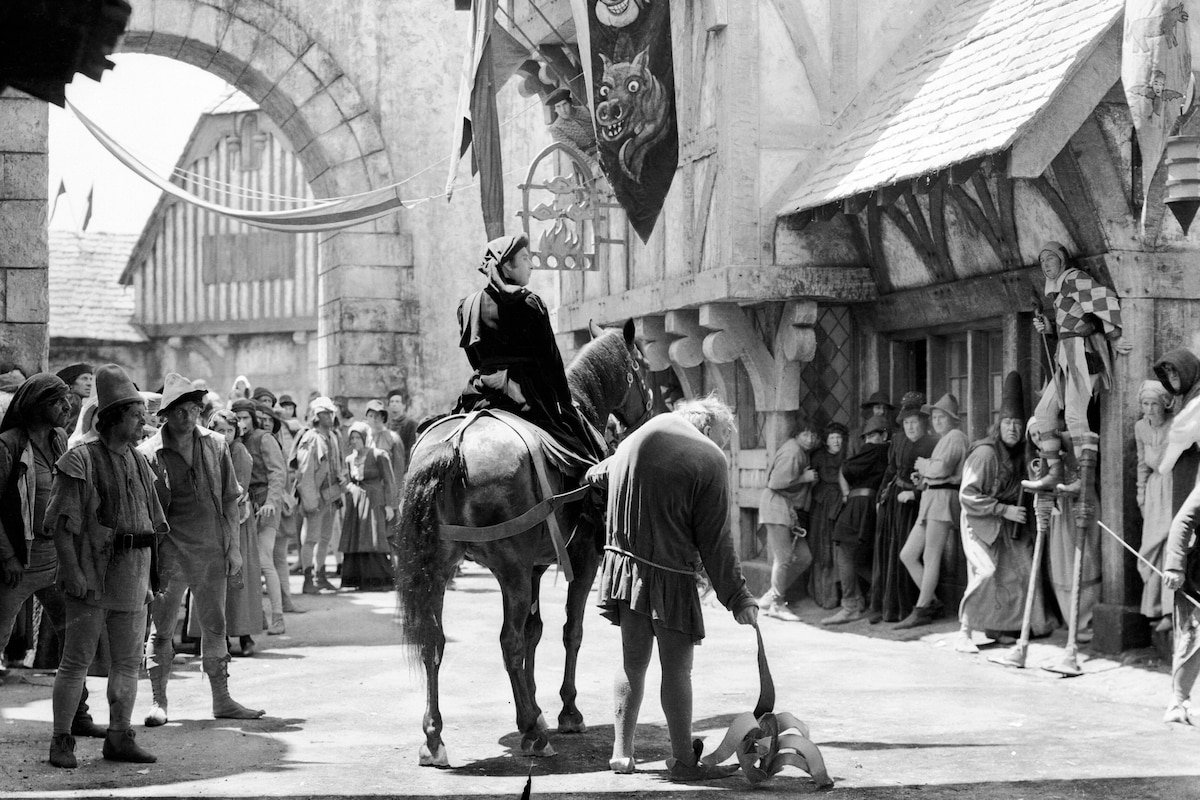
Van Nest Polglase reconstructed medieval Paris in a lavish set built on location in the San Fernando Valley. The cathedral stood 190 feet high and included gargoyles, vaulted ceilings and stained glass windows, all at a cost of $250,000. Polglase also incorporated scenic pieces from Lon Chaney's silent version.
To turn Charles Laughton into the deformed bell ringer, Perc Westmore covered half his face with sponge rubber, adding a protruding eyeball lower than the average. Laughton's other eye was covered with a milky contact lens. The hump consisted of an aluminum framework stuffed with four pounds of foam rubber, and the rest of Laughton's torso was padded with rubber to create a sense of the muscles developed from pulling on the bell ropes. It took two and a half hours to apply the makeup.
To convincingly play a character deafened by the ringing of the cathedral bells, Laughton had his ears plugged with wax so he couldn't react to any unexpected sounds.
On the first day of shooting, director William Dieterle assembled a crowd of extras in front of the cathedral set and called for Laughton. The actor, in full costume and makeup, protested that he wasn't ready to play the scene yet and couldn't shoot that day. Dieterle said, "Please, Charles, the next time you are not ready, let me know it previously so I can plan accordingly."
The Hunchback of Notre Dame was filmed during one of the hottest summers in recent history, with temperatures regularly topping 100 degrees as Laughton labored under the heavy makeup and costume. It was so hot at night, he had to sleep in wet sheets to keep cool, and the moisture usually evaporated within minutes. On top of that, he had to be at the studio by 4 a.m. each day to get into the makeup.
For the scene in which Quasimodo is whipped, Laughton instructed an assistant director to twist his ankle outside of camera range so he would really be in pain. Even through the heavy hump and rubber body suit, he felt every lash and often came home badly bruised. Before the 16th take, Dieterle whispered to him, "Now, Charles, listen to me. Let's do it one more time, but this time I want you...I want you to suffer." According to Laughton's wife, Elsa Lanchester, the actor never forgave him for that.
The scene in which Quasimodo rings the cathedral bells for Esmeralda was shot the day World War II began in Europe. The director and star were so overwhelmed, the scene took on a new meaning, with Laughton ringing the bells frantically and Dieterle forgetting to yell "cut." Finally, the actor just stopped ringing when he became too tired to continue. Later, Laughton said, "I couldn't think of Esmeralda in that scene at all. I could only think of the poor people out there, going in to fight that bloody, bloody war! To arouse the world, to stop that terrible butchery! Awake! Awake! That's what I felt when I was ringing the bells!"
As part of the film's publicity buildup, RKO Studios did not allow any publicity photos of Laughton in makeup for his character.
The Hunchback of Notre Dame premiered as the Christmas attraction at the Radio City Music Hall, triggering complaints from some critics who viewed it more as a horror film than an historical spectacle and considered it too frightening for family audiences.
by Frank Miller
SOURCES:
Charles Laughton: A Difficult Actor by Simon Callow
Behind the Camera - The Hunchback of Notre Dame
by Frank Miller | January 21, 2010
SIGN UP FOR OUR NEWSLETTERS

CONNECT WITH TCM