Victor Hugo's novel, originally titled Notre-Dame de Paris, first appeared in 1831 and was an instant hit. Its depiction of late 15th century Paris inspired a renewed interest in Gothic architecture and even led to major renovations of the cathedral. The book's success contributed to the use of the hunchback's name, Quasimodo, as a word signifying a great heart masked by an ugly external appearance.
The 1836 opera La Esmeralda, with music by Louise Berlin and a libretto by Victor Hugo, was the first stage version of the great work. It would be followed by Arthur Goring Thomas' 1847 opera Esmeralda, Dargomyzhsky's 1847 opera of the same name and Franz Schmidt and Leopold Wilk's 1914 Viennese romantic opera Notre Dame.
Hugo's novel was filmed five times as a silent. The first version, in 1905, was directed by pioneer Alice Guy as Esmeralda, with Denise Becker in the title role and Henri Vorins as Quasimodo. That version was only one reel (approximately ten minutes) long. The book's original title came back for the three-reel version shot in 1911, with Henri Krauss and Stacia Napierkowska in the leads. That version was praised for drawing a coherent narrative out of the novel and maintaining the original tragic ending. 1917 marked the story's first Hollywood adaptation entitled The Darling of Paris with legendary silent screen vamp Theda Bara as Esmeralda and Glen White as the bell ringer. An English version named Esmeralda appeared in 1922 with Sybil Thorndike in the title role and Booth Conway as Quasimodo.
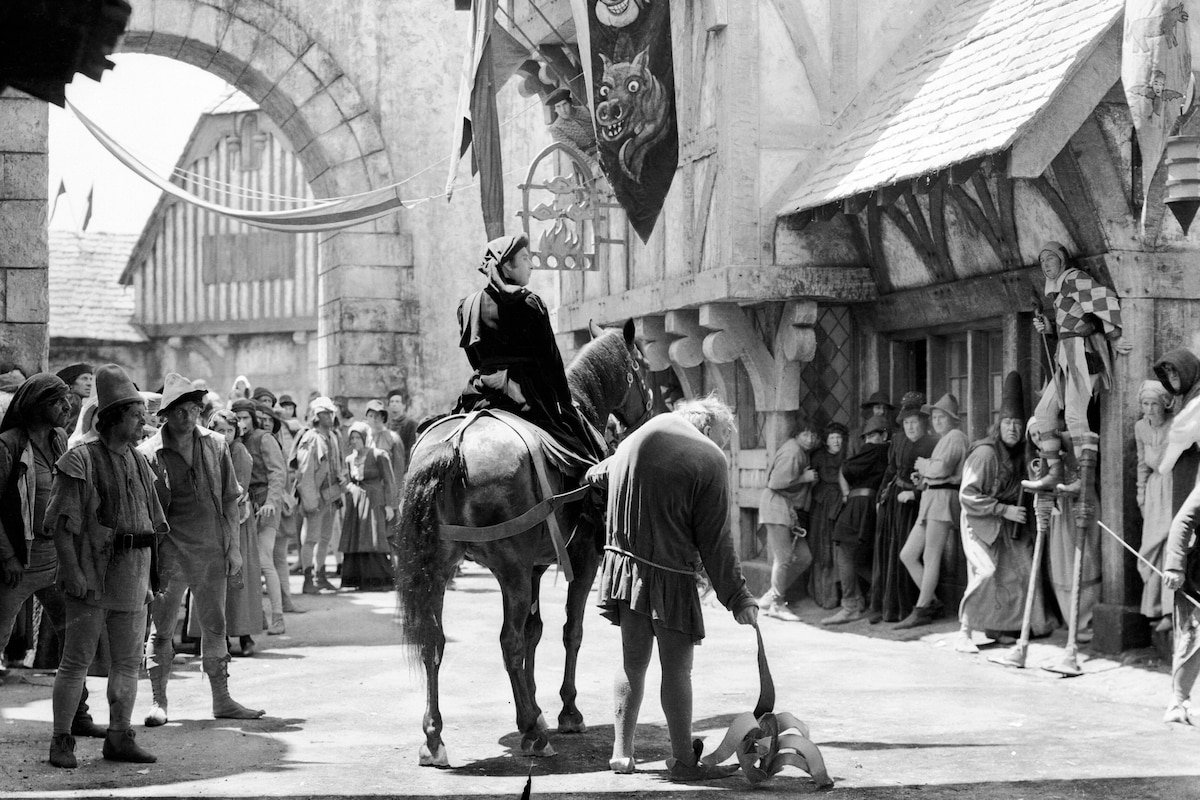
Lon Chaney created one of his most memorable characterizations in 1923 for the first version titled The Hunchback of Notre Dame. Patsy Ruth Miller co-starred as Esmeralda with Wallace Worsley directing. The film was praised for its lavish sets and Chaney's extensive makeup and his sensitive performance, which catapulted him from character actor to super star. It also set the standard for lavish horror films in the silent era, followed by Chaney's epic 1925 The Phantom of the Opera. The film ended with Esmeralda saved from hanging but Quasimodo dying from a fatal stab wound sustained when he turns on Frollo.
In 1932, Universal Pictures announced that they had hired John Huston to write the treatment for a re-make to star Boris Karloff. Nothing ever came of the project. MGM also considered a film version starring Peter Lorre in 1937.
The idea of casting Charles Laughton as Quasimodo was first broached by MGM's Irving G. Thalberg in 1934, when his wife, Norma Shearer, befriended the actor while they were working on The Barretts of Wimpole Street (1934). It was one of the productions he would have mounted had he lived to start his own independent production company, with Laughton as one of his first contract stars.
The re-make of The Hunchback of Notre Dame was a pet project of RKO Studios' producer Pandro S. Berman; he was trying to raise the studio's profile in Hollywood, where it was beginning to develop a reputation as a studio whose own productions took a backseat to the work it released from independent producers like Walt Disney and David O. Selznick. Although Victor Hugo's novel was in the public domain, the studio still paid $135,000 for the story rights from the Chaney version.
Bela Lugosi, Claude Rains, Orson Welles, Robert Morley and Lon Chaney, Jr. were among the actors considered for the title role before he chose Laughton. One reason so many other actors were being considered was that Laughton was not available at first as he was negotiating with MGM for a film version of Cyrano de Bergerac. When that project fell through, he signed to play Quasimodo.
At Laughton's insistence, Maureen O'Hara, who had been his leading lady in Jamaica Inn (1939), was signed to make her U.S. film debut as Esmeralda. RKO put the 19-year-old under contract and began giving her the star build-up.
Berman borrowed William Dieterle from Warner Bros. to direct the film because of his facility with historical films (The Story of Louis Pasteur in 1935 and The Life of Emile Zola in 1937). Dieterle had also started as an assistant to German stage director Max Reinhardt, whose lavish productions of Oedipus Rex and Everyman had made theatre history.
At Laughton's insistence, RKO borrowed make-up man Perc Westmore from Warner Bros. at a cost of $10,000.
Writer Bruno Frank did the first adaptation of the novel before Sonya Levien was assigned to finish the writing. In preparing the script, Levien played up the original novel's political commentary about the gap between the aristocracy and the poor. With World War II looming in Europe and word filtering in about Nazi persecution of the Jews, the gypsies in the film were treated as a metaphor for the oppressed peoples of the time.
One concession the studio had to make to the Production Code was turning Frollo, Quasimodo's benefactor and the film's villain, from the Archdeacon of Notre Dame to the Archdeacon's brother. The Code forbade unflattering portrayals of the clergy and would not have passed the film had Frollo remained a priest.
by Frank Miller
The Big Idea - The Hunchback of Notre Dame
by Frank Miller | January 21, 2010
SIGN UP FOR OUR NEWSLETTERS

CONNECT WITH TCM