SYNOPSIS
Fifteenth century Paris is a city of contrasts with an aristocracy living in glittering luxury while the poor endure almost unimaginable squalor and all the while the church offers spiritual salvation while its leaders wallow in corruption and decadence. Those contrasts come to a head when Quasimodo, the deformed bell ringer at the Cathedral of Notre Dame, falls in love with the beautiful gypsy Esmeralda. Their doomed relationship plays out against a city ready to erupt from class rivalries and the machinations of Esmeralda's most ardent and powerful suitor, the brother of the Cathedral's Archdeacon.
Director: William Dieterle
Producer: Pandro S. Berman
Screenplay: Sonya Levien, Bruno Frank
Based on the novel Notre Dame de Paris by Victor Hugo
Cinematography: Joseph H. August
Editing: William Hamilton, Robert Wise
Art Direction: Van Nest Polglase
Music: Alfred Newman
Cast: Charles Laughton (The Hunchback), Cedric Hardwicke (Frollo), Thomas Mitchell (Clopin), Maureen O'Hara (Esmeralda), Edmond O'Brien (Gringoire), Alan Marshal (Phoebus), Walter Hampden (Claude), Harry Davenport (Louis XI), Katharine Alexander (Mme. De Lys), George Zucco (Procurator), Fritz Leiber (A Nobleman), Etienne Girardot (The King's Physician), Minna Gombell (Queen of Beggars), Rod La Rocque (Phillippo), Spencer Charters (Court Clerk), Rondo Hatton (Ugly Man), Louis Jean Heydt (Bit), Victor Kilian (Hangman), Elmo Lincoln (Bit), Nestor Paiva (Man in Street), Tempe Pigott (Madeleine)
BW -115 m.
Why THE HUNCHBACK OF NOTRE DAME is Essential
Charles Laughton's biographer, Simon Callow, has called The Hunchback of Notre Dame (1939) the actor's last great screen performance, certainly the last in which he endured physical hardship and tapped his most painful inner conflicts to create a character.
Released in 1939, the film is one of an amazing lineup of movies - including Gone With the Wind, The Wizard of Oz, Wuthering Heights, Mr. Smith Goes to Washington and Gunga Din - that have earned that year a reputation as the greatest in Hollywood history.
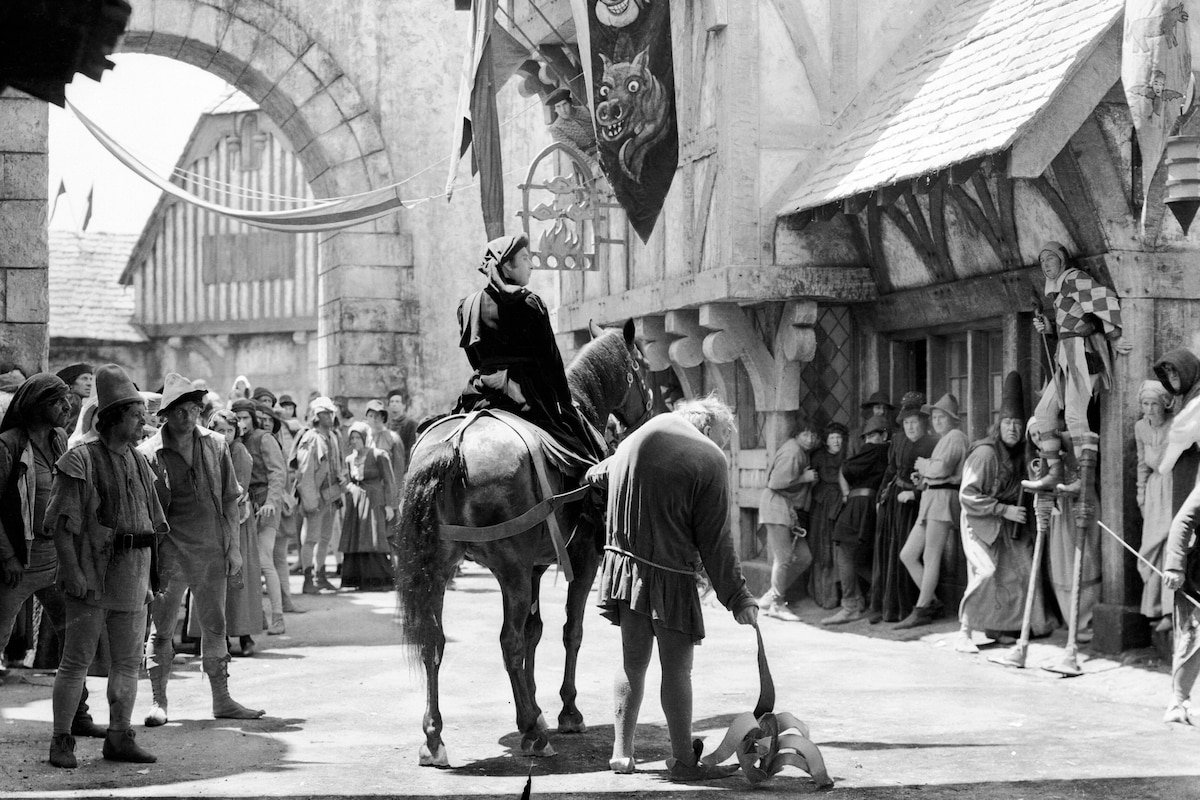
Despite the Hollywood ending, this is often cited as the best screen version of Victor Hugo's classic story. Critics usually credit the lavish production design, literate script, strong cast and direction and, particularly, Laughton's extremely sympathetic performance in the title role, as reasons why the movie has enduring appeal.
The Hunchback of Notre Dame was the last produced at RKO Studios by Pandro S. Berman before he left for MGM. His pictures at RKO, many uncredited, included the earliest films with Katharine Hepburn and the first Fred Astaire-Ginger Rogers musicals.
This was the last RKO release of the '30s, an era when the studio was at its height. It was also one of the biggest and most successful productions of the studio's most successful year, 1939.
The Hunchback of Notre Dame marked the first U.S. screen appearance of Maureen O'Hara, a protégée of Laughton's since her appearance in Jamaica Inn (1939); the film debut of Edmond O'Brien, a stage actor who had worked with Orson Welles and John Houseman's Mercury Theatre; and the talking film debut of legendary stage actor Walter Hampden, whose interpretation of Cyrano de Bergerac is considered the most famous of all American theatre productions.
by Frank Miller
The Essentials - The Hunchback of Notre Dame
by Frank Miller | January 21, 2010
SIGN UP FOR OUR NEWSLETTERS

CONNECT WITH TCM