Even years after their deaths, Charles Brackett and Billy Wilder remain one of the most famous writing teams in motion pictures. They wrote the scripts for a number of films made by such established directors as Ernst Lubitsch, Howard Hawks, and Mitchell Leisen before taking more control over their projectsWilder as director, Brackett as producerin the early 40s, working almost exclusively together throughout the decade. They split temporarily (Wilder referred to it as "the usual marital infidelity") when Wilder collaborated with Raymond Chandler on Double Indemnity (1944) but re-teamed for the Oscar-winning The Lost Weekend (1945). They went back to Wilder's European roots for The Emperor Waltz (1948), a romantic musical comedy set in pre-World War I Austria. Then Wilder decided to turn his attention to the city where he got his filmmaking start and from which he fled after the Nazi takeover, Berlin, now a ravaged ruin following the defeat of Germany in World War II.
Wilder had been to Germany right after the war and seen conditions firsthand. His one war-related film assignment took him right into the thick of its most horrifying detailwhat Allied troops found when they liberated the Nazi death camps. Death Mills (1945) was made specifically for release in occupied Germany and Austria to show the citizens of those countries what had taken place there under Nazi rule and was one of the few incidences of directly implicating the common people of Germany in complicity with the Holocaust.
Wilder also spent time in Berlin right after V-E Day as an officer with the U.S. Army assigned to approve or deny artistic performance licenses for German companies. Wilder saw firsthand what life was like in occupied Berlin, both for the people of the city and their Allied occupiers, and he began to formulate a story that would take a satirical look at the situation from both points of view.
Wilder's intention to make a "propaganda comedy" set in war-torn Berlin evolved, in the course of collaboration with Brackett, into a culture-clash romance between a struggling German woman and an American GI.
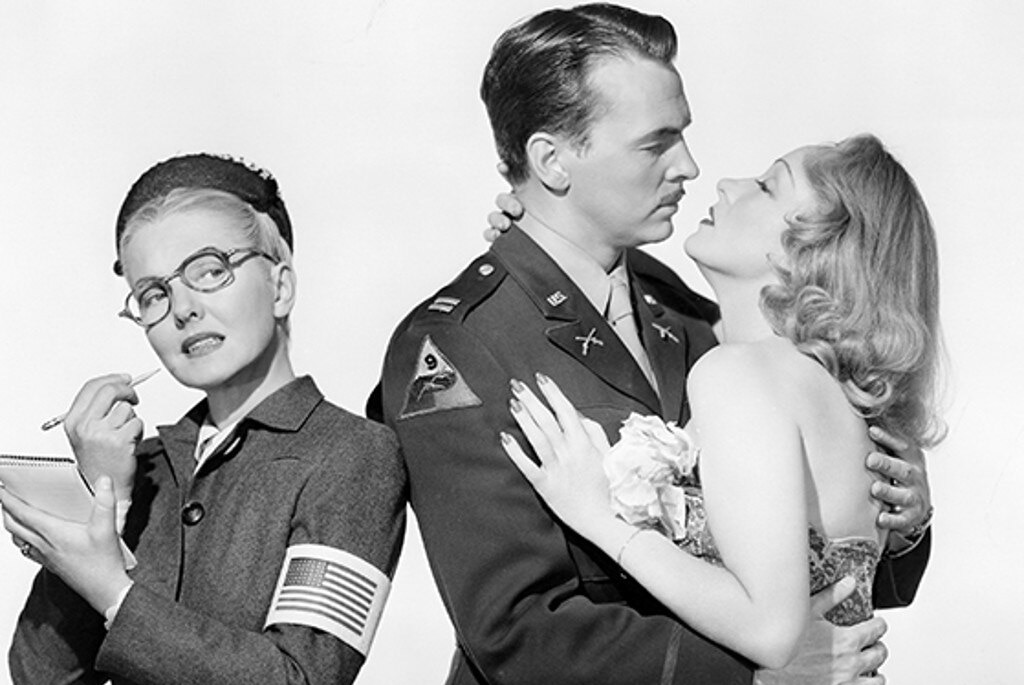
By 1947 the story had taken on an additional character, thanks to another script Paramount owned by Irwin and David Shaw. "Love in the Air" was a comedy about a GI lothario who gets the chance to see the girls he left behind in every port of the war by accompanying a female member of Congress on a fact-finding mission through Europe and the Pacific. By the end of the trip, he has fallen in love with and proposed to the congresswoman. Wilder and Brackett decided to incorporate her into the story and made the GI a Berlin-based officer assigned to guide her through Berlin but retained his relationship with the shady German lady, turning the story into a romantic triangle.
In the hands of the writing team, the congressional representative morphed into a strictly moral, uptight servant of the people, described in the script as a former notary public, "one of those who, prior to putting her seal on a document, had to see the signatory actually sign it, and inspect the signatory's birth certificate, and verify the seal of the notary certifying the birth certificate."
Another writer, Robert Harari, was brought in to help them polish the story, and at the end of May 1947, they submitted their first treatment, beginning with a description of Berlin that already displayed some of the tone of the final product: "The city looked like a great hunk of burned Gorgonzola cheese on which rats had been gnawing. The rats were gone and the ants had taken over, putting some neatness into the ruins, piling the crumbs of destruction into tiny piles."
In the coming months, with a production date looming, former journalist Richard L. Breen replaced Harari on the writing team, his first screenplay assignment. Brackett and Wilder were used to going into production without a completed script, which had the advantage of not only allowing dialogue and action to develop somewhat organically but also of keeping the screenplay from the scrutiny of studio executives and film censors. A finished script was not ready until November.
The title A Foreign Affair made the studio nervous with its suggestions of both international politics and sex. Several other titles were proposed: "The Feeling Is Mutual," "Out of Bounds," "No Limit," "Irresistible," "The Honorable Phoebe Frost," "Two Loves Have I." Brackett and Wilder briefly considered one suggestion, "Operation Candybar," before returning to the original.
In spite of all their attempts to keep the script under wraps, eventually the Production Code Administration (PCA) had to weigh in on censorship matters. The PCA found plenty to be concerned about, right on the brink of production. The U.S. government, army, and members of Congress were not to be ridiculed, they said, and they objected to "an overemphasis on illicit sex" running throughout the script. Brackett and Wilder agreed to some revisions, mostly in minor language and innuendo, while managing to keep the basic plot, ideas, and tone intact.
According to Wilder biographer Maurice Zolotow, Brackett disliked the premise of the movie and the concentration on corruption and sin. He preferred the character of the prim Congresswoman played by Jean Arthur, Zolotow claims, and concentrated on writing her. It's not clear if this is entirely true, but it has long been acknowledged that Brackett was the more staid and conservative member of the team and that the two often clashed. But until they split up a couple years after this production, Wilder always described their creative partnership as one of the happiest marriages in Hollywood.
by Rob Nixon
The Big Idea - A Foreign Affair
by Rob Nixon | January 21, 2010
SIGN UP FOR OUR NEWSLETTERS

CONNECT WITH TCM