SYNOPSIS
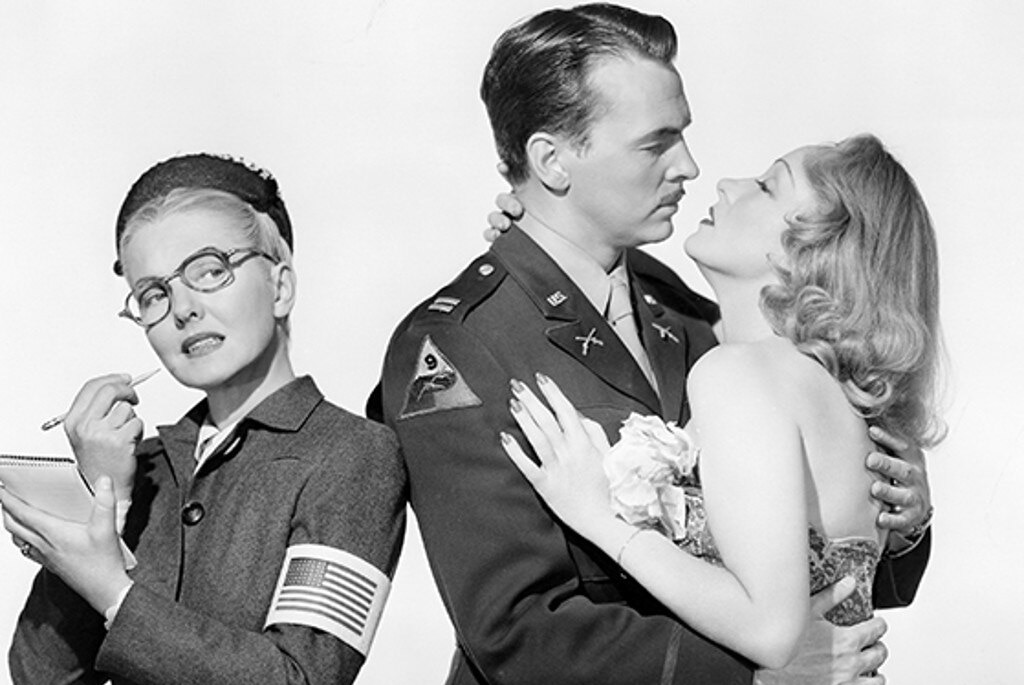
Billy Wilder, collaborating with his longtime screenwriting partner Charles Brackett, pits good old-fashioned American Heartland values against the cynical opportunism and survival instincts of a war-torn city in this biting comedy...and doesn't necessarily come out on the side of mom and apple pie. Jean Arthur plays an upright Iowa Republican member of Congress who travels to Berlin to look into reports of corruption and "moral malaria" among the occupying American forces. She enlists an Army captain (John Lund) in her crusade and finds herself falling for him, unaware that he's the man romantically involved with a German cabaret singer (Marlene Dietrich) who can lead army investigators to a high-level Nazi war criminal who was once her lover.
Director: Billy Wilder
Producer: Charles Brackett
Screenplay: Charles Brackett, Billy Wilder, Richard L. Breen, Robert Harari; story by David Shaw
Cinematography: Charles B. Lang
Editing: Doane Harrison
Art Direction: Hans Dreier, Walter Tyler
Original Music: Frederick Hollander
Cast: Jean Arthur (Phoebe Frost), Marlene Dietrich (Erika von Schluetow), John Lund (Captain John Pringle), Millard Mitchell (Colonel Rufus J. Plummer), Peter von Zerneck (Hans Otto Birgel), Frederick Hollander (Pianist)
Why A FOREIGN AFFAIR is Essential
Billy Wilder may well be the most critically reviled of any of the "great" directors, popular with the moviegoing public for decades but inspiring fierce debate among film scholars. Audiences made hits out of The Apartment (1960) and The Fortune Cookie (1966), crack up over and over again at the cross-gender humor of Some Like It Hot (1959), and still cherish the Audrey Hepburn of Sabrina (1954) and Love in the Afternoon (1957). Actors like Jack Lemmon, William Holden, Gloria Swanson, and Barbara Stanwyck have had some of their finest moments in a Wilder film, and Sunset Boulevard (1950) and The Seven Year Itch (1955) provided American film history with some of its most indelible images and moments. But a high number of critics and film scholars see only someone "too cynical to believe even his own cynicism," a director "hardly likely to make a coherent film on the human condition," and "a heartless exploiter of public taste who manipulates situation in the name of satire." Strong stuff. And much of it may be traced back to A Foreign Affair.
Starting out as a writer in Hollywood, the Austrian-born Wilder brought a touch of jaded eloquence from the Old World he fled when much of it moved toward fascism in the early 1930s. He found an unlikely but worthy creative partner in the urbane, more conservative former New Yorker film critic Charles Brackett, and together they wrote a number of scripts for other directors, undeniable classics like Midnight (1939), Ninotchka (1939), and Ball of Fire (1941), praised for their witty sophistication and sly humor. In the early 40s, the team began making their own films from their scriptsBrackett as producer, Wilder as directorand had much success with the multiple Oscar winner The Lost Weekend (1945), following closely on the heels of Wilder's success (without Brackett) in Double Indemnity (1944).
Then Wilder returned to his old stomping grounds, Berlin, on assignment from the U.S. government following World War II, and his experiences there, the clash of cultures and values he observed, and his mixed feelings of regret for the lost city of his youth and hatred for the society that had perverted it under the sway of the Nazi regime found their way into a new story idea. The bombed-out remains of a defeated Germany may not have been anyone's idea of comic territoryeven Brackett reportedly had serious problems with that notionbut Wilder saw it as fertile ground for a satire on innocent, paternalistic Americanism clashing with the unsentimental survival instincts of a ravaged civilization, wrapped in the fluff of a romantic triangle tinged with sexual innuendo. Many were not amused.
The picture drew mixed reviews; Bosley Crowther of the New York Times called it "dandy entertainment" while James Agee found much of it to be "in rotten taste." It was denounced on the floor of the House of Representatives, whose members resented its skewering of their institution, and banned by the army from being shown in Germany to the troops, many of whom no doubt engaged in the blatant sexual fraternization and black market trading depicted in the movie. In the following decades and up to today, opinion has remained widely divergent, some seeing it as "brutal" to its American leading lady (Jean Arthur) and "clumsily forced" in its humor, others finding it to be one of the best black comedies ever produced in Hollywood, full of daring (for its time) humor and amazingly fresh and relevant to our own times. Surely a film that inspires that much controversy and debate has to be essential viewing, if only to see what all the fuss is about.
But if that's not reason enough to give this largely overlooked comedy a closer look, then the picture holds one other major fascinationMarlene Dietrich. One of the central problems with A Foreign Affair is the sudden about-face of its leading man from bluff opportunist to mooning romantic as he falls for Congresswoman Phoebe Frost, whose own swift turn from uptight spinster to dewy prom girl is equally unconvincing. But there's no doubt that Dietrich as Erika, the cabaret singer with a shady past, has the power to enslave him or any other man she chooses. Even nearing 50 years old, Dietrich is as captivating and believably seductive as she was in her early films with Josef von Sternberg. The picture comes to life whenever she's on screen, whether she's crooning one of Friedrich Hollaender's bitterly ironic songs or simply brushing her teeth in her bombed-out shell of an apartment.
Dietrich spent much of the war years in the trenches, so to speak, tirelessly visiting the troops, speaking out against the destructive path taken by her native Germany, and she was justly honored for that work. But her on-screen popularity had slipped in a handful of films that made ill use of her particular talents and appeal. A Foreign Affair brought Dietrich back in full force, ironically as a woman whose only political convictions seem to be her own best interest, even if that means cozying up to high Nazi officials. It is one of the most iconic roles of her career, embodying at once the treacherous Lola Lola of The Blue Angel (1930), the feisty Frenchie of her previous "comeback" film Destry Rides Again (1939), and the international cabaret sensation she was about to become. Even if viewers find this film to be the genesis of the "rotten taste" Wilder was accused of for most of the remainder of his career, it's essential for any fan or student of the Dietrich persona.
by Rob Nixon
The Essentials - A Foreign Affair
by Rob Nixon | January 21, 2010
SIGN UP FOR OUR NEWSLETTERS

CONNECT WITH TCM