Charles Webb, author of the original book, and his partner have been described as "the world's most notoriously eccentric arts couple." Originally named Eva, she changed her name to Fred in solidarity with a California self-help group of the same name for men with low self-esteem. Their first date was in a graveyard, and they married soon after, but later divorced in protest of the lack of marriage rights for gay couples, although they are still together. Fiercely anti-materialistic, Webb donated the book's copyright to the Anti-Defamation League. The couple gave away their tickets to the film's premiere. They eventually settled in England, where Webb continued to write and care for his "ex-wife," who suffered a nervous breakdown in 2001.
Charles Webb's mother-in-law, Jo Rudd, bitterly resented the implication that she was the real-life Mrs. Robinson and denied it vehemently, as did Webb, until her death.
Mike Nichols was offered The Graduate as his debut film but decided to do Who's Afraid of Virginia Woolf? (1966) first. His reputation was very high coming off that project, which starred Elizabeth Taylor and Richard Burton, then the most in-demand star team in movies; that first effort earned five Academy Awards and an additional eight nominations, including one for Nichols.
Buck Henry began his career on television. He and Mel Brooks created the spy spoof series Get Smart, for which Henry won an Emmy. This was the first of three films he wrote for Mike Nichols. They also made Catch-22 (1970) and The Day of the Dolphin (1973), which like The Graduate, had been adapted from novels.
Co-writer Calder Willingham was a respected and sometimes controversial novelist and playwright from Atlanta. His book End as a Man was made into the film The Strange One (1957), the screen debut of Ben Gazzara. His first screenplay was for Stanley Kubrick's Paths of Glory (1957), where he first worked with Kirk Douglas. It was a relationship that would get him employed as the scriptwriter on the actor's next project, The Vikings (1958) as well as uncredited work on some scenes in Spartacus (1960), also directed by Kubrick. He wrote another script for Dustin Hoffman, Little Big Man (1970), and adapted his own novel based on his experiences in small town Georgia, Rambling Rose (1991). Willingham died in 1995 at the age of 72 and was inducted into the Georgia Writers Hall of Fame in 2008.
Much of the feel of The Graduate comes from the production design, especially in the earlier suburban California sequences and in the scenes in the hotel where Ben meets Mrs. Robinson. The design was the work of Richard Sylbert, a six-time Academy Award nominee and two-time winner. His first nomination and win was for Mike Nichols' first film, Who's Afraid of Virginia Woolf?. He became the first production designer to take the job of chief of production when he was selected to succeed Robert Evans at Paramount. Among his other memorable films are The Manchurian Candidate (1962), Rosemary's Baby (1968), Chinatown (1974), Reds (1981), Oscar®-winner Dick Tracy (1990), as well as four other Nichols films. The annual production design award presented by the Hollywood Film Festival was named in his honor after his death in 2002.
Editor Sam O'Steen worked on 12 of Mike Nichols' films, from Nichols' first, Who's Afraid of Virginia Woolf?, to Wolf (1994). Among his notable films without Nichols are Rosemary's Baby, Chinatown, and the Dustin Hoffman drama Straight Time (1978).
Dustin Hoffman was only paid $17,000 to make The Graduate and after taxes and living expenses, he had only $4,000 left. An overnight success in The Graduate, he nevertheless found himself collecting unemployment checks after its release. It wasn't long, however, before he landed his next major feature role, Ratso in Midnight Cowboy (1969), a part Mike Nichols warned him not to take for fear it would ruin his image and emerging career.
"No one had any idea what it was going to be. Even after the film was made, they had no idea. They did not know until they showed it to a general audience at a preview. We never saw any rushes." Dustin Hoffman, interviewed by Leonard Probst for his book Off Camera.
"It's Nichols's picture, his victory, not mine. I look terrific up therenobody will ever take such care with lighting on me again, I'm surebut I don't have much feeling of personal accomplishment about it." Dustin Hoffman, interview in the New York Times, December 30, 1967
The Graduate was released in December 1967 in time for Academy Award consideration, following its New York premiere. It was immediately a huge hit, bringing in more than $40 million on its initial release. It was the top grossing movie of 1968, and has reportedly brought in well over $100,000 in the years since its release. For a time, it was ranked third, after Gone with the Wind (1939) and The Sound of Music (1965) on Variety's list of all-time box office champions. With domestic gross receipts adjusted for inflation, it still ranks at #18 of the all-time box office champs.
"I went to the theater, a regular showing [of The Graduate], and the theater was full and actually, it was more than full. They were sitting on the steps, breaking the fire laws." Buck Henry in a December 9, 2002, interview on National Public Radio
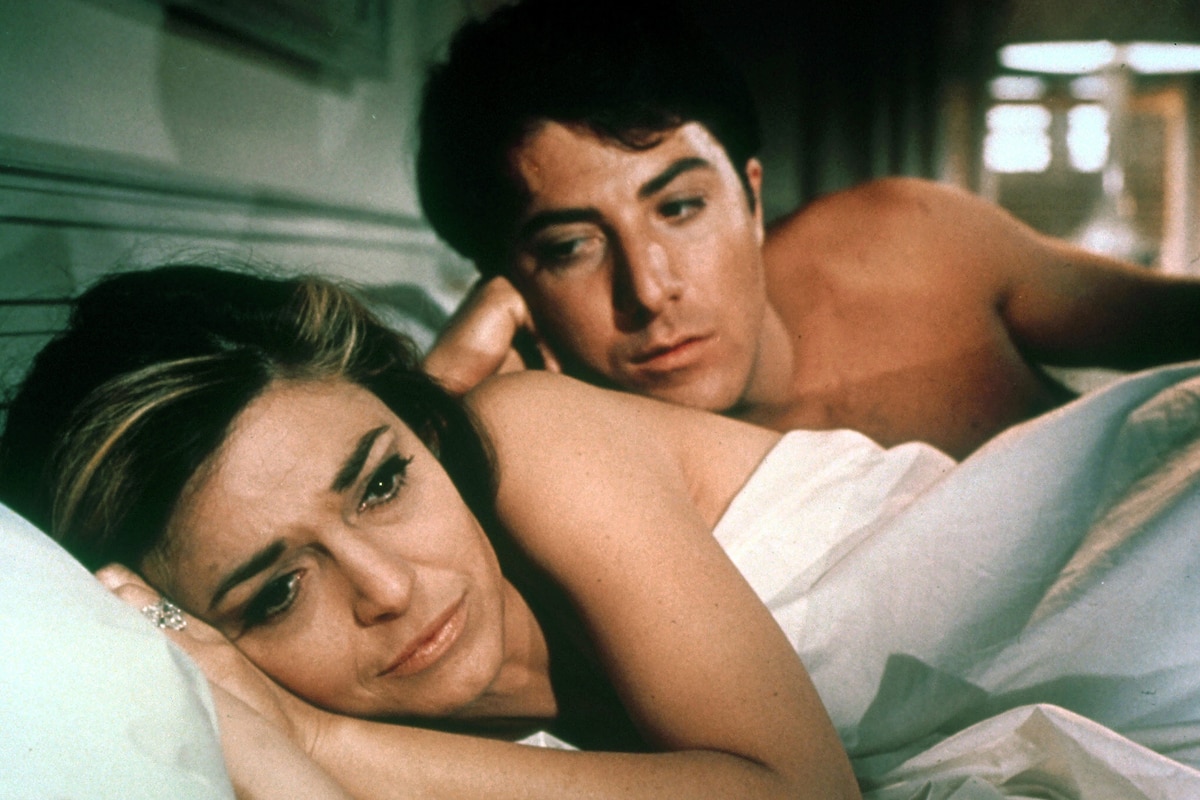
Anne Bancroft was actually only six years older than Dustin Hoffman, who was a 30-year-old playing 20.
Dustin Hoffman was named after silent screen star Dustin Farnum.
Nichols said he felt bad for the gentle and very shy Hoffman, who became an instant celebrity after The Graduate, because he would see his great discomfort and reticence while being interviewed on television. "He seemed exactly like the boy in the picture."
Charles Grodin was reportedly cast as Ben but didn't play the part due to salary disagreements. Nichols still offered him a role in his next picture, Catch-22.
After working in New York for a few years, Hoffman went to Los Angeles for The Graduate and found the atmosphere there depressing. "There is so much class consciousness out there you can cut it," he said in an interview about six months after the film's release. "You walk into those shrouded temple studios, and nobody talks to the crew, and the extras are treated like scum."
Richard Dreyfuss has a bit part in The Graduate as the Berkeley boarding house tenant who offers to call the cops on Ben. It was his second (uncredited) feature film bit, after Valley of the Dolls (1967).
The famous poster shot of Benjamin framed by Mrs. Robinson's leg was not taken with Anne Bancroft's leg but that of then- unknown model Linda Gray, who years later starred in the TV series Dallas; she would play Mrs. Robinson in the London stage version.
According to Dustin Hoffman, speaking at New York University's Tisch School of the Arts graduation in 2003, his old friend and former roommate Gene Hackman was cast as Mr. Robinson but was fired after a few weeks of work. Mike Farrell, later famous as B.J. Hunnicut on the TV series M*A*S*H, made his film debut here in an uncredited bit as a bellhop in the hotel.
by Rob Nixon
Memorable Quotes from THE GRADUATE
MR. BRADDOCK: What is it, Ben?
BEN: I'm just
MR. BRADDOCK: Worried.
BEN: Well...
MR. BRADDOCK: About what?
BEN: I guess about my future.
MR. BRADDOCK: What about it?
BEN: I don't know. I want it to be...
MR. BRADDOCK: To be what?
BEN: Different.
MR. MCGUIRE: Ben.
BEN: Mr. McGuire.
MR. MCGUIRE: Ben.
BEN: Mr. McGuire.
MR. MCGUIRE: Come with me for a minute. I want to talk to you. ... I just want to say one word to you. Just one word.
BEN: Yes, sir.
MR. MCGUIRE: Are you listening?
BEN: Yes, sir, I am.
MR. MCGUIRE: Plastics.
BEN (after a pause): Exactly how do you mean?
BEN: Are you always this much afraid of being alone?
MRS. ROBINSON: Yes.
BEN: Well, why can't you just lock the doors and go to bed?
MRS. ROBINSON: I'm very neurotic.
BEN: For God's sake, Mrs. Robinson. Here we are, you got me into your house, you give me a drink, you put on music, now you start opening your personal life to me and tell me your husband won't be home for hours.
MRS. ROBINSON: So?
BEN: Mrs. Robinson, you're trying to seduce me.
CLERK: Are you here for an affair, sir?
BEN: What?
CLERK: The Singleman party?
BEN: Ah yes, the Singleman party.
CLERK: It's in the main ballroom.
BEN: Ah. Thank you.
BEN: I think you're the most attractive of all my parents' friends.
MR. BRADDOCK: Would you mind telling me what that four years of college was for, why all that work?
BEN: You got me.
MRS. ROBINSON: How about art?
BEN: Art! That's a good subject. You start it off.
MRS. ROBINSON: You start it off, I don't know anything about it.
BEN: Well, what do you want to know about it? Are you interested more in modern art or in classical art?
MRS. ROBINSON: Neither.
BEN: You're not interested in art?
MRS. ROBINSON: No.
BEN: Then why do you want to talk about it?
MRS. ROBINSON: I don't.
BEN: What was your major subject?
MRS. ROBINSON: Art.
BEN: Art? I thought you... Hnh, I guess you kinda lost interest in it along the way.
BEN: So old Elaine Robinson got started in a Ford!
BEN: I'm not proud that I spend my time with a broken-down alcoholic.
MR. BRADDOCK: This whole idea sounds pretty half-baked.
BEN: Oh no, it's completely baked. It's a decision I made.
MR. BRADDOCK: Well what makes you think she wants to marry you?
BEN: She doesn't. To be perfectly honest, she doesn't like me.
Compiled by Rob Nixon
Trivia - The Graduate - Trivia and Fun Facts About THE GRADUATE
by Rob Nixon | January 21, 2010
SIGN UP FOR OUR NEWSLETTERS

CONNECT WITH TCM