The Graduate's journey from page to screen began with the 1963 novel of the same name by Charles Webb, son of a well-to-do San Francisco doctor. In a 2005 interview with the British newspaper The Guardian, Webb acknowledged that the Benjamin Braddock character was based on himself and Elaine was modeled after his real-life spouse, an artist known as Fred. Webb denied Mrs. Robinson was Fred's mother and insisted the character grew out of a fantasy he had about one of his parents' friends. The book had its genesis when Webb went to the Pasadena Library one day and jotted down a short plot outline "to get that person out of my system."
Webb said he wrote the novel partly to win his mother's approval, but it didn't work. His father was furious about the book's publication and what he considered shame being brought to his family. But when The Graduate came out, according to Webb, his father finally began bragging about him.
Producer Lawrence Turman read about the novel in the New York Times, picked up a copy, and decided he could make a good film out of it while remaining almost entirely faithful to the book.
Webb sold the film rights to the book for $20,000, a good sum at the time but far short of the millions he might have earned by holding out for percentages. It was typical of his anti-materialist philosophy and attitude toward his parents and the wealth he grew up with, all of which found its way into the book. He turned down a huge inheritance from his father, gave thousands of dollars to a range of causes and charities over the years, and even donated the book's royalties to the Anti-Defamation League, preferring to live life on the most meager means.
Joseph E. Levine was the epitome of the independent producer who turned out top-grossing films after the collapse of the Hollywood studio system. After producing a number of hits, he formed his own company in the late 1960s, Avco Embassy, and The Graduate was his first project.
This was actually going to be Mike Nichols' first film, following his successful career as part of a comedy team with Elaine May and then as a Broadway director. He had put the word out that he wanted to direct, but he wasn't interested in the scripts he was offered. Then Lawrence Turman brought him The Graduate. He agreed but at the same time got the chance to direct the film adaptation of Edward Albee's Who's Afraid of Virginia Woolf? (1966), so he decided to do that first.
Nichols said what convinced him he wanted to make The Graduate was one moment in the book, when Ben and Mrs. Robinson are trying to have a conversation and she is reluctant to discuss art. We find out shortly after that art was her major in college, where she met her husband and became pregnant. "That tiny moment allowed me to see a Mrs. Robinson I knew very wella woman who had been one kind of person and had consciously moved away from what she was into something for which she had contempt, a woman who had a very low opinion of herself, who was now almost parodying herself out of anger with herself for having left who she had been," Nichols told Leonard Probst in an interview for the book Off Camera.
Buck Henry was one of the writers brought in to adapt the book to the screen. Henry had been working in television, most notably on the development of the comedy series Get Smart with Mel Brooks. He had written one screenplay, The Troublemaker (1964), an independent production made with members of The Premise, a comedy group Henry joined in 1960. It displayed much of his satiric talent and offbeat humor but lacked a tight narrative structure in order to allow improvisation by the cast. Adapting Webb's book gave him a good structure as a starting point.
Another writer who was brought in to develop the script was Atlanta-born novelist, playwright, and screenwriter Calder Willingham.
Much of the book's dialogue made it into the film version of The Graduate. One of the biggest alterations was the novel's ending. In the book, Ben snatches Elaine away from her wedding just in time. In the screenplay, she has already taken her vows, but she runs off with Ben anyway.
"It's the hardest thing I've ever had to cast," Nichols said in an interview during pre-production. "These people are so far removed from stock characters."
Warren Beatty, Charles Grodin, Robert Redford, and Burt Ward (who played Robin on the TV series Batman) were all considered for the role of Benjamin.
Nichols had worked with Redford on Broadway and favored him, but producer Lawrence Turman found Redford to be too much the classic matinee idol and insisted the story would only work if Ben were 21-going-on-16 and sexually insecure. About a third of the way into Redford's test, Nichols turned to Turman and conceded he was right.
Dustin Hoffman said his test for the role of Ben was a disaster but that Nichols saw something in him that was right for the movie. "Panic, maybe?" Nichols said Hoffman was chosen because he had a face that suggested suffering. Hoffman was sure he was wrong for the role, however, because after reading the book he found Ben to be "a young, conventional, square-jawed Time magazine Man of the Year type."
Nichols said he tested a number of actors who were the actual age of the character, but he chose 30-year-old Hoffman because he had enough distance from his early 20s to have an attitude about that period in his life and "get rid of that self-pity."
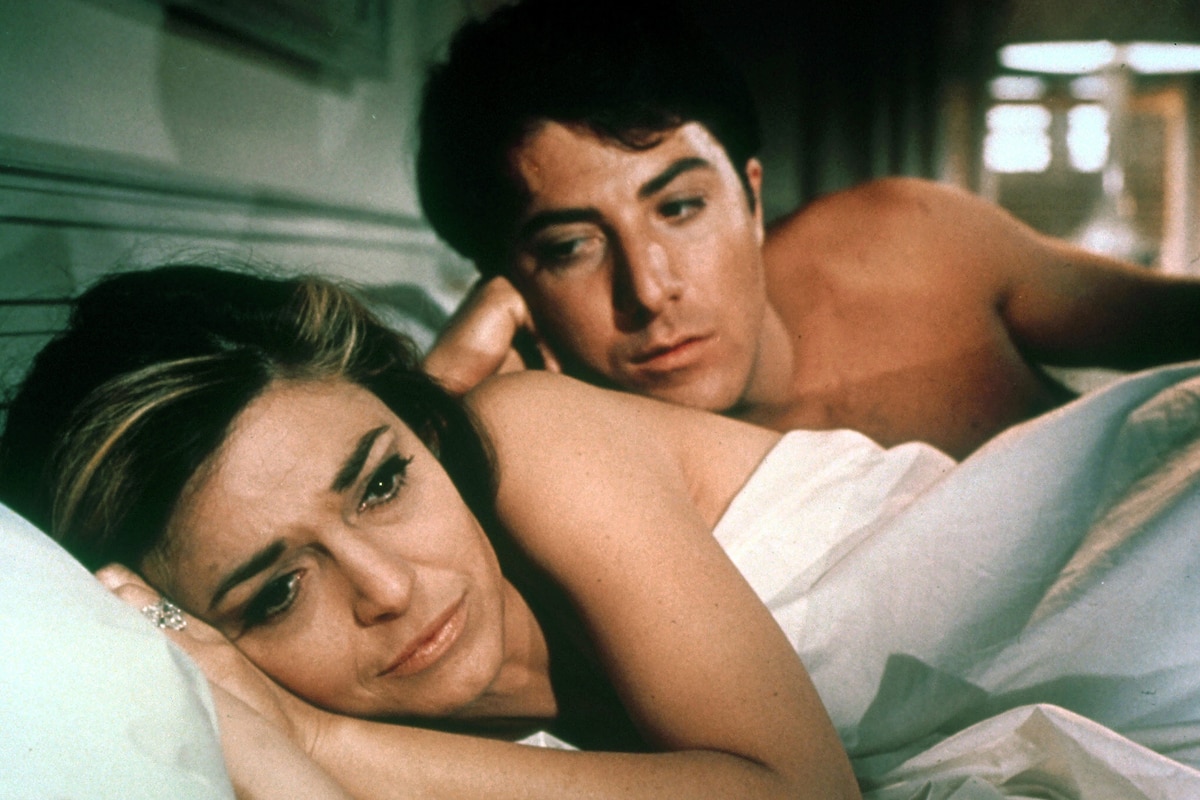
Dustin Hoffman had worked on stage and appeared in some television programs and had only one other film role to his credit, a small part in The Tiger Makes Out (1967). He was already cast to play the playwright Franz Liebkind in Mel Brooks' The Producers (1968) when he was offered the part of Ben, so he asked to be released from his contract. Brooks, whose wife, Anne Bancroft, was going to play Mrs. Robinson, agreed, almost certain Nichols would reject Hoffman.
Hoffman was told before his test that all the other actors who tested had agreed to a six-picture contract, but he refused, telling his agent he would rather do it for free and not be obligated to appear in pictures he didn't like. He ended up getting paid $17,000 without further contracted films.
Patricia Neal, Susan Hayward, and Doris Day were considered for the part of Mrs. Robinson. In her autobiography, Day wrote that she was offered the part but turned it down because it offended her sense of values. "I could not see myself rolling around in the sheets with a young man half my age whom I'd seduced."
Nichols said he also discussed the part with Jeanne Moreau but realized a non-American Mrs. Robinson would throw the whole picture off balance.
Candice Bergen was considered for the role of Elaine, Sally Field allegedly tested for it, and Patty Duke is reported to have turned it down.
by Rob Nixon
The Big Idea - The Graduate
by Rob Nixon | January 21, 2010
SIGN UP FOR OUR NEWSLETTERS

CONNECT WITH TCM