SYNOPSIS
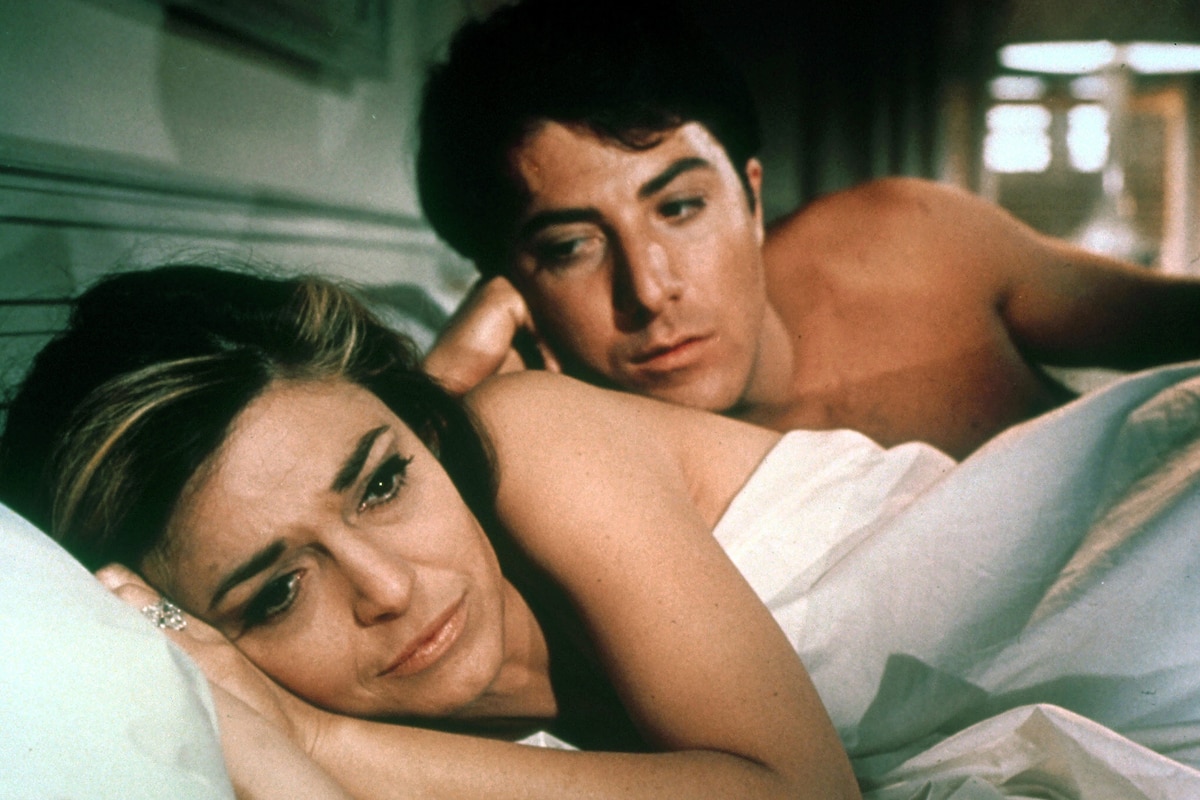
Benjamin Braddock returns home to his wealthy parents in California after finishing college back East, uncertain of his
future and unable to make any kind of decisive move in his life. He falls into an affair with an older woman, Mrs.
Robinson, the wife of his father's business partner, but the relationship only depresses and confuses him more. Then he
reconnects with the Robinsons' daughter, Elaine, and over her mother's violent objections begins to pursue her, discovering
for the first time a sense of meaning and purpose in his life.
Director: Mike Nichols
Producer: Lawrence Turman
Screenplay: Calder Willingham, Buck Henry, based on the novel by Charles Webb
Cinematography: Robert Surtees
Editing: Sam O'Steen
Production Design: Richard Sylbert
Cast: Anne Bancroft (Mrs. Robinson), Dustin Hoffman (Ben Braddock), Katharine Ross (Elaine Robinson), William Daniels (Mr.
Braddock), Murray Hamilton (Mr. Robinson), Elizabeth Wilson (Mrs. Braddock).
C-106m. Letterboxed. Closed Captioning.
Why THE GRADUATE is Essential
After more than 40 years The Graduate remains so iconic that images, lines, and references, both direct and oblique,
keep turning up throughout popular culture. It's a measure of the film's lasting impact and appeal that it's still
discussed, debated, and dissected among scholars, critics, and fans; some see it as a groundbreaking, sharp satire of the
younger generation seeking to break free of the stultifying hypocrisy of their parents while others view it as a
superficially clever and essentially conservative take on the youth culture in bloom at the time. The truth probably lies
in the middle...or somewhere else altogether.
Witness the various reactions to the final scene alone: Is it an expression of love winning the day even as it faces an
uncertain future? Or a cop-out that virtually advertises the most sacred notions of chaste courtship blooming into "the
lasting and conventionally monogamous relationship," as one critic put it. Director Mike Nichols has said that scene is the
one thing he most likes about the film, the fact that Ben and Elaine don't know what to say to each other, the sense that
they're ill-prepared for whatever lies ahead. To him, this last moment shows that Ben and Elaine will end up like their
parentsnothing changed, little gained from a moment of sheer impulse.
In fact, Nichols has said The Graduate is not at all about the "generation gap," as it is so often perceived, but
about the idea of objectsthe material things people strive to acquire and cling to in their lives, the objects
through which people become objects themselves. For him, Benjamin's story is not one of youth in rebellion but of someone
trying to become "active instead of passive" and struggling "not to be used as an object" like everything surrounding
him.
Despite critical analysis and revision, and Nichols' statements notwithstanding, The Graduate remains in our
cultural memory as the quintessential youth picture of its time; it is a portrait of New America (the 60s) versus Old (the
50s), with themes, narrative devices, and cinematic techniques influenced by European and avant-garde movies and
popularized in television commercials. Its soundtrack alone became a huge bestselling album, featuring pop songs that,
even when not obviously connected to the actions or the characters on screen, added a certain tone. This is a method used
(some say overused) to this day, particularly in movies about love and angst among younger generations. Regardless of what
one reads into the movie's ideas, intentions, and effects, it certainly signaled a fresh, freer, and more daring Hollywood,
paving the way for the new directors and bold films that emerged in the following decade.
In his insightful look at the cinema era that came to be known as "New Hollywood," Easy Riders, Raging Bulls: How the
Sex, Drugs and Rock-'n'-Roll Generation Saved Hollywood, Peter Biskind noted that, along with Bonnie and Clyde
(1967), The Graduate "sent tremors through the industry," kicking off a decade when film directors enjoyed more
power and prestige than they ever had before. Fueled by the auteur theory that had emerged from France in the 1950s
and was first popularized in this country in the 1960s by Andrew Sarris of the Village Voice, these young filmmakers
were unembarrassed, as Biskind said, "to assume the mantle of artists." They also developed their own personal style that
would be as much of the film's attraction as the story and characters. Already established as a promising young director
with his debut film Who's Afraid of Virginia Woolf? (1966), Nichols became one of the most powerful and
influentialand the most highly paidof this new breed, thanks to the huge commercial success of The Graduate, his
sophomore effort.
With these new directors came a new generation of actors, Dustin Hoffman one of the foremost among them, who broke the mold
of the traditional movie star and brought to their roles a new candor, ethnicity, and eagerness to dive deep into complex,
even unlikable characters. While Hoffman would go much farther on this track in films to come, in The Graduate he
created a lasting resonance as Ben Braddock that made him an overnight sensation and set him on the road to becoming one of
our biggest stars and most respected actors. Whether the film reflected the social-protest movement of the decade or
romanticized youth for an older mass audience, it was undeniably a phenomenon of the era.
by Rob Nixon
The Essentials - The Graduate
by Rob Nixon | January 21, 2010
SIGN UP FOR OUR NEWSLETTERS

CONNECT WITH TCM