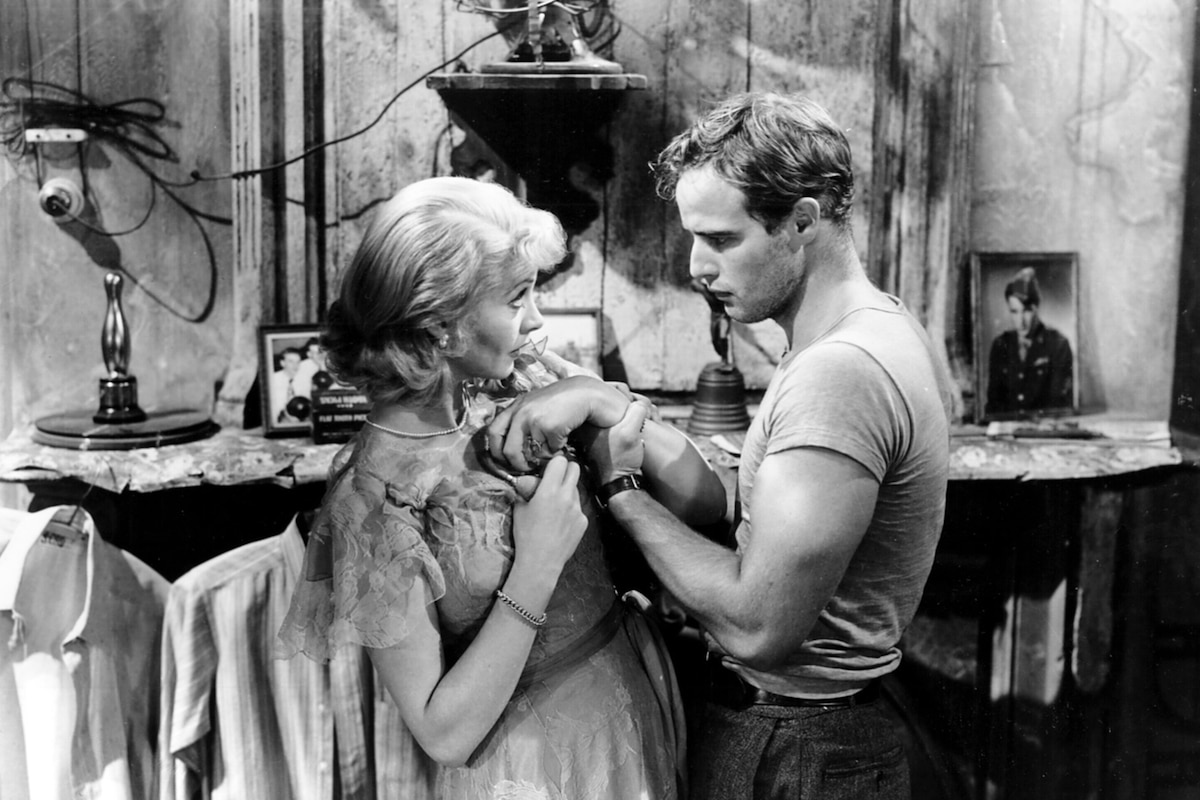
A Streetcar Named Desire was only Marlon Brando's second movie. He first appeared in director Fred Zinnemann's The Men (1950) as a wounded ex-GI trying to readjust to civilian life in a wheelchair.
By the time Brando agreed to appear in the film version of A Streetcar Named Desire he had become a major star. He was now able to demand twice his previous salary, billing on all screen, marquee, and advertising credits in lettering which was just as large as the title, and veto power over wardrobe fittings, makeup tests, and press interviews during the first week of production.
Brando's reputation as a difficult actor has been confirmed by several directors but Elia Kazan isn't among them. He was one of the few who commanded the actor's complete respect. In his autobiography, Brando: Songs My Mother Taught Me, Marlon wrote, "I have worked with many movie directors - some good, some fair, some terrible. Kazan was the best actors' director by far of any I've worked for. Gadg, who got his nickname because of an affection for gadgets, was the only one who ever really stimulated me, got into a part with me and virtually acted it with me."
Although A Streetcar Named Desire made Marlon Brando a star, he admits he never liked playing Stanley Kowalski and his identification with the role has haunted him ever since.
Vivien Leigh, who suffered from bipolar disorder in real life, later had difficulties in distinguishing her actual life from that of Blanche DuBois.
Kim Hunter, who plays the role of Stella in A Streetcar Named Desire, was blacklisted for several years after her name appeared in Red Channels, a rabid anti-communist publication.
Kim Hunter and Wright King, who plays the Young Collector, later appeared together in Planet of the Apes (1968).
Karl Malden co-starred with Marlon Brando in three movies. After A Streetcar Named Desire, they were both Oscar nominated for their performances in On the Waterfront (1954). They also played former friends turned arch enemies in One-Eyed Jacks (1961).
Vivien Leigh's two Academy Award-winning performances in Gone With the Wind (1939) and A Streetcar Named Desire have much in common. First, Leigh plays an emotionally conflicted Southern belle in both films. Secondly, both were adapted from works by Southern authors, Margaret Mitchell and Tennessee Williams, respectively. And lastly, both films involved the creative hand of a Selznick: David O. Selznick produced Gone With the Wind and Irene Mayer Selznick, MGM chief Louis B. Mayer's daughter and David Selznick's wife, produced the New York production of A Streetcar Named Desire. By the time A Streetcar Named Desire hit movie screens, Irene and David were divorced.
In his autobiography, Marlon Brando confirmed his preference for the film over the original stage production of the Tennessee Williams play due to the casting. He thought A Streetcar Named Desire reached a pinnacle of "perfect casting" when Vivien Leigh took on the role of Blanche DuBois.
While Vivien Leigh was in Hollywood shooting A Streetcar Named Desire, her husband, Sir Laurence Olivier, was in town as well, shooting Carrie (1952) for director William Wyler.
A Streetcar Named Desire marked the first of Marlon Brando's four consecutive Academy Award nominations for Best Actor. His subsequent films included Viva Zapata! (1952), Julius Caesar (1953), and On the Waterfront (1954), for which he finally won the coveted Oscar. Brando won again over 20 years later with his monumental work in The Godfather (1972).
The wonderful film score was composed by Alex North, a relative newcomer at the time, who earned an Academy Award nomination for his work on A Streetcar Named Desire. Throughout his career, North was nominated for 15 Academy Awards but did not win one until 1985, when he was awarded an honorary lifetime achievement Oscar "in recognition of his brilliant artistry in the creation of memorable music for a host of distinguished motion pictures." North died in 1991.
On Broadway, Brando's understudy for the part of Stanley Kowalski was Ralph Meeker, who would later follow Brando to Hollywood where he would give acclaimed performances in such films as Teresa (1951), Kiss Me Deadly (1955), and Stanley Kubrick's Paths of Glory (1957). Unfortunately, Meeker never reached the level of success that Brando achieved in motion pictures and his biggest acting triumph remains his stage performance in William Inge's Picnic in 1953.
Prior to the Broadway production of A Streetcar Named Desire, Margaret Sullavan and John Garfield had been approached for the lead roles of Blanche and Stanley, respectively. However, Tennessee Williams vetoed Sullavan after she read for him and Garfield was dropped after he insisted on several contract demands, such as having Williams rewrite the play to make Stanley the major character.
The original title of A Streetcar Named Desire had been The Poker Night but Tennessee Williams decided to change it after he completed the play in 1946.
by Scott McGee
Memorable Quotes from A STREETCAR NAMED DESIRE
Blanche: Please don't get up.
Stanley: Nobody's going to get up, so don't be worried.
Stanley: Hey STELLA!
Blanche: Deliberate cruelty is unforgivable, and the one thing I've never been guilty of.
Blanche: Oh look, we have created enchantment!
Blanche: I can't stand a naked light bulb, any more than I can a rude remark or a vulgar action.
Mitch: I guess we strike you as being a pretty rough bunch.
Blanche: I'm very adaptable to circumstances.
Blanche: Tarantula was the name of it! I stayed at a hotel called the Tarantula Arms!
Mitch: Tarantula Arms?
Blanche: Yes, a big spider! That's where I brought my victims. Yes, I've had many meetings with strangers.
Stanley: I never met a woman that didn't know if she was good-looking or not without being told, and some of them give themselves credit for more than they've got.
Blanche: Whoever you are, I have always depended on the kindness of strangers.
Blanche: I know I fib a good deal. After all, a woman's charm is 50% illusion.
Blanche: I don't want realism. I want magic!
