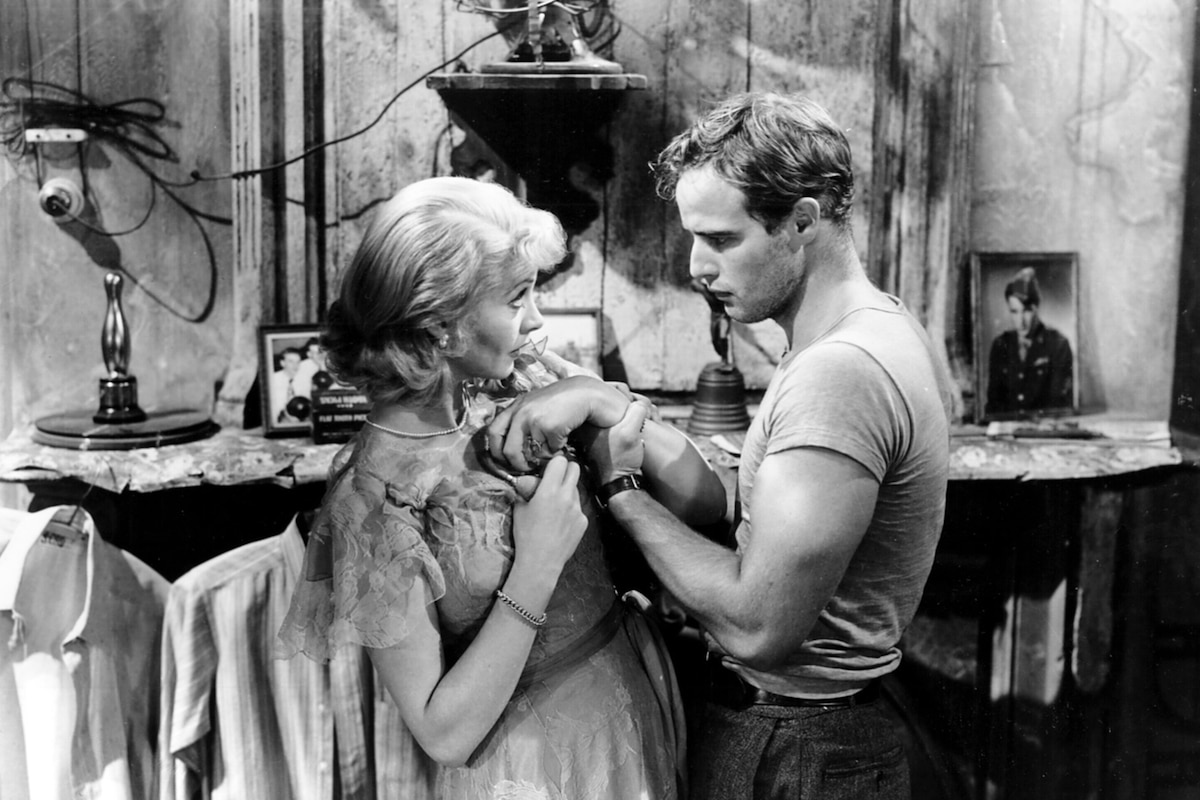
A
Streetcar Named Desire grossed more than $4 million at the box office which was
a considerable chunk of change in 1951. It was also a popular favorite among the
major film critics.
Some critics referred to Marlon Brando's style of
acting and carnal attractiveness as "the torn T-shirt school of acting." Brando's
fashion statement, of wearing only T-shirts around the house, caused a national
surge in undershirt sales.
The Hollywood Reporter thought that
both A Streetcar Named Desire and another contemporary film, A Place in
the Sun (1951), "would land on their nose when they got out in general
release...because of the downbeat type of stories and because those stories were
made so realistic." Nevertheless, The New York Film Critics Association awarded
A Streetcar Named Desire as the Best Picture of the year.
While not a critical organization, the Catholic Legion of Decency certainly had
much to say about A Streetcar Named Desire: the Legion condemned it, since
"the entire tone of the picture is 'desire,'" with "no mitigating circumstances
whatsoever." In their not-so humble opinion, the film was beyond redeeming, that
is, unless substantial cuts were made to the film before its national release.
After much debate over artistic license and moral turpitude, memo blasting, and
cinematic compromising, three to four minutes of footage was excised from the final
screen time. The film was released to the public with the Legion's seal of
approval. Although the film still shocked many patrons, it did very well at the box
office. But its biggest accomplishment was opening the doors further for the
Production Code Administration's acceptance of more racy and sensational fare.
A Streetcar Named Desire earned a slew of Academy Award
nominations. Vivien Leigh won her second Best Actress Oscar for her work, while Kim
Hunter and Karl Malden each picked up respective Oscars for Best Supporting Actress
and Best Supporting Actor. This was the first time a motion picture won three
awards for acting. Richard Day won the Oscar for Art Direction, and George James
Hopkins took home the little golden guy for Set Decoration. Marlon Brando was
nominated for Best Actor, but lost to Humphrey Bogart in The African Queen
(1951). A Streetcar Named Desire was, of course, nominated for Best Picture,
but it lost to An American in Paris (1951). The film also earned nominations
for Best Director, Best Score, Best Screenplay, Best Cinematography, Best Sound
Recording, and Best Costume Design. After the film became a big hit at the Oscars,
Jack Warner scurried to get A Streetcar Named Desire in more theaters,
especially in the Los Angeles area, where it was scheduled to leave theaters a week
after the awards to make way for Abbott and Costello in Jack and the
Beanstalk (1952).
Humphrey Bogart received a pleasant surprise on
March 20, 1952, at the RKO Pantages Theatre in Hollywood. Nominated for a Best
Actor Academy Award, Bogart did not expect to win, even though his performance in
The African Queen was some of his best work. Bogie and the rest of Hollywood
simply expected the sensational Marlon Brando to win for A Streetcar Named
Desire. Brando lost, and Bogie won his first and only Oscar. The folks over at
MGM were caught by surprise as well, since their entry, An American in Paris,
was expected to lose the Best Picture award to either A Streetcar Named
Desire or A Place in the Sun. But the lavish musical extravaganza walked
off with Oscar that night, becoming the third musical in Oscar history to win Best
Picture. MGM ran a congratulatory ad in the trade papers that had Leo the Lion,
MGM's logo mascot, looking slightly embarrassed and off-guard, saying, "Honestly, I
was just standing 'in the Sun' waiting for 'A Streetcar.'"
Influential film critic Pauline Kael raved about Vivien Leigh's "rare"
performance, one "that can truly be said to evoke pity and terror." Praising both
Leigh and Marlon Brando as giving "two of the greatest performances ever put on
film," she was equally praiseworthy toward Tennessee Williams' screenplay, which she
wrote had "some of the finest dialogue ever written by an American..."
Film reviewer Roger Ebert has said that one could make the case that "no
performance had more influence on modern film acting styles than Brando's work as
Stanley Kowalski, Tennessee Williams' rough, smelly, sexually charged hero."
by Scott McGee
